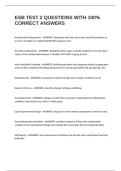
ESB TEST 2 QUESTIONS WITH 100%
CORRECT ANSWERS
Nondirectional Hypothesis - ANSWERS -hypothesis that does not make a specific prediction as
to how 2 variables are related (SOMEONE is going to win)
Directional Hypothesis - ANSWERS -hypothesis that makes a specific prediction as to the exact
nature of the relationship between 2 variables (MY TEAM is going to win)
Area-Probability Sampling - ANSWERS -dividing population into subgroups based on geographic
area and then randomly selecting participants from each group (bailey hall, georgia hall, etc)
Response Rate - ANSWERS -proportion of invited sample that actually completes survey
Research Process - ANSWERS -Question, design, findings, publishing
True Experiment - ANSWERS -designs in which the researcher manipulates ALL independent
variables; total control over who's in what group
Quasi Experimental Design - ANSWERS -designs in which random assignments cannot be used
Quasi Independent Variables - ANSWERS -variables treated as if they were independent
variables in the experimental design even though the researchers did not manipulate them
Self Reports - ANSWERS -any measurement technique that directly asks a participant how they
think/feel
, Advantages of Self Report - ANSWERS -inexpensive, easily administered, firsthand info from the
source
Disadvantages of Self Report - ANSWERS -social desirability concerns, potential demand
characteristics (wanting a specific result like on buzzfeed quiz), possible retrospective bias
Behavioral Measure - ANSWERS -a measure of a participant's actions in a research design, must
be able to operationally define and measure participants' behavior (Behavioral
trace/observation/choice)
Raw Score - ANSWERS -the actual score; trace score + error
True Score - ANSWERS -what your score would be if the test was a perfect measure of that
attribute and uninfluenced by any extraneous factors
Error - ANSWERS -extraneous influences that will cause the raw score to deviate from the true
score; (random error + bias)/systematic error
Random Error - ANSWERS -variation from the measure's true score due to unsystematic or
chance factors, present if you get different results when the same measure was used multiple
times
Systematic Error - ANSWERS -aka bias, error that consistently pushes scores in a given direction,
worse than random error bc leads to inaccurate conclusions
Strategies for Minimizing Error - ANSWERS -standardization of experiments, reduce scorer
biases
Observer/Scorer Bias - ANSWERS -misinterpreting an observation based on the researcher's
existing beliefs, previous experiences, expectations, etc
CORRECT ANSWERS
Nondirectional Hypothesis - ANSWERS -hypothesis that does not make a specific prediction as
to how 2 variables are related (SOMEONE is going to win)
Directional Hypothesis - ANSWERS -hypothesis that makes a specific prediction as to the exact
nature of the relationship between 2 variables (MY TEAM is going to win)
Area-Probability Sampling - ANSWERS -dividing population into subgroups based on geographic
area and then randomly selecting participants from each group (bailey hall, georgia hall, etc)
Response Rate - ANSWERS -proportion of invited sample that actually completes survey
Research Process - ANSWERS -Question, design, findings, publishing
True Experiment - ANSWERS -designs in which the researcher manipulates ALL independent
variables; total control over who's in what group
Quasi Experimental Design - ANSWERS -designs in which random assignments cannot be used
Quasi Independent Variables - ANSWERS -variables treated as if they were independent
variables in the experimental design even though the researchers did not manipulate them
Self Reports - ANSWERS -any measurement technique that directly asks a participant how they
think/feel
, Advantages of Self Report - ANSWERS -inexpensive, easily administered, firsthand info from the
source
Disadvantages of Self Report - ANSWERS -social desirability concerns, potential demand
characteristics (wanting a specific result like on buzzfeed quiz), possible retrospective bias
Behavioral Measure - ANSWERS -a measure of a participant's actions in a research design, must
be able to operationally define and measure participants' behavior (Behavioral
trace/observation/choice)
Raw Score - ANSWERS -the actual score; trace score + error
True Score - ANSWERS -what your score would be if the test was a perfect measure of that
attribute and uninfluenced by any extraneous factors
Error - ANSWERS -extraneous influences that will cause the raw score to deviate from the true
score; (random error + bias)/systematic error
Random Error - ANSWERS -variation from the measure's true score due to unsystematic or
chance factors, present if you get different results when the same measure was used multiple
times
Systematic Error - ANSWERS -aka bias, error that consistently pushes scores in a given direction,
worse than random error bc leads to inaccurate conclusions
Strategies for Minimizing Error - ANSWERS -standardization of experiments, reduce scorer
biases
Observer/Scorer Bias - ANSWERS -misinterpreting an observation based on the researcher's
existing beliefs, previous experiences, expectations, etc