7. Customer value-driven ( STP logic)
Type Lecture
Completed
https://app.jungleai.com/deck/MghMRl6zPqDL0GJ6blnr/marketing---ch71-flashcards-multiple-
Flashcards choice-questions-quiz?r=m9iaHSxCYeYwBXX4JWoHrSYNOqez2U
Prac prac 2
👉🏻 Table of Contents
1. Marketing strategy
1.1 Consumer-Driven Marketing
strategy
2. Marketing Segmentation
2.1 What is Segmentation
2.2 Segmenting Consumer Markets
2.3 Segmenting Business Markets
3. Marketing Targeting
3.1 What is Targeting
3.2 Selecting Target Market Segments
4. Differentiation and Positioning
4.1 What positioning is
4.2 Choosing a differentiation and
positioning strategy
4.3 Choosing the right competitive
advantages
recap
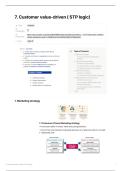
1. Marketing strategy
1.1 Consumer-Driven Marketing strategy
⇒ Consumers differ in needs, wants and buying behaviour
→ One of the most important marketing decisions is to determine which C to build
a relationship with
7. Customer value-driven ( STP logic) 1
, 2. Marketing Segmentation
2.1 What is Segmentation
Segmentation
Segmentation is the process of dividing a company’s market
with potential customers into subsets of potential
customers with similar needs and behaviours
⇒ A company typically doesn’t try to appeal to everyone, it usually targets and
why attracts some type of Consumers and rejects others
Reasons for market segmentation
hetero markets with different needs
different reactions toward marketing
competition
organizational capabilities are different
….
pro/con
Pro and cons of Market segmentation
PRO CON
Matching
Market research costs
consumer preferences
More effective marketing &
design, production and promotion costs
advertising strategy
Stronger marketing
inventory costs
messages
Boost client satisfaction small segments may not be profitable
Why is marketing segmentation the 1st step?
It helps understanding Consumer needs, preferences and behaviours
Prevents mistakes and guides strategy
Criteria
Ensures all marketing efforts align with the right target audience
Segmentation criteria
→ the main criteria that are being used are geographic, demographic,
psychographic and behavioral
7. Customer value-driven ( STP logic) 2
Type Lecture
Completed
https://app.jungleai.com/deck/MghMRl6zPqDL0GJ6blnr/marketing---ch71-flashcards-multiple-
Flashcards choice-questions-quiz?r=m9iaHSxCYeYwBXX4JWoHrSYNOqez2U
Prac prac 2
👉🏻 Table of Contents
1. Marketing strategy
1.1 Consumer-Driven Marketing
strategy
2. Marketing Segmentation
2.1 What is Segmentation
2.2 Segmenting Consumer Markets
2.3 Segmenting Business Markets
3. Marketing Targeting
3.1 What is Targeting
3.2 Selecting Target Market Segments
4. Differentiation and Positioning
4.1 What positioning is
4.2 Choosing a differentiation and
positioning strategy
4.3 Choosing the right competitive
advantages
recap
1. Marketing strategy
1.1 Consumer-Driven Marketing strategy
⇒ Consumers differ in needs, wants and buying behaviour
→ One of the most important marketing decisions is to determine which C to build
a relationship with
7. Customer value-driven ( STP logic) 1
, 2. Marketing Segmentation
2.1 What is Segmentation
Segmentation
Segmentation is the process of dividing a company’s market
with potential customers into subsets of potential
customers with similar needs and behaviours
⇒ A company typically doesn’t try to appeal to everyone, it usually targets and
why attracts some type of Consumers and rejects others
Reasons for market segmentation
hetero markets with different needs
different reactions toward marketing
competition
organizational capabilities are different
….
pro/con
Pro and cons of Market segmentation
PRO CON
Matching
Market research costs
consumer preferences
More effective marketing &
design, production and promotion costs
advertising strategy
Stronger marketing
inventory costs
messages
Boost client satisfaction small segments may not be profitable
Why is marketing segmentation the 1st step?
It helps understanding Consumer needs, preferences and behaviours
Prevents mistakes and guides strategy
Criteria
Ensures all marketing efforts align with the right target audience
Segmentation criteria
→ the main criteria that are being used are geographic, demographic,
psychographic and behavioral
7. Customer value-driven ( STP logic) 2