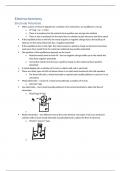
Electrochemistry
Electrode Potentials
When a piece of metal is dipped into a solution of its metal ions, an equilibrium is set up
o Mn+(aq) + ne– ⇋ M(s)
o There is a tendency for the metal to form positive ions and go into solution
o There is also a tendency for the metal ions in solution to gain electrons and form metal
If the equilibrium lies to the left, the metal acquires a negative charge due to the build up of
eletrons on the metal (electrode has a negative potential)
If the equilibrium lies to the right, the metal acquires a positive charge as electrons have been
used up to form metal from the metal ions (eletrode has positive potential)
The position of the equilibrium depends on the metal
o Reactive metals tend to form Mn+ ions so negative charge builds up on the metal and
they have negative potentials
o Unreactive metals tend to have a positive charge on the metal and have positive
potentials
A metal dipping into a solution of its ions is called a half-cell or electrode
There are other types of half cell where there is no solid metal involved in the half-equation
o For these half cells, a metal electrode is required and usually platinum is used as it is so
unreactive
Metal electrodes – consist of a metal surrounded by a solution of its ions
o Zn(s)|Zn2+(aq)
Gas electrodes – inert metal (usually platinum) is the actual electrode to allow the flow of
electrodes
o Pt(s)|H2(g)|H+(aq)
o
Redox electrodes – two different ions of the same element, two types of ions are present in
solution with an inert metal electrode (usually platinum) to allow the flow of electrons
o Pt(s)|Fe2+(aq), Fe3+(aq)
o
, Measuring the Electrode Potential
The actual potential (E) of a half cell cannot be measured directly
o To measure it, it has to be connected to another half cell of known potential, and the
potential difference between the two half cells measured
Combining two half cells together produces an electrochemical cell
Before the potential of any half cells can be measured, a potential had to be assigned to one
particular half cell so the potential of all the other electrodes could be measured against it
o The electrode chosen was the standard hydrogen electrode (SHE) and this electrode is
assigned the potential of 0 volts by definition
o The SHE is known as the primary standard as it is the potential to which all others are
compared
Setting Up an Electrochemical Cell
The two half cells are joined together to give a complete circuit
o The two metals are joined with a wire (electrons flow through the wire)
o The two solutions are joined with a salt bridge (ions flow through the salt bridge)
o A voltmeter is often included to allow the potential difference to be measured
A salt bridge is either a piece of filter paper soaked with a solution of unreactive ions or a tube
containing unreactive ions in an agar gel
o Compounds such as KNO3 are often used in the salt bridge as K + and NO3– ions are quite
unreactive
Standard Conditions
Cell concentration – 1.0 mol dm-3 of ions involved in the half equation
Cell temperature – 298K
Cell pressure – 100kPa (only affects half cells with gases)
The potential should be measured under 0 current conditions
o To measure the full potential difference (emf), no current must be drawn from the cell
o Can be achieved by using a high resistance voltmeter
A standard potential is witten as Eo
Standard conditions are required because the position of the redox equilibrium will change with
conditions and thus alter the measured potential
Electrode Potentials
When a piece of metal is dipped into a solution of its metal ions, an equilibrium is set up
o Mn+(aq) + ne– ⇋ M(s)
o There is a tendency for the metal to form positive ions and go into solution
o There is also a tendency for the metal ions in solution to gain electrons and form metal
If the equilibrium lies to the left, the metal acquires a negative charge due to the build up of
eletrons on the metal (electrode has a negative potential)
If the equilibrium lies to the right, the metal acquires a positive charge as electrons have been
used up to form metal from the metal ions (eletrode has positive potential)
The position of the equilibrium depends on the metal
o Reactive metals tend to form Mn+ ions so negative charge builds up on the metal and
they have negative potentials
o Unreactive metals tend to have a positive charge on the metal and have positive
potentials
A metal dipping into a solution of its ions is called a half-cell or electrode
There are other types of half cell where there is no solid metal involved in the half-equation
o For these half cells, a metal electrode is required and usually platinum is used as it is so
unreactive
Metal electrodes – consist of a metal surrounded by a solution of its ions
o Zn(s)|Zn2+(aq)
Gas electrodes – inert metal (usually platinum) is the actual electrode to allow the flow of
electrodes
o Pt(s)|H2(g)|H+(aq)
o
Redox electrodes – two different ions of the same element, two types of ions are present in
solution with an inert metal electrode (usually platinum) to allow the flow of electrons
o Pt(s)|Fe2+(aq), Fe3+(aq)
o
, Measuring the Electrode Potential
The actual potential (E) of a half cell cannot be measured directly
o To measure it, it has to be connected to another half cell of known potential, and the
potential difference between the two half cells measured
Combining two half cells together produces an electrochemical cell
Before the potential of any half cells can be measured, a potential had to be assigned to one
particular half cell so the potential of all the other electrodes could be measured against it
o The electrode chosen was the standard hydrogen electrode (SHE) and this electrode is
assigned the potential of 0 volts by definition
o The SHE is known as the primary standard as it is the potential to which all others are
compared
Setting Up an Electrochemical Cell
The two half cells are joined together to give a complete circuit
o The two metals are joined with a wire (electrons flow through the wire)
o The two solutions are joined with a salt bridge (ions flow through the salt bridge)
o A voltmeter is often included to allow the potential difference to be measured
A salt bridge is either a piece of filter paper soaked with a solution of unreactive ions or a tube
containing unreactive ions in an agar gel
o Compounds such as KNO3 are often used in the salt bridge as K + and NO3– ions are quite
unreactive
Standard Conditions
Cell concentration – 1.0 mol dm-3 of ions involved in the half equation
Cell temperature – 298K
Cell pressure – 100kPa (only affects half cells with gases)
The potential should be measured under 0 current conditions
o To measure the full potential difference (emf), no current must be drawn from the cell
o Can be achieved by using a high resistance voltmeter
A standard potential is witten as Eo
Standard conditions are required because the position of the redox equilibrium will change with
conditions and thus alter the measured potential