lOMoARcPSD|
lOMoAR cPSD| 51648332
51648332
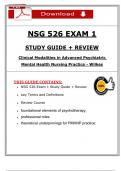
NSG 526 EXAM 1
STUDY GUIDE + REVIEW
Clinical Modalities in Advanced Psychiatric
Mental Health Nursing Practice - Wilkes
THIS GUIDE CONTAINS:
● NSG 526 Exam 1 Study Guide + Review
● key Terms and Definitions
● Review Course
● foundational elements of psychotherapy,
● professional roles
● theoretical underpinnings for PMHNP practice:
, lOMoAR cPSD| 51648332
EXAM 1 STUDY GUIDE- 526
1. DSM 5 classification of Psychiatric illness:
PER MODULE MATERIAL: When working with the DSM-5 the PMH-APRN must remember that normal
reactions to stressful events are not considered mental disorders. The DSM-5 conceptualizes each of the
mental disorders as a clinically significant behavioral or psychological syndrome or pattern that occurs in
an individual and is associated with present distress (e.g., a painful symptom), disability (i.e., impairment
in one or more important areas of functioning), or with a significantly increased risk of suffering death,
pain, disability, or an important loss of freedom (APA, 2013). This syndrome or pattern must not be
merely an expected and transient response to a particular event, such as the death of a loved one.
Whatever its original causes, the behavior must currently be considered a manifestation of a behavioral,
psychological, or biological dysfunction to be classified as a mental disorder. Deviant behaviors (e.g.,
political, religious, or sexual) and conflicts between the individual and society are not considered mental
orders per se, but if the deviance or conflict is a symptom of dysfunction in the individual, then it may be
considered a symptom of the illness.
2. Scope and standards of Practice:
By having a scope and standard of practice, this defines boundaries about nursing practice. This also
guides the development of state level practice acts. PMHNPs must ensure they practice within their
respective states’ set scope, defined by the nurse practice act. The scope statement defines PMH
nursing and describes its evolution in nursing, the levels of practice based on education, current clinical
, lOMoAR cPSD| 51648332
practice activities and sites, and current trends and issues relevant to practice. The standards of PMH
nursing practice are authoritative statements that describe the responsibilities for which its practitioners
are accountable. Scope can be thought of as what you are able to do and may vary from practice to
practice and state to state. Standards are what you must do for every patient including assessment,
diagnosis, treatment, coordination of care etc. regardless of location.
3. Purpose of the Psychiatric Interview:
To establish a current and past psychiatric history and diagnosis as well as begin the therapeutic
relationship and building rapport.
is to gather information necessary to understand, diagnose, and treat the client. Per textbook (Perese)-
The purpose of the psychiatric interview are to understand the patient’s illness to evaluate the effect of
the illness on the patient’s life and create a beginning diagnosis and treatment plan.
4. Therapeutic alliance:
a cooperative working relationship between client and therapist, considered by many to be an essential
aspect of successful therapy. Derived from the concept of the psychoanalytic working alliance, the
therapeutic alliance comprises bonds, goals, and tasks. Bonds are constituted by the core conditions of
therapy, the client’s attitude toward the therapist, and the therapist’s style of relating to the client;
goals are the mutually negotiated, understood, agreed upon, and regularly reviewed aims of the
therapy; and tasks are the activities carried out by both client and therapist
An important part in building a therapeutic relationship is to help the patient feel accepted. Regardless
of the patient’s actual presentation, the clinician should assume that the patient is anxious and seek to
maintain the anxiety within workable limits. The clinician needs to demonstrate empathy which is the
ability to understand what the patient feels, by using empathetic statements such as “It sounds to me as
if you have been feeling some very painful emotions.”
-Important components of therapeutic alliance:
1. The therapist and patient work collaboratively to create therapeutic change through an
affectionate bond
2. Agreement on goals of therapy
3. The therapist’s ability to be empathetic and involved in therapy
4. The ability of the patient to do the work of therapy
**The therapeutic alliance is the key to successful psychotherapy. It is the strength of the bond
and connection that can be built between you and your therapist over time. Without a trusting
and respectful therapeutic alliance, no meaningful therapy can happen.
5. Hildegard Peplau’s Interpersonal relations In Nursing:
, lOMoAR cPSD| 51648332
earliest modern nursing theory. Enabled nursing to establish the groundwork for Advanced Practice
Nursing (APN) (first role was Clinical Nurse Specialist in Psychiatric Nursing).
6. Psychotherapy:
holistic treatment that relies on the nurse’s processing of what the patient is experiencing.
7. Peplau’s Theory integrated with the psychological theories of
interpersonal relations and communication.
Peplau emphasized the art of communication to highlight the importance of nursing interventions in
facilitating achievement of quality clients–centered care and quality of life (Haber, 2000). The PMH-
APRN must establish and maintain a therapeutic relationship in which the client will feel safe and
hopeful that positive change is possible. Once a therapeutic relationship is established, specific needs
and problems can be identified, and the nurse can work with the client on increasing problem-solving
skills, learning new coping behaviors, and experiencing more appropriate and satisfying ways of relating
to others. To do this, the advanced practice psychiatric mental health nurse must have a sound
knowledge of communication skills. PMH-APRNs must become more aware of their own interpersonal
methods, eliminating obstructive, non-therapeutic communication techniques and developing additional
responses that maximize nurse-client interactions and increase the use of helpful therapeutic
communication techniques.
lOMoAR cPSD| 51648332
51648332
NSG 526 EXAM 1
STUDY GUIDE + REVIEW
Clinical Modalities in Advanced Psychiatric
Mental Health Nursing Practice - Wilkes
THIS GUIDE CONTAINS:
● NSG 526 Exam 1 Study Guide + Review
● key Terms and Definitions
● Review Course
● foundational elements of psychotherapy,
● professional roles
● theoretical underpinnings for PMHNP practice:
, lOMoAR cPSD| 51648332
EXAM 1 STUDY GUIDE- 526
1. DSM 5 classification of Psychiatric illness:
PER MODULE MATERIAL: When working with the DSM-5 the PMH-APRN must remember that normal
reactions to stressful events are not considered mental disorders. The DSM-5 conceptualizes each of the
mental disorders as a clinically significant behavioral or psychological syndrome or pattern that occurs in
an individual and is associated with present distress (e.g., a painful symptom), disability (i.e., impairment
in one or more important areas of functioning), or with a significantly increased risk of suffering death,
pain, disability, or an important loss of freedom (APA, 2013). This syndrome or pattern must not be
merely an expected and transient response to a particular event, such as the death of a loved one.
Whatever its original causes, the behavior must currently be considered a manifestation of a behavioral,
psychological, or biological dysfunction to be classified as a mental disorder. Deviant behaviors (e.g.,
political, religious, or sexual) and conflicts between the individual and society are not considered mental
orders per se, but if the deviance or conflict is a symptom of dysfunction in the individual, then it may be
considered a symptom of the illness.
2. Scope and standards of Practice:
By having a scope and standard of practice, this defines boundaries about nursing practice. This also
guides the development of state level practice acts. PMHNPs must ensure they practice within their
respective states’ set scope, defined by the nurse practice act. The scope statement defines PMH
nursing and describes its evolution in nursing, the levels of practice based on education, current clinical
, lOMoAR cPSD| 51648332
practice activities and sites, and current trends and issues relevant to practice. The standards of PMH
nursing practice are authoritative statements that describe the responsibilities for which its practitioners
are accountable. Scope can be thought of as what you are able to do and may vary from practice to
practice and state to state. Standards are what you must do for every patient including assessment,
diagnosis, treatment, coordination of care etc. regardless of location.
3. Purpose of the Psychiatric Interview:
To establish a current and past psychiatric history and diagnosis as well as begin the therapeutic
relationship and building rapport.
is to gather information necessary to understand, diagnose, and treat the client. Per textbook (Perese)-
The purpose of the psychiatric interview are to understand the patient’s illness to evaluate the effect of
the illness on the patient’s life and create a beginning diagnosis and treatment plan.
4. Therapeutic alliance:
a cooperative working relationship between client and therapist, considered by many to be an essential
aspect of successful therapy. Derived from the concept of the psychoanalytic working alliance, the
therapeutic alliance comprises bonds, goals, and tasks. Bonds are constituted by the core conditions of
therapy, the client’s attitude toward the therapist, and the therapist’s style of relating to the client;
goals are the mutually negotiated, understood, agreed upon, and regularly reviewed aims of the
therapy; and tasks are the activities carried out by both client and therapist
An important part in building a therapeutic relationship is to help the patient feel accepted. Regardless
of the patient’s actual presentation, the clinician should assume that the patient is anxious and seek to
maintain the anxiety within workable limits. The clinician needs to demonstrate empathy which is the
ability to understand what the patient feels, by using empathetic statements such as “It sounds to me as
if you have been feeling some very painful emotions.”
-Important components of therapeutic alliance:
1. The therapist and patient work collaboratively to create therapeutic change through an
affectionate bond
2. Agreement on goals of therapy
3. The therapist’s ability to be empathetic and involved in therapy
4. The ability of the patient to do the work of therapy
**The therapeutic alliance is the key to successful psychotherapy. It is the strength of the bond
and connection that can be built between you and your therapist over time. Without a trusting
and respectful therapeutic alliance, no meaningful therapy can happen.
5. Hildegard Peplau’s Interpersonal relations In Nursing:
, lOMoAR cPSD| 51648332
earliest modern nursing theory. Enabled nursing to establish the groundwork for Advanced Practice
Nursing (APN) (first role was Clinical Nurse Specialist in Psychiatric Nursing).
6. Psychotherapy:
holistic treatment that relies on the nurse’s processing of what the patient is experiencing.
7. Peplau’s Theory integrated with the psychological theories of
interpersonal relations and communication.
Peplau emphasized the art of communication to highlight the importance of nursing interventions in
facilitating achievement of quality clients–centered care and quality of life (Haber, 2000). The PMH-
APRN must establish and maintain a therapeutic relationship in which the client will feel safe and
hopeful that positive change is possible. Once a therapeutic relationship is established, specific needs
and problems can be identified, and the nurse can work with the client on increasing problem-solving
skills, learning new coping behaviors, and experiencing more appropriate and satisfying ways of relating
to others. To do this, the advanced practice psychiatric mental health nurse must have a sound
knowledge of communication skills. PMH-APRNs must become more aware of their own interpersonal
methods, eliminating obstructive, non-therapeutic communication techniques and developing additional
responses that maximize nurse-client interactions and increase the use of helpful therapeutic
communication techniques.