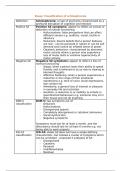
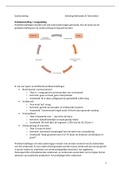
Philosophy is an attempt to ask&answer very basic questions about the universe and our place within.
The Scientific revolution Copernicus finding out the 🌍orbits the ☀, Newton saying objects have
attraction, Galileo inventing telescope and by observing phases of Venus. „Yet it moves! “Even before
that, the Aristoteles (Scholastic View) claimed the world is made out of 💦, air, earth and 🔥and that
the motion is violent and natural. Plato introduces the necessary (if a doesn’t have the property s, it is
not x = essential) and sufficient (if a does have property s, it is x = enough) defined knowledge as a
„true justified belief “, which is something De Montaigne (SCEPTICISM) didn’t fancy because: even
though we have beliefs, and some of them might be accidentally true, we are not certain, therefore we
cannot justify them. Sceptics said it’s because our senses & reasoning are unreliable, so we cannot
trust them. Therefore, necessary condition of “justification” of knowledge is not met. There are two
positions concerning the source of knowledge: 1. RATIONALISM by Descartes (Cogito argument:
“I think; therefore, I am”) claimed the following: if you know the premises are true, you are absolutely
certain that the conclusion is true (a deductive argument). Clear distinct ideas Deduction
Knowledge. This bird is black, this bird is black: some birds are black. This is how maths works. 2.
EMPIRICISM by Bacon🥓 (Tabula Rasa: we are not born with any innate knowledge. “There is
nothing in our mind that was not first in our senses”). If you are certain that the premises are true, it
becomes more likely that the conclusion is true (induction). Observation Induction Knowledge.
Socrates is mortal. Roy Dongers is mortal. Trump is mortal. All humans are mortal. Criticism of
empiricism includes I. Vulnerability to Sceptics since they believed observations are unreliable II.
Problem of Induction: we believe in past to predict future which is circular as it presupposes that
induction is reliable.
During Annus Mirabilis (1905), Einstein proved 💡consists of particles, that ⚛ exist, relativity theory
and E=mc2. There is more than just Newton’s gravity. Let’s Vienna Circle lead by Moritz Chlick a.
examine the logical structure of scientific theories which will lead us to the exact nature of science and
come up with b. verifiability and confirmability as a demarcation criterion (to know what is/n’t
pseudoscience). It was important to search for the demarcation because of Nazis and the Einstein-
Bergson debate who had a philosophical theory of time and did not want Einstein get the Nobel prize
for the Theory of Relativity. However, confirmation is too weak and verification is too strong.
According to The Raven’s Paradox, confirmation is too weak, because observation of a black raven
confirms the theory but so does observation of a white 👟. This means that confirmation is not a
sufficient condition for increasing the probability of a hypothesis to be true. The Goodman’s New
Riddle of Induction shows there is no logical theory of confirmation since some arguments are
better arguments than others just based on their contents (grue). Therefore, Popper came up with
another demarcation criterion – falsification to get rid of induction and confirmation
(FALSIFICAIONSM). The cycle of falsification is the following: I. Conjecture: creating a theory
with novel predictions II. Refutation: test the hypothesis and try to refute it. If a theory is not
falsified, it is only corroborated. Following this logic, why are conspiracies a pseudoscience?
Because they built in protection mechanisms and denounce counterevidence as part of the conspiracy.
Advantages of falsification? I. No confirmation bias 2. Thinking outside of the 📦3. Deduction.
Criticism of falsification includes: I. Too radical: negative knowledge, corroborated. II. Duhem-
Quine thesis: I know I falsified something but I am not sure what exactly (a theory is a 🕸). Orbit of
Uranus didn’t follow Newton’s theory, maybe another planet would be in the way? Yes, indeed:
Neptune. Also, Mercury’s orbit was few secs off and when Einstein proved Newton wrong, it
suddenly could be explained. III. Theory Ladenness of Observation: everything we observe is
interpreted through prior knowledge = theories, therefore observation is “theory-laden” = “-driven”
RELATIVISM(Kuhn&Feyerabend): truth & justification is relative to paradigm. Kuhn said that
instead of searching for demarcation criteria, let’s examine the history of 🧪. “🧪is just an opinion”. Kuhn
came up with Episodic Model of Science in which periods of normal 🧪are occasionally interrupted by
periods of revolutionary 🧪. Normal 🧪is paradigm driven and follows certain methodological rules, it is
not open to testing. Next step: anomaly being a 🧩that has resisted solution, later: critical mass of
anomalies, later crisis: losing faith in the paradigm and looking for alternatives. Revolutionary 🧪:
many rival paradigms emerge and one replaces the old one. Normal 🧪 Anomalies Crisis
Revolution. We have a Modest👉👈Kuhn: with each new paradigm, the problem-solving power of
The Scientific revolution Copernicus finding out the 🌍orbits the ☀, Newton saying objects have
attraction, Galileo inventing telescope and by observing phases of Venus. „Yet it moves! “Even before
that, the Aristoteles (Scholastic View) claimed the world is made out of 💦, air, earth and 🔥and that
the motion is violent and natural. Plato introduces the necessary (if a doesn’t have the property s, it is
not x = essential) and sufficient (if a does have property s, it is x = enough) defined knowledge as a
„true justified belief “, which is something De Montaigne (SCEPTICISM) didn’t fancy because: even
though we have beliefs, and some of them might be accidentally true, we are not certain, therefore we
cannot justify them. Sceptics said it’s because our senses & reasoning are unreliable, so we cannot
trust them. Therefore, necessary condition of “justification” of knowledge is not met. There are two
positions concerning the source of knowledge: 1. RATIONALISM by Descartes (Cogito argument:
“I think; therefore, I am”) claimed the following: if you know the premises are true, you are absolutely
certain that the conclusion is true (a deductive argument). Clear distinct ideas Deduction
Knowledge. This bird is black, this bird is black: some birds are black. This is how maths works. 2.
EMPIRICISM by Bacon🥓 (Tabula Rasa: we are not born with any innate knowledge. “There is
nothing in our mind that was not first in our senses”). If you are certain that the premises are true, it
becomes more likely that the conclusion is true (induction). Observation Induction Knowledge.
Socrates is mortal. Roy Dongers is mortal. Trump is mortal. All humans are mortal. Criticism of
empiricism includes I. Vulnerability to Sceptics since they believed observations are unreliable II.
Problem of Induction: we believe in past to predict future which is circular as it presupposes that
induction is reliable.
During Annus Mirabilis (1905), Einstein proved 💡consists of particles, that ⚛ exist, relativity theory
and E=mc2. There is more than just Newton’s gravity. Let’s Vienna Circle lead by Moritz Chlick a.
examine the logical structure of scientific theories which will lead us to the exact nature of science and
come up with b. verifiability and confirmability as a demarcation criterion (to know what is/n’t
pseudoscience). It was important to search for the demarcation because of Nazis and the Einstein-
Bergson debate who had a philosophical theory of time and did not want Einstein get the Nobel prize
for the Theory of Relativity. However, confirmation is too weak and verification is too strong.
According to The Raven’s Paradox, confirmation is too weak, because observation of a black raven
confirms the theory but so does observation of a white 👟. This means that confirmation is not a
sufficient condition for increasing the probability of a hypothesis to be true. The Goodman’s New
Riddle of Induction shows there is no logical theory of confirmation since some arguments are
better arguments than others just based on their contents (grue). Therefore, Popper came up with
another demarcation criterion – falsification to get rid of induction and confirmation
(FALSIFICAIONSM). The cycle of falsification is the following: I. Conjecture: creating a theory
with novel predictions II. Refutation: test the hypothesis and try to refute it. If a theory is not
falsified, it is only corroborated. Following this logic, why are conspiracies a pseudoscience?
Because they built in protection mechanisms and denounce counterevidence as part of the conspiracy.
Advantages of falsification? I. No confirmation bias 2. Thinking outside of the 📦3. Deduction.
Criticism of falsification includes: I. Too radical: negative knowledge, corroborated. II. Duhem-
Quine thesis: I know I falsified something but I am not sure what exactly (a theory is a 🕸). Orbit of
Uranus didn’t follow Newton’s theory, maybe another planet would be in the way? Yes, indeed:
Neptune. Also, Mercury’s orbit was few secs off and when Einstein proved Newton wrong, it
suddenly could be explained. III. Theory Ladenness of Observation: everything we observe is
interpreted through prior knowledge = theories, therefore observation is “theory-laden” = “-driven”
RELATIVISM(Kuhn&Feyerabend): truth & justification is relative to paradigm. Kuhn said that
instead of searching for demarcation criteria, let’s examine the history of 🧪. “🧪is just an opinion”. Kuhn
came up with Episodic Model of Science in which periods of normal 🧪are occasionally interrupted by
periods of revolutionary 🧪. Normal 🧪is paradigm driven and follows certain methodological rules, it is
not open to testing. Next step: anomaly being a 🧩that has resisted solution, later: critical mass of
anomalies, later crisis: losing faith in the paradigm and looking for alternatives. Revolutionary 🧪:
many rival paradigms emerge and one replaces the old one. Normal 🧪 Anomalies Crisis
Revolution. We have a Modest👉👈Kuhn: with each new paradigm, the problem-solving power of