Garantie de satisfaction à 100% Disponible immédiatement après paiement En ligne et en PDF Tu n'es attaché à rien 4.2 TrustPilot
logo-home
Examen

COS3761 Assignment 3 (ANSWERS) 2025 - DISTINCTION GUARANTEED

Note
-
Vendu
-
Pages
9
Grade
A+
Publié le
16-07-2025
Écrit en
2024/2025

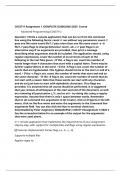
Well-structured COS3761 Assignment 3 (ANSWERS) 2025 - DISTINCTION GUARANTEED. (DETAILED ANSWERS - DISTINCTION GUARANTEED!)... QUESTION 1 In which world of the Kripke model in Figure 1 is the formula ◊ p  □ q true? Option 1: world x₁ Option 2: world x₂ Option 3: world x₃, Option 4: Option 1 and Option 3 are true. UESTION 2 Which of the following does not hold in the Kripke model in Figure 1? Option 1: x₁ ╟ ◊ ◊ p .Option 2: x₂ ╟ □ p .Option 3: x₃ ╟ □ p  □ q .Option 4: x₄ ╟ □□ p QUESTION 3 Which of the following holds in the Kripke model given in Figure 1? Option 1: x₁ ╟ □ p .Option 2: x₂ ╟ ◊ ( p  q) .Option 3: x₃ ╟ ◊ p  □ ¬ q q p, q q p q x₁ x₄ x₃ q Downloaded by Vusi Xhumalo () lOMoARcPSD| COS3761/103/2025 20 Option 4: x₄ ╟ □ (p  q) . QUESTION 4 Which of the following formulas is true in the Kripke model given in Figure 1? Option 1: ◊ p Option 2: □ q Option 3: □ ◊ q Option 4: □ p QUESTION 5 Which of the following formulas is false in the Kripke model given in Figure 1? Option 1: p  q Option 2: □ ◊ p Option 3: □ (p  q) Option 4: p  ◊ q QUESTION 6 If we interpret □  as "It ought to be that  ", which of the following formulas correctly expresses the English sentence It ought to be the case that if it rains outside then it is permitted to take leave from work. : p stands for the declarative sentence "It rains outside" and q stands for "take leave from work"? Option 1: □ (p ¬ □ ¬ q) Option 2: □( p ¬ ◊ q) Option 3: □ p  ◊ ¬ q Option 4: □ p  □ q .QUESTION 7 Downloaded by Vusi Xhumalo () lOMoARcPSD| COS3761/103/2025 21 If we interpret □  as "It is necessarily true that  ", why should the formula scheme □   □ □  hold in this modality? Option 1: Because for all formulas , it is necessarily true that if  then . Option 2:Because for all formulas , if  is necessarily true, then it is necessary that it is necessarily true. Option 3:Because for all formulas , if  is not possibly true, then it is true. Option 4: Because for all formulas ,  is necessarily true if it is true. QUESTION 8 If we interpret □  as "the agent knows  ", why should the formula scheme □   □ □  hold in this modality? Option 1: If the agent knows something he knows that he knows it. Option 2: the agent knows something it doesn’t mean that he knows. Option 3: If the agent does not know something, he again knows that he knows it. Option 4: If the agent knows something, he knows that he does not know it. QUESTION 9 If we interpret □  as "it is necessarily true", which of the following formulas is not valid? Option 1: □ p  p Option 2: □ p  □¬ p Option 3: □ p  ◊ p Option 4: ◊ p  □ ◊ p Downloaded by Vusi Xhumalo () lOMoARcPSD| COS3761/103/2025 22 QUESTION 10 If we interpret □  as "agent A believes  ", what is the modal translation of the English sentence If agent A believes p then he believes that agent A does not believe q. Option 1: □ p □ q Option 2: □ p  ¬□ q Option 3: □ p  ¬□¬ q Option 4: □ p  □¬ q QUESTION 11 If we interpret □  as "Agent A believes  ", English translation of the formula □ p  □ ¬ q ? Option 1: If Agent A believes  then Agent A believes not . Option 2 : If Agent A believes  then Agent A does not believe . Option 3: If Agent A believes  then Agent A believes . Option 4: If Agent A believes  then Agent A does not believe not . QUESTION 12 If we interpret Kᵢ as “agent 1 knows ”, the formula scheme ¬  K₁ ¬ K₁  means Option 1: If  is true then agent 1 knows that he does not know  Option 2: If  is false then agent 1 knows that he does not know  Option 3: If  is true then agent 1 knows that he knows  Option 4: If  is false then agent 1 knows that he knows  The following natural deduction proof (without reasons) is referred to in Questions 13, 14 and 15: 1 ¬ □ ¬ (p  q) Downloaded by Vusi Xhumalo () lOMoARcPSD| COS3761/103/2025 23 2 □ p 3 □ ¬ q 4 p  q assumption 5 p □ e 2 6 q  e 4, 5 7 ¬ q □ e 3 8  ¬ e 6, 7 9 ¬ (p  q) ¬ i 4 - 8 10 □ ¬ (p  q) □ i 4 - 9 11  ¬ e 10, 1 12 ¬ □ ¬ q ¬ i 3 - 11 13 □ p  ¬ □ ¬ q  i 2 – 12 QUESTION 13 How many times are □ elimination and introduction rules used in the above proof? Option 1: None Option 2: □ elimination and □ introduction once are both used only once. Option 3: □ elimination is used only once but □ introduction twice. Option 4: □ elimination is used twice but □ introduction only once. QUESTION 14 What are the correct reasons for steps 1, 2 and 3 of the above proof? Option 1: 1 premise 2 assumption 3 assumption Downloaded by Vusi Xhumalo () lOMoARcPSD| COS3761/103/2025 24 Option 2: 1 premise 2 ¬e 1 3 ¬i 2 Option 3: 1 assumption 2 ¬e 1 3 □e 4 Option 4: 1 assumption 2 □i 2 3 assumption QUESTION 15 What sequent is proved by the above proof? Option 1: □ p  ◊ p Option 2: □ p  ¬ □ ¬ q Option 3: ¬ □ ¬ q Option 4: No proof The following incomplete natural deduction proof is referred to in Questions 16 and 17: 1 2 3 4 5 6 7 8 □ (p  q) →□ p □ q □ (p  q) assumption □p □ i3 □q □ i4 □p  □ q p  q p  e2 q e2 Downloaded by Vusi Xhumalo () lOMoARcPSD| COS3761/103/2025 25 QUESTION 16 What formulas and their reasons are missing in steps 2 and 7 of the above proof? Option 1: 2 p  q □ e1 7 □p□ q  I 5,6 Option 2: 2 p  q assumption 7 □p□ q →i 5,6 Option 3: 2 p  q □ e1 7 □p□ q  i 2 Option 4: 2 p  q assumption 7 □p  □ q  i 5,6 QUESTION 17 What rule is used in line 8? Option 1:  e Option 2: ¬e Option 3:  i Option 4:  i QUESTION 18 What proof strategy would you use to prove the following sequent: □ (p  q) KT4 □ □ p  □ □ q Option 1: Open a solid box and start with □ (p  q) as an assumption Use axiom T to remove the □ to get p  q. Use  elimination twice to obtain the separate atomic formulas. Use axiom 4 twice, i.e. once on each atomic formula, to add a □ to each. Use axiom 4 twice, i.e. once on □ p and once on □ q, to get □ □ p and □ □ q. Combine □ □ p and □ □ q using  introduction. Close the solid box to get the result. Downloaded by Vusi Xhumalo () lOMoARcPSD| COS3761/103/2025 26 Option 2: Start with □ (p  q) as a premise. Use axiom T to remove the □ to get p  q. Open a dashed box and use  elimination twice to obtain the separate atomic formulas. Use axiom 4 twice, i.e. once on each atomic formula, to add a □ to each. Close the dashed box and use □ introduction twice, i.e. once on □ p and once on □ q, to get □ □ p and □ □ q. Combine □ □ p and □ □ q using  introduction. Option 3: Start with □ (p  q) as a premise. Open a dashed box and use □ elimination to get p  q. Use  elimination twice to obtain the separate atomic formulas. Close the dashed box and use □ introduction twice, i.e. once on each atomic formula. Use axiom 4 twice, once on □ p and once on □ q, to get □ □ p and □ □ q. Combine □ □ p and □ □ q using  introduction. Option 4: Open a solid box and start with □ (p  q) as an assumption. Open a dashed box and use □ elimination to get p  q. Use  elimination twice to obtain the separate atomic formulas. Use axiom 4 twice, i.e. once on each atomic formula, to add a □ to each. Close the dashed box and use □ introduction twice, i.e. once on □ p and once on □ q, to get □ □ p and □ □ q. Close the solid box to get the result. QUESTION 19 If we interpret Ki  as "Agent i knows  ", what is the English translation of the formula ¬K1 K2 (p  q) Option 1: Agent 1 knows that agent 2 doesn't know that p and q. Option 2: Agent 1 doesn't know that agent 2 knows p and q. Option 3: If agent 1 knows that agent 2 doesn't know p and q. Option 4: If agent 1 doesn't know that agent 2 knows p and q. QUESTION 20 If we interpret Ki  as "Agent i knows  ", what formula of modal logic is correctly translated to English as Downloaded by Vusi Xhumalo () lOMoARcPSD| COS3761/103/2025 27 If agent 1 knows p then agent 2 doesn't know q. Option 1: K1 p  K2 ¬ q Option 2: ¬ (K1 p  K2 q) Option 3: K1 (p  ¬ K2 q) Option 4: K1 ¬ K2 (p  q)

Montrer plus Lire moins
Établissement
Cours


Oups ! Impossible de charger votre document. Réessayez ou contactez le support.

Livre connecté

École, étude et sujet

Établissement
Cours

Infos sur le Document

Publié le
16 juillet 2025
Nombre de pages
9
Écrit en
2024/2025
Type
Examen
Contient
Questions et réponses

Sujets

Aperçu du contenu

COS3761 Assignment 3 2025
Unique Number:
Due date: July 2025
QUESTION 1

In which world is the formula ◊p ∧ □q true?

To evaluate ◊p ∧ □q, we must:

 Have at least one accessible world where p is true (◊p), and
 In all accessible worlds, q must be true (□q)

From the model (text-based info):

 In x₁: p is true in some accessible world(s) (say x₂ or x₃), and q is always true.
 In x₃: we must check if both p is possibly true and q is necessarily true.

Answer: Option 4 – World x₁ and x₃
✔ x₁ satisfies ◊p and □q
✔ x₃ satisfies ◊p (if x₄ accessible and has p) and □q (if all accessible worlds have q)


DISCLAIMER & TERMS OF USE
 Educational Aid: These study notes are intended to be used as educational resources and should not be seen as a
replacement for individual research, critical analysis, or professional consultation. Students are encouraged to perform
their own research and seek advice from their instructors or academic advisors for specific assignment guidelines.
 Personal Responsibility: While every effort has been made to ensure the accuracy and reliability of the information in
these study notes, the seller does not guarantee the completeness or correctness of all content. The buyer is
responsible for verifying the accuracy of the information and exercising their own judgment when applying it to their
assignments.
 Academic Integrity: It is essential for students to maintain academic integrity and follow their institution's policies
regarding plagiarism, citation, and referencing. These study notes should be used as learning tools and sources of
inspiration. Any direct reproduction of the content without proper citation and acknowledgment may be considered
academic misconduct.
 Limited Liability: The seller shall not be liable for any direct or indirect damages, losses, or consequences arising from
the use of these notes. This includes, but is not limited to, poor academic performance, penalties, or any other negative
consequences resulting from the application or misuse of the information provided.

, For additional support +27 81 278 3372

QUESTION 1

In which world is the formula ◊p ∧ □q true?

To evaluate ◊p ∧ □q, we must:

 Have at least one accessible world where p is true (◊p), and
 In all accessible worlds, q must be true (□q)

From the model (text-based info):

 In x₁: p is true in some accessible world(s) (say x₂ or x₃), and q is always true.
 In x₃: we must check if both p is possibly true and q is necessarily true.

Answer: Option 4 – World x₁ and x₃
✔ x₁ satisfies ◊p and □q
✔ x₃ satisfies ◊p (if x₄ accessible and has p) and □q (if all accessible worlds have q)


QUESTION 2

Which does NOT hold?

Let’s test each:

 Option 1: x₁ ⊨ ◊◊p → true if a path to a path with p exists.
 Option 2: x₂ ⊨ □p → false if any accessible world does not satisfy p.
 Option 3: x₃ ⊨ □p ∧ □q → check if both p and q are true in all accessible
worlds.
 Option 4: x₄ ⊨ □□p → likely true if p holds in all nested accessible worlds.

Answer: Option 2 – x₂ ⊨ □p
✘ This fails if not all accessible worlds from x₂ have p true
€2,65
Accéder à l'intégralité du document:

Garantie de satisfaction à 100%
Disponible immédiatement après paiement
En ligne et en PDF
Tu n'es attaché à rien

Faites connaissance avec le vendeur

Seller avatar
Les scores de réputation sont basés sur le nombre de documents qu'un vendeur a vendus contre paiement ainsi que sur les avis qu'il a reçu pour ces documents. Il y a trois niveaux: Bronze, Argent et Or. Plus la réputation est bonne, plus vous pouvez faire confiance sur la qualité du travail des vendeurs.
Edge
S'abonner Vous devez être connecté afin de suivre les étudiants ou les cours
Vendu
9706
Membre depuis
2 année
Nombre de followers
4253
Documents
2686
Dernière vente
11 heures de cela

4,2

1181 revues

5
666
4
237
3
178
2
27
1
73

Récemment consulté par vous

Pourquoi les étudiants choisissent Stuvia

Créé par d'autres étudiants, vérifié par les avis

Une qualité sur laquelle compter : rédigé par des étudiants qui ont réussi et évalué par d'autres qui ont utilisé ce document.

Le document ne convient pas ? Choisis un autre document

Aucun souci ! Tu peux sélectionner directement un autre document qui correspond mieux à ce que tu cherches.

Paye comme tu veux, apprends aussitôt

Aucun abonnement, aucun engagement. Paye selon tes habitudes par carte de crédit et télécharge ton document PDF instantanément.

Student with book image

“Acheté, téléchargé et réussi. C'est aussi simple que ça.”

Alisha Student

Foire aux questions