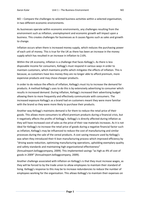
BCP Exam Prep Questions With Correct
Answers
Which |assessment |is |used |widely |in |early |intervention |with |children |under |6 |years |of |age? |It |
has |685 |developmental |skills |and |is |considered |a |very |family-centered |assessment |since |
parents |can |also |report |child's |skills |in |a |"natural" |environment |(i.e., |home, |preschool):
a. |PDMS-2
b. |HELP
c. |PEDI
d. |AMPS |- |CORRECT |ANSWER✔✔-The |Hawaii |Early |Learning |Profile |(HELP)
When |an |occupational |therapist |assists |a |child |to |identify, |develop, |and |use |strategies |for |
various |situations |and |empowers |them |to |repeat |the |strategy |in |similar |situations |they |are |
using |which |FOR?
a. |biomechanical
b. |cognitive
c. |developmental
d. |motor |control |- |CORRECT |ANSWER✔✔-b. |cognitive
You |are |working |with |an |infant |who |has |had |a |modified |barium |swallow |study |(MBSS) |exam. |It
|is |revealed |during |the |MBSS |that |the |infant |penetrates |on |thin |liquids |but |does |not |aspirate |
thin |liquids. |What |does |this |mean?
a. |the |thin |liquid |passes |through |the |vocal |cords |and |enters |the |trachea |and |lungs
b. |the |thin |liquid |hits |the |vocal |cords |during |the |swallow |but |does |not |pass |the |vocal |cords |
into |the |airway
c. |the |baby |has |nasal |regurgitation |which |enters |into |the |airway
,d. |the |baby |has |cricopharyngeal |insufficiency |- |CORRECT |ANSWER✔✔-b. |the |thin |liquid |hits |
the |vocal |cords |during |the |swallow |but |does |not |pass |the |vocal |cords |into |the |airway
Factors |influencing |the |use |of |non-standardized |assessment |methods |may |include |all |of |the |
following |ethical |reasons |EXCEPT:
a. |Assessment |measures |with |strong |research |data |do |not |exist |for |some |activities |or |
occupations |(e.g., |chewing, |sleeping)
b. |Some |settings |are |natural |(e.g., |home, |school, |community) |and |may |easily |provide |peer |
data |or |activity |analysis |during |activities/occupations
c. |Administering |standardized |tools |may |not |be |appropriate |due |to |the |person's |specific |
illness, |medical |condition, |injury, |or |cognition
d. |Standardized |tools |require |administering |tools |in |a |uniformed |way |and |may |require |costly |
training |so |tools |should |be |used |often. |- |CORRECT |ANSWER✔✔-d. |Standardized |tools |require |
administering |tools |in |a |uniformed |way |and |may |require |costly |training |so |tools |should |be |
used |often.
After |completing |an |OT |feeding |evaluation, |you |are |concerned |that |the |child |may |have |chronic
|reflux |or |other |gastrointestinal |problems. |You |would |like |to |have |a |radiographic |study |
completed |to |look |at |the |function |of |his |esophagus |and |upper |gastrointestinal |tract. |What |
study |would |you |recommend?
a. |modified |barium |swallow |study
b. |PH |probe
c. |impedance |probe
d. |upper |GI |study |- |CORRECT |ANSWER✔✔-d. |upper |GI |study
Information |pertaining |to |anatomical |structures |of |the |head |and |neck |are |important |to |know |
for |proper |evaluation |and |treatment |of |eating, |feeding, |and |swallowing |disorders. |The |pharynx
|is |divided |into |three |sections. |Which |section |of |the |pharynx |is |a |space |common |to |both |the |
function |of |eating |and |breathing?
,a. |oropharynx |
b. |nasopharynx
c. |laropharynx
d. |hyperpharynx |- |CORRECT |ANSWER✔✔-a. |oropharynx
Healthy |People |2030 |Identified |5 |Domains |related |to |the |Social |Determinants |of |Health. |
Identify |one |of |these |domains: |
a. |neighborhood |and |built |environment
b. |access |to |social |media
c. |food |and |nutrition |security
d. |inter-relationships |with |core |family |members |- |CORRECT |ANSWER✔✔-a. |neighborhood |and |
built |environment
This |occupation-based |assessment |determines |how |a |child's |volition, |habituation, |skills |and |
the |environment |facilitate |or |restrict |participation |and |is |based |on |a |child's |individual |
developmental |trajectory.
a. |child |occupational |self |assessment
b. |goal-oriented |assessment |of |life |skills
c. |pediatric |evaluation |of |disability |inventory |CAT
d. |short |child |occupational |profile |- |CORRECT |ANSWER✔✔-d. |short |child |occupational |Profile
Which |reflex |is |elicited |by |placing |an |infant |in |prone |position |supported |by |the |trunk |over |the |
examiner's |knee. |The |examiner |passively |flexes |then |extends |the |infant's |head |or |facilitates |
movement |of |the |head |with |movement |of |a |toy |to |encourage |neck |flexion |and |extension. |In |
older |children, |this |reflex |can |be |assessed |by |observing |the |child |in |a |quadruped |position. |
Flexion |of |the |head |(chin |tuck) |produces |flexion |of |the |upper |extremities, |extension |of |the |
, lower |extremities. |Extension |of |the |head |produces |extension |of |the |upper |extremities |and |
flexion |of |the |lower |extremities.
a. |moro
b. |landau
c. |neonatal |neck |righting
d. |symmetrical |tonic |neck |reflex |- |CORRECT |ANSWER✔✔-d. |symmetrical |tonic |neck |reflex
Which |grasping |pattern |is |seen |in |an |infant |at |12 |months |of |age |and |requires |opposition |of |
the |thumb |to |the |tip |of |the |index |finger. |Many |times |seen |as |an |infant |is |picking |up |a |cube |or |
objects |smaller |than |1/2 |inch.
a. |scissor |graso
b. |radial-palmar |grasp
c. |pincer |grasp
d. |three |jaw |chuck |- |CORRECT |ANSWER✔✔-c. |pincer |grasp
which |statement |is |not |true: |
a. |Children |with |health, |neurological, |and |mental |conditions |are |at |high |risk |of |sleep |pathology
b. |There |is |a |low |success |rate |with |intervention |for |infant |sleep |problems |in |the |first |3 |years
c. |Problems |with |sleep |may |contribute |to |a |child's |cardiovascular |and |metabolic |abnormalities.
d. |Parental |stress |and |mental |health |conditions |have |been |linked |to |sleep |problems |in |early |
childhood. |- |CORRECT |ANSWER✔✔-b. |There |is |a |low |success |rate |with |intervention |for |infant |
sleep |problems |in |the |first |3 |years
which |of |the |following |is |true:
a. |Extreme |poverty, |parent |substance |abuse, |child |mental |health |negatively |impact |child's |
executive |functioning.
Answers
Which |assessment |is |used |widely |in |early |intervention |with |children |under |6 |years |of |age? |It |
has |685 |developmental |skills |and |is |considered |a |very |family-centered |assessment |since |
parents |can |also |report |child's |skills |in |a |"natural" |environment |(i.e., |home, |preschool):
a. |PDMS-2
b. |HELP
c. |PEDI
d. |AMPS |- |CORRECT |ANSWER✔✔-The |Hawaii |Early |Learning |Profile |(HELP)
When |an |occupational |therapist |assists |a |child |to |identify, |develop, |and |use |strategies |for |
various |situations |and |empowers |them |to |repeat |the |strategy |in |similar |situations |they |are |
using |which |FOR?
a. |biomechanical
b. |cognitive
c. |developmental
d. |motor |control |- |CORRECT |ANSWER✔✔-b. |cognitive
You |are |working |with |an |infant |who |has |had |a |modified |barium |swallow |study |(MBSS) |exam. |It
|is |revealed |during |the |MBSS |that |the |infant |penetrates |on |thin |liquids |but |does |not |aspirate |
thin |liquids. |What |does |this |mean?
a. |the |thin |liquid |passes |through |the |vocal |cords |and |enters |the |trachea |and |lungs
b. |the |thin |liquid |hits |the |vocal |cords |during |the |swallow |but |does |not |pass |the |vocal |cords |
into |the |airway
c. |the |baby |has |nasal |regurgitation |which |enters |into |the |airway
,d. |the |baby |has |cricopharyngeal |insufficiency |- |CORRECT |ANSWER✔✔-b. |the |thin |liquid |hits |
the |vocal |cords |during |the |swallow |but |does |not |pass |the |vocal |cords |into |the |airway
Factors |influencing |the |use |of |non-standardized |assessment |methods |may |include |all |of |the |
following |ethical |reasons |EXCEPT:
a. |Assessment |measures |with |strong |research |data |do |not |exist |for |some |activities |or |
occupations |(e.g., |chewing, |sleeping)
b. |Some |settings |are |natural |(e.g., |home, |school, |community) |and |may |easily |provide |peer |
data |or |activity |analysis |during |activities/occupations
c. |Administering |standardized |tools |may |not |be |appropriate |due |to |the |person's |specific |
illness, |medical |condition, |injury, |or |cognition
d. |Standardized |tools |require |administering |tools |in |a |uniformed |way |and |may |require |costly |
training |so |tools |should |be |used |often. |- |CORRECT |ANSWER✔✔-d. |Standardized |tools |require |
administering |tools |in |a |uniformed |way |and |may |require |costly |training |so |tools |should |be |
used |often.
After |completing |an |OT |feeding |evaluation, |you |are |concerned |that |the |child |may |have |chronic
|reflux |or |other |gastrointestinal |problems. |You |would |like |to |have |a |radiographic |study |
completed |to |look |at |the |function |of |his |esophagus |and |upper |gastrointestinal |tract. |What |
study |would |you |recommend?
a. |modified |barium |swallow |study
b. |PH |probe
c. |impedance |probe
d. |upper |GI |study |- |CORRECT |ANSWER✔✔-d. |upper |GI |study
Information |pertaining |to |anatomical |structures |of |the |head |and |neck |are |important |to |know |
for |proper |evaluation |and |treatment |of |eating, |feeding, |and |swallowing |disorders. |The |pharynx
|is |divided |into |three |sections. |Which |section |of |the |pharynx |is |a |space |common |to |both |the |
function |of |eating |and |breathing?
,a. |oropharynx |
b. |nasopharynx
c. |laropharynx
d. |hyperpharynx |- |CORRECT |ANSWER✔✔-a. |oropharynx
Healthy |People |2030 |Identified |5 |Domains |related |to |the |Social |Determinants |of |Health. |
Identify |one |of |these |domains: |
a. |neighborhood |and |built |environment
b. |access |to |social |media
c. |food |and |nutrition |security
d. |inter-relationships |with |core |family |members |- |CORRECT |ANSWER✔✔-a. |neighborhood |and |
built |environment
This |occupation-based |assessment |determines |how |a |child's |volition, |habituation, |skills |and |
the |environment |facilitate |or |restrict |participation |and |is |based |on |a |child's |individual |
developmental |trajectory.
a. |child |occupational |self |assessment
b. |goal-oriented |assessment |of |life |skills
c. |pediatric |evaluation |of |disability |inventory |CAT
d. |short |child |occupational |profile |- |CORRECT |ANSWER✔✔-d. |short |child |occupational |Profile
Which |reflex |is |elicited |by |placing |an |infant |in |prone |position |supported |by |the |trunk |over |the |
examiner's |knee. |The |examiner |passively |flexes |then |extends |the |infant's |head |or |facilitates |
movement |of |the |head |with |movement |of |a |toy |to |encourage |neck |flexion |and |extension. |In |
older |children, |this |reflex |can |be |assessed |by |observing |the |child |in |a |quadruped |position. |
Flexion |of |the |head |(chin |tuck) |produces |flexion |of |the |upper |extremities, |extension |of |the |
, lower |extremities. |Extension |of |the |head |produces |extension |of |the |upper |extremities |and |
flexion |of |the |lower |extremities.
a. |moro
b. |landau
c. |neonatal |neck |righting
d. |symmetrical |tonic |neck |reflex |- |CORRECT |ANSWER✔✔-d. |symmetrical |tonic |neck |reflex
Which |grasping |pattern |is |seen |in |an |infant |at |12 |months |of |age |and |requires |opposition |of |
the |thumb |to |the |tip |of |the |index |finger. |Many |times |seen |as |an |infant |is |picking |up |a |cube |or |
objects |smaller |than |1/2 |inch.
a. |scissor |graso
b. |radial-palmar |grasp
c. |pincer |grasp
d. |three |jaw |chuck |- |CORRECT |ANSWER✔✔-c. |pincer |grasp
which |statement |is |not |true: |
a. |Children |with |health, |neurological, |and |mental |conditions |are |at |high |risk |of |sleep |pathology
b. |There |is |a |low |success |rate |with |intervention |for |infant |sleep |problems |in |the |first |3 |years
c. |Problems |with |sleep |may |contribute |to |a |child's |cardiovascular |and |metabolic |abnormalities.
d. |Parental |stress |and |mental |health |conditions |have |been |linked |to |sleep |problems |in |early |
childhood. |- |CORRECT |ANSWER✔✔-b. |There |is |a |low |success |rate |with |intervention |for |infant |
sleep |problems |in |the |first |3 |years
which |of |the |following |is |true:
a. |Extreme |poverty, |parent |substance |abuse, |child |mental |health |negatively |impact |child's |
executive |functioning.