Social Identity Theory
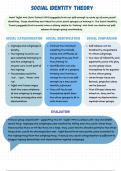
Henri Tajfel and John Turner (1979) suggests that our self-concept is made up of many social
identities. These identities are linked to which social groups we belong in. The Social Identity
Theory suggests that humans have a strong desire to ‘belong’ and that we derive our self-
esteem through group membership.
Social categorisation Social identification Social comparison
Ingroups and outgroups in Involves the individual Self-esteem can be
society. adopting the beliefs, boosted by comparisons
The ingroup is which we values and attitudes of to other outgroups.
see ourselves belonging in the group they see that The idea of inferiority and
and the outgroup is they belong to. superiority come into play
anyone who is not part of Identification can also as one group views
the ingroup. include shift in a persons themselves to be superior
The phrases would be thinking and involves a to the other group.
‘me’ , ‘you’, ‘them’ and change to his or her self- When these views are
‘us’. concept as a new social formed, prejudice ideas
Tajfel and Turner argue identity is formed. can be formed.
that the mere existence They will try to set Then if these ideas are
of one outgroup is enough themselves apart from acted on, they can be
to bring out prejudice and the other groups to fit in classed as discrimination
discrimination. with their own. against other groups.
Evaluation
Minimal group experiment - supporting the SIT. Tajfel (1970) worked with 15yr old Bristol
school boys. Ingroups and outgroups were created by telling each boy which other boys
behaved like them or nit like them on a task. They were told to allocate points to the other
boys which would be exchanged for cash. Tajfel found that more points were awarded to
the ingroup boys than the outgroup boys. It shows how social categorisation is sufficient to
trigger ingroup favouritism and discrimination against outgroups.
Henri Tajfel and John Turner (1979) suggests that our self-concept is made up of many social
identities. These identities are linked to which social groups we belong in. The Social Identity
Theory suggests that humans have a strong desire to ‘belong’ and that we derive our self-
esteem through group membership.
Social categorisation Social identification Social comparison
Ingroups and outgroups in Involves the individual Self-esteem can be
society. adopting the beliefs, boosted by comparisons
The ingroup is which we values and attitudes of to other outgroups.
see ourselves belonging in the group they see that The idea of inferiority and
and the outgroup is they belong to. superiority come into play
anyone who is not part of Identification can also as one group views
the ingroup. include shift in a persons themselves to be superior
The phrases would be thinking and involves a to the other group.
‘me’ , ‘you’, ‘them’ and change to his or her self- When these views are
‘us’. concept as a new social formed, prejudice ideas
Tajfel and Turner argue identity is formed. can be formed.
that the mere existence They will try to set Then if these ideas are
of one outgroup is enough themselves apart from acted on, they can be
to bring out prejudice and the other groups to fit in classed as discrimination
discrimination. with their own. against other groups.
Evaluation
Minimal group experiment - supporting the SIT. Tajfel (1970) worked with 15yr old Bristol
school boys. Ingroups and outgroups were created by telling each boy which other boys
behaved like them or nit like them on a task. They were told to allocate points to the other
boys which would be exchanged for cash. Tajfel found that more points were awarded to
the ingroup boys than the outgroup boys. It shows how social categorisation is sufficient to
trigger ingroup favouritism and discrimination against outgroups.