CPA Exam – FAR
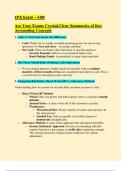
Ace Your Exams Crystal-Clear Summaries of Key
Accounting Concepts
1. Cash vs. Not Cash: Know the Difference
Cash: Think of it as readily available spending power for day-to-day
operations. It's free and clear – no strings attached!
Not Cash: These are funds with restrictions or specific purposes:
o Security Deposits: Held to cover potential future costs.
o Bond Sinking Funds: Accumulated to repay long-term debt.
2. The Three-Month Rule: Defining Cash Equivalents
For accounting purposes, highly liquid investments with an original
maturity of three months or less are considered equivalent to cash. This is
a crucial rule for classifying assets correctly.
3. Navigating Bad Debts: Direct Write-Off vs. Allowance Methods
Understanding how to account for uncollectible customer accounts is vital.
Direct Write-Off Method:
o When? Only recognizes bad debt expense when a customer actually
defaults.
o Journal Entry: A direct write-off of the customer's account.
o Weaknesses:
Theoretical Flaw: Poorly matches revenues and expenses in
the same period.
Limited Use: Only acceptable if bad debt expense is
immaterial (insignificant).
Allowance Method: A more robust approach that anticipates bad debts.
o Income Statement Approach: Focuses on estimating bad debt
expense based on a percentage of credit sales (matching concept).
The existing allowance balance doesn't influence the current
adjustment.
, o Balance Sheet Approach: Focuses on the desired ending balance in
the Allowance for Doubtful Accounts based on an aging of accounts
receivable. Prior allowance balances do affect the adjustment.
4. Balance Sheet Reporting: Presenting Accounts Receivable Accurately
The net realizable value of accounts receivable is what you expect to
actually collect:
Accounts Receivable
Less: Allowance for Bad Debts
= Net Realizable Value of A/R
5. Recovering Written-Off Accounts: A Second Chance!
If an account previously written off is later collected:
1. Reverse the original write-off entry. This reinstates the customer's
account.
2. Record the cash collection as usual.
6. Managing Accounts Receivable: Assignment vs. Factoring vs. Pledging
Understand the different ways businesses leverage their receivables.
Assigning Accounts Receivable:
o Typically done with recourse (the seller retains responsibility if the
customer doesn't pay).
o Usually done without notification to the customers.
Factoring Accounts Receivable:
o Can be with or without recourse, depending on the agreement.
Pledging Accounts Receivable:
o Using receivables as security for a loan.
o Requires footnote disclosure in the financial statements.
7. Noninterest-Bearing Notes: The Implicit Interest
Generally, APB 21 requires imputing interest on noninterest-bearing notes.
Exception: No imputation is needed for notes arising from customary
trade terms and due in less than one year.
8. Investments: A Spectrum of Intentions
How investments are classified dictates their accounting treatment.
, Held-to-Maturity (HTM) Securities:
o Type: Only debt securities.
o Intent: Management has both the intent and ability to hold until
maturity.
o Balance Sheet Classification: Based on maturity date (current or
non-current).
o Carrying Value: Amortized cost.
Trading Securities:
o Type: Equity or debt securities held primarily for short-term
resale.
o Balance Sheet Classification: Always current.
o Carrying Value: Fair Market Value (FMV).
o Unrealized Gains/Losses: Reported on the income statement.
Available-for-Sale (AFS) Securities:
o Type: Debt or equity securities not classified as HTM or Trading.
o Balance Sheet Classification: Debt by maturity, equity by
management's intent.
o Carrying Value: Aggregate FMV.
o Unrealized Gains/Losses: Go directly to shareholders' equity as
Other Comprehensive Income (OCI).
9. Derivatives: Value Derived Elsewhere
A derivative's value is linked to an underlying asset or liability.
10. Hedging: Mitigating Financial Risk
A strategy using derivatives to offset potential losses from other investments
or transactions.
11. Non-Hedge Derivatives: Straight to the Income Statement
Recorded on the balance sheet at FMV.
Unrealized gains and losses are reported on the income statement.
12. Fair Value Hedge: Protecting Asset/Liability Value
Protects against changes in the FMV of an asset or liability.
Recorded on the balance sheet at FMV.
Unrealized holding gains and losses are reported on the income statement.
Ace Your Exams Crystal-Clear Summaries of Key
Accounting Concepts
1. Cash vs. Not Cash: Know the Difference
Cash: Think of it as readily available spending power for day-to-day
operations. It's free and clear – no strings attached!
Not Cash: These are funds with restrictions or specific purposes:
o Security Deposits: Held to cover potential future costs.
o Bond Sinking Funds: Accumulated to repay long-term debt.
2. The Three-Month Rule: Defining Cash Equivalents
For accounting purposes, highly liquid investments with an original
maturity of three months or less are considered equivalent to cash. This is
a crucial rule for classifying assets correctly.
3. Navigating Bad Debts: Direct Write-Off vs. Allowance Methods
Understanding how to account for uncollectible customer accounts is vital.
Direct Write-Off Method:
o When? Only recognizes bad debt expense when a customer actually
defaults.
o Journal Entry: A direct write-off of the customer's account.
o Weaknesses:
Theoretical Flaw: Poorly matches revenues and expenses in
the same period.
Limited Use: Only acceptable if bad debt expense is
immaterial (insignificant).
Allowance Method: A more robust approach that anticipates bad debts.
o Income Statement Approach: Focuses on estimating bad debt
expense based on a percentage of credit sales (matching concept).
The existing allowance balance doesn't influence the current
adjustment.
, o Balance Sheet Approach: Focuses on the desired ending balance in
the Allowance for Doubtful Accounts based on an aging of accounts
receivable. Prior allowance balances do affect the adjustment.
4. Balance Sheet Reporting: Presenting Accounts Receivable Accurately
The net realizable value of accounts receivable is what you expect to
actually collect:
Accounts Receivable
Less: Allowance for Bad Debts
= Net Realizable Value of A/R
5. Recovering Written-Off Accounts: A Second Chance!
If an account previously written off is later collected:
1. Reverse the original write-off entry. This reinstates the customer's
account.
2. Record the cash collection as usual.
6. Managing Accounts Receivable: Assignment vs. Factoring vs. Pledging
Understand the different ways businesses leverage their receivables.
Assigning Accounts Receivable:
o Typically done with recourse (the seller retains responsibility if the
customer doesn't pay).
o Usually done without notification to the customers.
Factoring Accounts Receivable:
o Can be with or without recourse, depending on the agreement.
Pledging Accounts Receivable:
o Using receivables as security for a loan.
o Requires footnote disclosure in the financial statements.
7. Noninterest-Bearing Notes: The Implicit Interest
Generally, APB 21 requires imputing interest on noninterest-bearing notes.
Exception: No imputation is needed for notes arising from customary
trade terms and due in less than one year.
8. Investments: A Spectrum of Intentions
How investments are classified dictates their accounting treatment.
, Held-to-Maturity (HTM) Securities:
o Type: Only debt securities.
o Intent: Management has both the intent and ability to hold until
maturity.
o Balance Sheet Classification: Based on maturity date (current or
non-current).
o Carrying Value: Amortized cost.
Trading Securities:
o Type: Equity or debt securities held primarily for short-term
resale.
o Balance Sheet Classification: Always current.
o Carrying Value: Fair Market Value (FMV).
o Unrealized Gains/Losses: Reported on the income statement.
Available-for-Sale (AFS) Securities:
o Type: Debt or equity securities not classified as HTM or Trading.
o Balance Sheet Classification: Debt by maturity, equity by
management's intent.
o Carrying Value: Aggregate FMV.
o Unrealized Gains/Losses: Go directly to shareholders' equity as
Other Comprehensive Income (OCI).
9. Derivatives: Value Derived Elsewhere
A derivative's value is linked to an underlying asset or liability.
10. Hedging: Mitigating Financial Risk
A strategy using derivatives to offset potential losses from other investments
or transactions.
11. Non-Hedge Derivatives: Straight to the Income Statement
Recorded on the balance sheet at FMV.
Unrealized gains and losses are reported on the income statement.
12. Fair Value Hedge: Protecting Asset/Liability Value
Protects against changes in the FMV of an asset or liability.
Recorded on the balance sheet at FMV.
Unrealized holding gains and losses are reported on the income statement.