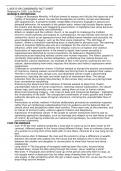
L’AGE D’OR CONDENSED FACT SHEET
Released in 1930, Luis Buñuel
BUÑUEL’S INTENTIONS
- Critique of Bourgeois Morality Buñuel aimed to expose and ridicule the hypocrisy and
rigidity of bourgeois values. He saw the bourgeoisie as morally corrupt and obsessed
with appearances. It presents wealth, respectable characters engaged in absurd and
debased behaviour. An example is the garden party, where high-society figures ignore
the chaotic and obscene acts happening around them. It highlights how social decorum
masks underlying brutality and selfishness
- Attack on religion and the catholic church He sought to challenge the Catholic
Church’s moral authority and expose its contradictions. He was fiercely anti-clerical. He
viewed the church as an oppressive force that stifled human freedom and sexuality. He
uses blasphemous imagery, such as the final scene inspired by ‘The 120 Days of
Sodom’, where a character resembling Jesus is implicated in perverse acts. The opening
scene of scorpions fighting also acts as a metaphor for the church’s destructive
influence, while later scenes directly link religious icons to corruption and violence
- Exploration of repressed desire He aimed to depict how human sexuality is
suppressed and distorted by social conventions. He believed in liberating the
subconscious and rejecting rational control over human impulses. The lovers’ passion is
constantly interrupted by societal obligations, symbolising how natural desires are
thwarted by cultural repression. An example of this is the woman sucking the toe of a
stature, demonstrating how erotic impulses find bizarre and indirect expressions when
suppressed.
- Challenge to conventional cinema Buñuel wanted to disrupt the passive consumption
of cinema by making viewers uncomfortable and forcing them to question their values.
The film’s non-linear plot, abrupt cuts, and disjointed scenes create a disorienting
experience, rejecting the logic and order typical of mainstream films. The abrupt
transition from the scorpion documentary to the human story serves as a jarring break
from conventional storytelling
- Embracing the absurd and the irrational Buñuel wanted to depict the chaotic,
unpredictable nature of human experience, rejecting rational explanations. He valued
dream logic and irrationality over reason, seeing them as truer to human nature.
Absurd and shocking imagery – like cows on beds and nonsensical dialogue – highlights
the irrationality of life itself. The unexpected combination of erotic passion and violent
outbursts disrupts any sense of logical coherence, mirroring the unpredictable flow of
dreams
- Provocation as artistic method Buñuel deliberately provoked an emotional response
rather than an intellectual understanding from his audience and he believed that art
should shock and destabilise rather than comfort. There were riots at the premiere, due
to scenes of animal cruelty, violence against children and blasphemy.
- Subversion of traditional values He sought to subvert institutions that he saw as
upholding oppressive ideologies, such as marriage and religion as he saw these as tools
of control. By portraying aristocrats as irrational and grotesque, he undermines their
perceived superiority.
FILM TECHNIQUES
- Cuts Of the man walking (originally a long shot to close-up as he gets closer to the
camera), different people in the house doing different things, from an extreme close-up
of a woman to a long shot of the toilet with no one there, mid-shot of a cow lying on her
bed
- Shot-reverse-shot Between the man and the priests to show a difference in wealth,
between the bandit who walked into the house and the talkative one in the house,
between the mother and daughter in conversation to show their formal and tense
relationship
- Long shots The big group of bourgeois walking down the rocks, houses being
knocked down, shows the bike going through the house, ‘Jesus’ walking a plank’
- Mid shots Of people and extreme close-up of the person who tells them to stop, as
rich people watch a dead poor boy be taken away showing their lack of care
- Low angles Man protesting when the girl is taken away from him, as we see the man
drop things out the window
, - Ariel shot Establishing shot of Rome, as we see the man chuck a blanket and it turns
into a Priest
- Extreme close-up Man having blood coming down his face, shot-reverse-shot
between the man’s shocked expression and the statues foot
- Close-up shot Woman indicating to someone to get off her bed to reveal it is a cow
- Shaky camera Filming the conductor and mirroring his actions
- Diegetic sound Birds fluttering when the woman and man have a moment in the
garden together, people talking loudly when the conductor stops conducting music and
walks away
- Romantic score Flute when the boats sail into the harbour, music plays when the
man gets into the bed
- Non-diegetic sound Stops when the conductor stops playing music, resumes with
militaristic drumming when the man gets up angry at the woman for kissing the
conductor
- Score Violin score ends as the man walks to the hut and resumes when we go into
the hut, cuts out repeatedly when the different houses get knocked down, slow and sad
score when the man is escorted away
- Cacophony Romantic violin and low hum of 4 priests leading a prayer, and the wind,
cow bell and dog barking
- Militaristic drumming Restarts when the man pulls all the duck feathers out the
pillow, ‘Jesus’ walking a plank
FILM TECHNIQUES
- Surrealist imagery It is filled with dreamlike, irrational and shocking images that defy
logic. Examples include a bishop skeleton, a cow on a bed, and a man shooting a child.
These images are designed to evoke strong, visceral reactions and challenge bourgeois
sensibilities.
- Nonlinear narrative It’s fragmented and disjointed, moving abruptly from one scene
to another without clear cause-and-effect relationships. This mirrors the chaotic nature
of dreams and defies traditional storytelling conventions.
- Juxtaposition and montage Buñuel uses Eisenstein’s montage theory to create
shocking associations. For instance, shots of a couple making love are intercut with
images of violence, critiquing both romantic and societal norms.
- Symbolism and metaphor It is filled of symbolic imagery that critiques social
institutions, particularly by the Church and the bourgeoisie. For example, the cow in the
bed symbolises the absurdity of rigid social norms.
- Sound design Use of non-diegetic sound, including classical music, ambient noises,
often contrasts with the visuals, adding to the disorienting atmosphere. It serves to
heighten the absurdity and discomfort
- Cinematic irony and satire Uses irony to critique authority. The revered figure of
Christ is replaced by a figure resembling the Marquis de Sade, mocking religious and
moral hypocrisy.
- Breaking the fourth wall Characters occasionally acknowledge the camera or the
audience, further breaking conventional cinematic boundaries and emphasising the
film’s artificiality
- Visual absurdity and shock The film’s final scene, inspired by The 120 Days of Sodom
by de Sade, involves grotesque and blasphemous imagery that purposefully confronts
societal taboos.
- Long takes Some scenes linger uncomfortably long, forcing the viewer to engage
with bizarre content without the relief of a cut, enhancing the film’s unsettling quality.
- Experimental cinematography Buñuel uses unconventional framing, abrupt zooms,
and handheld camera work to convey a sense of instability and rebellion against
cinematic norms
OPENING SEQUENCE
- Iris vignetting Around pincers, forces our attention to only be on the most brutal part
of the scorpion. It unnerves us and sets the tone for the rest of the film
- Intertitles Provide information, lulling us into a false sense of security as we feel like
we are being told what is going on
- Music crescendos after each intertitle This creates a feeling of danger and makes us
feel at unease.
Released in 1930, Luis Buñuel
BUÑUEL’S INTENTIONS
- Critique of Bourgeois Morality Buñuel aimed to expose and ridicule the hypocrisy and
rigidity of bourgeois values. He saw the bourgeoisie as morally corrupt and obsessed
with appearances. It presents wealth, respectable characters engaged in absurd and
debased behaviour. An example is the garden party, where high-society figures ignore
the chaotic and obscene acts happening around them. It highlights how social decorum
masks underlying brutality and selfishness
- Attack on religion and the catholic church He sought to challenge the Catholic
Church’s moral authority and expose its contradictions. He was fiercely anti-clerical. He
viewed the church as an oppressive force that stifled human freedom and sexuality. He
uses blasphemous imagery, such as the final scene inspired by ‘The 120 Days of
Sodom’, where a character resembling Jesus is implicated in perverse acts. The opening
scene of scorpions fighting also acts as a metaphor for the church’s destructive
influence, while later scenes directly link religious icons to corruption and violence
- Exploration of repressed desire He aimed to depict how human sexuality is
suppressed and distorted by social conventions. He believed in liberating the
subconscious and rejecting rational control over human impulses. The lovers’ passion is
constantly interrupted by societal obligations, symbolising how natural desires are
thwarted by cultural repression. An example of this is the woman sucking the toe of a
stature, demonstrating how erotic impulses find bizarre and indirect expressions when
suppressed.
- Challenge to conventional cinema Buñuel wanted to disrupt the passive consumption
of cinema by making viewers uncomfortable and forcing them to question their values.
The film’s non-linear plot, abrupt cuts, and disjointed scenes create a disorienting
experience, rejecting the logic and order typical of mainstream films. The abrupt
transition from the scorpion documentary to the human story serves as a jarring break
from conventional storytelling
- Embracing the absurd and the irrational Buñuel wanted to depict the chaotic,
unpredictable nature of human experience, rejecting rational explanations. He valued
dream logic and irrationality over reason, seeing them as truer to human nature.
Absurd and shocking imagery – like cows on beds and nonsensical dialogue – highlights
the irrationality of life itself. The unexpected combination of erotic passion and violent
outbursts disrupts any sense of logical coherence, mirroring the unpredictable flow of
dreams
- Provocation as artistic method Buñuel deliberately provoked an emotional response
rather than an intellectual understanding from his audience and he believed that art
should shock and destabilise rather than comfort. There were riots at the premiere, due
to scenes of animal cruelty, violence against children and blasphemy.
- Subversion of traditional values He sought to subvert institutions that he saw as
upholding oppressive ideologies, such as marriage and religion as he saw these as tools
of control. By portraying aristocrats as irrational and grotesque, he undermines their
perceived superiority.
FILM TECHNIQUES
- Cuts Of the man walking (originally a long shot to close-up as he gets closer to the
camera), different people in the house doing different things, from an extreme close-up
of a woman to a long shot of the toilet with no one there, mid-shot of a cow lying on her
bed
- Shot-reverse-shot Between the man and the priests to show a difference in wealth,
between the bandit who walked into the house and the talkative one in the house,
between the mother and daughter in conversation to show their formal and tense
relationship
- Long shots The big group of bourgeois walking down the rocks, houses being
knocked down, shows the bike going through the house, ‘Jesus’ walking a plank’
- Mid shots Of people and extreme close-up of the person who tells them to stop, as
rich people watch a dead poor boy be taken away showing their lack of care
- Low angles Man protesting when the girl is taken away from him, as we see the man
drop things out the window
, - Ariel shot Establishing shot of Rome, as we see the man chuck a blanket and it turns
into a Priest
- Extreme close-up Man having blood coming down his face, shot-reverse-shot
between the man’s shocked expression and the statues foot
- Close-up shot Woman indicating to someone to get off her bed to reveal it is a cow
- Shaky camera Filming the conductor and mirroring his actions
- Diegetic sound Birds fluttering when the woman and man have a moment in the
garden together, people talking loudly when the conductor stops conducting music and
walks away
- Romantic score Flute when the boats sail into the harbour, music plays when the
man gets into the bed
- Non-diegetic sound Stops when the conductor stops playing music, resumes with
militaristic drumming when the man gets up angry at the woman for kissing the
conductor
- Score Violin score ends as the man walks to the hut and resumes when we go into
the hut, cuts out repeatedly when the different houses get knocked down, slow and sad
score when the man is escorted away
- Cacophony Romantic violin and low hum of 4 priests leading a prayer, and the wind,
cow bell and dog barking
- Militaristic drumming Restarts when the man pulls all the duck feathers out the
pillow, ‘Jesus’ walking a plank
FILM TECHNIQUES
- Surrealist imagery It is filled with dreamlike, irrational and shocking images that defy
logic. Examples include a bishop skeleton, a cow on a bed, and a man shooting a child.
These images are designed to evoke strong, visceral reactions and challenge bourgeois
sensibilities.
- Nonlinear narrative It’s fragmented and disjointed, moving abruptly from one scene
to another without clear cause-and-effect relationships. This mirrors the chaotic nature
of dreams and defies traditional storytelling conventions.
- Juxtaposition and montage Buñuel uses Eisenstein’s montage theory to create
shocking associations. For instance, shots of a couple making love are intercut with
images of violence, critiquing both romantic and societal norms.
- Symbolism and metaphor It is filled of symbolic imagery that critiques social
institutions, particularly by the Church and the bourgeoisie. For example, the cow in the
bed symbolises the absurdity of rigid social norms.
- Sound design Use of non-diegetic sound, including classical music, ambient noises,
often contrasts with the visuals, adding to the disorienting atmosphere. It serves to
heighten the absurdity and discomfort
- Cinematic irony and satire Uses irony to critique authority. The revered figure of
Christ is replaced by a figure resembling the Marquis de Sade, mocking religious and
moral hypocrisy.
- Breaking the fourth wall Characters occasionally acknowledge the camera or the
audience, further breaking conventional cinematic boundaries and emphasising the
film’s artificiality
- Visual absurdity and shock The film’s final scene, inspired by The 120 Days of Sodom
by de Sade, involves grotesque and blasphemous imagery that purposefully confronts
societal taboos.
- Long takes Some scenes linger uncomfortably long, forcing the viewer to engage
with bizarre content without the relief of a cut, enhancing the film’s unsettling quality.
- Experimental cinematography Buñuel uses unconventional framing, abrupt zooms,
and handheld camera work to convey a sense of instability and rebellion against
cinematic norms
OPENING SEQUENCE
- Iris vignetting Around pincers, forces our attention to only be on the most brutal part
of the scorpion. It unnerves us and sets the tone for the rest of the film
- Intertitles Provide information, lulling us into a false sense of security as we feel like
we are being told what is going on
- Music crescendos after each intertitle This creates a feeling of danger and makes us
feel at unease.