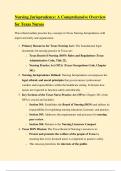
Nursing Jurisprudence: A Comprehensive Overview
for Texas Nurses
This refined outline presents key concepts in Texas Nursing Jurisprudence with
improved clarity and organization.
1. Primary Resources for Texas Nursing Law: The foundational legal
documents for nursing practice in Texas are:
o Texas Board of Nursing (BON) Rules and Regulations (Texas
Administrative Code, Title 22).
o Nursing Practice Act (NPA) (Texas Occupations Code, Chapter
301).
2. Nursing Jurisprudence Defined: Nursing Jurisprudence encompasses the
legal, ethical, and moral principles that govern nurses' professional
conduct and responsibilities within the healthcare setting. It dictates how
nurses are expected to function safely and ethically.
3. Key Sections of the Texas Nurse Practice Act (NPA): Chapter 301 of the
NPA is crucial and includes:
o Section 301: Establishes the Board of Nursing (BON) and defines its
responsibility for regulating nursing education, licensure, and practice.
o Section 303: Addresses the requirements and processes for nursing
peer review.
o Section 304: Pertains to the Nursing Licensure Compact.
4. Texas BON Mission: The Texas Board of Nursing's mission is to:
o Protect and promote the welfare of the people of Texas by
ensuring that every licensed nurse is competent to practice safely.
o This mission prioritizes the interests of the public.
,5. Comprehensive Overview of Chapter 301 NPA: This chapter details
various aspects of nursing regulation, including:
o The process for how the Board is appointed.
o The general powers and duties of the BON.
o License requirements and renewal procedures.
o Regulations concerning practice by license holders.
o Guidelines for reporting violations and patient care concerns.
o Prohibited practices and disciplinary actions.
o Other penalties and enforcement provisions.
o Specific regulations regarding anesthesia in outpatient settings.
o Procedures for corrective action proceedings.
6. Distinguishing the Board of Nursing: The Board of Nursing:
o Represents the interests of the people of Texas in ensuring safe
nursing care.
o Cannot lobby the legislature to advocate for specific nursing
interests.
o Does not regulate practice settings (e.g., hospital policies), but
focuses on individual nurse licensure and practice.
o Its core functions include:
Licensing qualified nurses.
Providing Enforcement Services for violations.
Conducting Audits of Continuing Education (CE)
compliance.
Providing Information Services related to nursing licensure
and regulation.
7. Contrasting Professional Nursing Associations: Professional Nursing
Associations:
, o Represent the interests of their members (nurses).
o Actively lobby the legislature to advocate for policies favorable to
nurses.
o Engage in efforts to improve working conditions and benefits for
nurses.
o Often provide member services such as:
Job referral services.
Legal referral services.
Information on salary expectations.
Guidance on co-worker disputes.
Assistance with various employment issues.
8. Texas Nursing Licensure and Regulation Details:
o Temporary Permit (Graduate Nurse - GN):
Typically expires within 75 days.
Its status is determined by the pass/fail result of the NCLEX
examination.
o Online License Renewal:
Nurses are required to renew their licenses online.
The BON will send a renewal reminder card approximately 60
days prior to the license expiration date.
o Continuing Education (CE):
Nurses must complete 20 contact hours every 2 years to
maintain licensure.
Nurses renewing for the first time are exempt from CE
requirements.
CE hours should be relevant to the nurse's area of practice.
for Texas Nurses
This refined outline presents key concepts in Texas Nursing Jurisprudence with
improved clarity and organization.
1. Primary Resources for Texas Nursing Law: The foundational legal
documents for nursing practice in Texas are:
o Texas Board of Nursing (BON) Rules and Regulations (Texas
Administrative Code, Title 22).
o Nursing Practice Act (NPA) (Texas Occupations Code, Chapter
301).
2. Nursing Jurisprudence Defined: Nursing Jurisprudence encompasses the
legal, ethical, and moral principles that govern nurses' professional
conduct and responsibilities within the healthcare setting. It dictates how
nurses are expected to function safely and ethically.
3. Key Sections of the Texas Nurse Practice Act (NPA): Chapter 301 of the
NPA is crucial and includes:
o Section 301: Establishes the Board of Nursing (BON) and defines its
responsibility for regulating nursing education, licensure, and practice.
o Section 303: Addresses the requirements and processes for nursing
peer review.
o Section 304: Pertains to the Nursing Licensure Compact.
4. Texas BON Mission: The Texas Board of Nursing's mission is to:
o Protect and promote the welfare of the people of Texas by
ensuring that every licensed nurse is competent to practice safely.
o This mission prioritizes the interests of the public.
,5. Comprehensive Overview of Chapter 301 NPA: This chapter details
various aspects of nursing regulation, including:
o The process for how the Board is appointed.
o The general powers and duties of the BON.
o License requirements and renewal procedures.
o Regulations concerning practice by license holders.
o Guidelines for reporting violations and patient care concerns.
o Prohibited practices and disciplinary actions.
o Other penalties and enforcement provisions.
o Specific regulations regarding anesthesia in outpatient settings.
o Procedures for corrective action proceedings.
6. Distinguishing the Board of Nursing: The Board of Nursing:
o Represents the interests of the people of Texas in ensuring safe
nursing care.
o Cannot lobby the legislature to advocate for specific nursing
interests.
o Does not regulate practice settings (e.g., hospital policies), but
focuses on individual nurse licensure and practice.
o Its core functions include:
Licensing qualified nurses.
Providing Enforcement Services for violations.
Conducting Audits of Continuing Education (CE)
compliance.
Providing Information Services related to nursing licensure
and regulation.
7. Contrasting Professional Nursing Associations: Professional Nursing
Associations:
, o Represent the interests of their members (nurses).
o Actively lobby the legislature to advocate for policies favorable to
nurses.
o Engage in efforts to improve working conditions and benefits for
nurses.
o Often provide member services such as:
Job referral services.
Legal referral services.
Information on salary expectations.
Guidance on co-worker disputes.
Assistance with various employment issues.
8. Texas Nursing Licensure and Regulation Details:
o Temporary Permit (Graduate Nurse - GN):
Typically expires within 75 days.
Its status is determined by the pass/fail result of the NCLEX
examination.
o Online License Renewal:
Nurses are required to renew their licenses online.
The BON will send a renewal reminder card approximately 60
days prior to the license expiration date.
o Continuing Education (CE):
Nurses must complete 20 contact hours every 2 years to
maintain licensure.
Nurses renewing for the first time are exempt from CE
requirements.
CE hours should be relevant to the nurse's area of practice.