IntroductionExams serve as a fundamental tool in evaluating a student's understanding of a subject, particularly in fields as diverse as business, law, and mathematics. These
disciplines not only have distinct areas of focus but also require unique approaches to assessment, with each exam testing different cognitive abilities, analytical skills, and subject-
specific knowledge. In this essay, we will explore the nature of exams in business, law, and mathematics, their format, and how they evaluate students’ comprehension and application
of core concepts. We will also discuss the similarities and differences in these exams and how they prepare students for their respective
careers.________________________________________1. Business Exams1.1. Overview of Business EducationBusiness education prepares students for leadership and management
roles in various industries. It focuses on critical thinking, decision-making, problem-solving, and understanding organizational processes. A typical business program might cover
topics like accounting, finance, marketing, management, economics, entrepreneurship, and international business.1.2. Structure of Business ExamsBusiness exams are often a mix of
theoretical knowledge and practical application. Depending on the subject area, these exams can vary significantly in format. Common types of business exams include:Multiple
Choice Questions (MCQs): These are frequently used to assess students’ understanding of business terminology, theories, and principles.Case Studies: A staple of business exams, case
studies present students with real-world business scenarios and ask them to apply their knowledge to solve complex problems. Case studies evaluate students' ability to think critically
and make strategic decisions.Essay/Short Answer Questions: These types of questions test the student’s ability to explain and analyze business concepts in a detailed and coherent
manner.1.3. Skills Tested in Business ExamsCritical Thinking and Problem-Solving: Business exams often include case studies that challenge students to apply theoretical knowledge,
and legal commentaries to build a solid understanding of the material. Law exams may include citations or the need to reference specific legal sources.Structured Writing
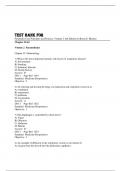
TEST BANK FOR
Paramedic Care Principles and Practice, Volume 2, 6th Edition by Bryan E. Bledsoe
Chapter 32-62
Volume 2 Paramedicine
Chapter 32 Pulmonology
1) What is the most important intrinsic risk factor for respiratory disease?
A) Environment
B) Smoking
C) Sedentary lifestyle
D) Family history
Answer: D
Diff: 1 Page Ref: 1018
Standard: Medicine (Respiratory)
Objective: 2
2) Air entering and leaving the lungs via inspiration and expiration is known as:
A) ventilation.
B) respirations.
C) perfusion.
D) oxygenation.
Answer: A
Diff: 1 Page Ref: 1022
Standard: Medicine (Respiratory)
Objective: 1
3) The diaphragm is controlled by which nerve?
A) Vagus
B) Olfactory
C) Abducens
D) Phrenic
Answer: D
Diff: 1 Page Ref: 1023
Standard: Medicine (Respiratory)
Objective: 3
4) An example of diffusion in the respiratory system is movement of:
A) oxygen from the alveoli into the pulmonary capillaries.
, B) air from the outside environment into the lungs.
C) oxygen from the tissues into the systemic capillaries.
D) carbon dioxide from the alveoli into the pulmonary capillaries.
Answer: A
Diff: 2 Page Ref: 1026
Standard: Medicine (Respiratory)
Objective: 4
5) Airway resistance is increased by:
A) sympathetic nervous system stimulation.
B) decreased elasticity of the chest wall.
C) anticholinergic drugs.
D) bronchospasm.
Answer: D
Diff: 2 Page Ref: 1024
Standard: Medicine (Respiratory)
Objective: 4
IntroductionExams serve as a fundamental tool in evaluating a student's understanding of a subject, particularly in fields as diverse as business, law, and mathematics. These disciplines not only have
distinct areas of focus but also require unique approaches to assessment, with each exam testing different cognitive abilities, analytical skills, and subject-specific knowledge. In this essay, we will
explore the nature of exams in business, law, and mathematics, their format, and how they evaluate students’ comprehension and application of core concepts. We will also discuss the similarities and
differences in these exams and how they prepare students for their respective careers.________________________________________1. Business Exams1.1. Overview of Business EducationBusiness
education prepares students for leadership and management roles in various industries. It focuses on critical thinking, decision-making, problem-solving, and understanding organizational processes. A
typical business program might cover topics like accounting, finance, marketing, management, economics, entrepreneurship, and international business.1.2. Structure of Business ExamsBusiness exams
are often a mix of theoretical knowledge and practical application. Depending on the subject area, these exams can vary significantly in format. Common types of business exams include:Multiple
Choice Questions (MCQs): These are frequently used to assess students’ understanding of business terminology, theories, and principles.Case Studies: A staple of business exams, case studies present
students with real-world business scenarios and ask them to apply their knowledge to solve complex problems. Case studies evaluate students' ability to think critically and make strategic
decisions.Essay/Short Answer Questions: These types of questions test the student’s ability to explain and analyze business concepts in a detailed and coherent manner.1.3. Skills Tested in Business
ExamsCritical Thinking and Problem-Solving: Business exams often include case studies that challenge students to apply theoretical k
6) Which patient is at risk for the most common cause of upper airway obstruction?
A) 4-year-old male with croup
B) 21-year-old female unconscious and supine on the floor
C) 22-year-old female stung by a wasp
D) 5-year-old female with epiglottitis
Answer: B
Diff: 2 Page Ref: 1040
Standard: Medicine (Respiratory)
Objective: 7
7) Normal tidal volume in an average 70 kg adult is approximately how many milliliters?
A) 1,500
B) 1,000
C) 750
D) 500
Answer: D
Diff: 1 Page Ref: 1024
Standard: Medicine (Respiratory)
Objective: 4
8) After a normal inspiration and expiration, an adult patient has about 2,400 mL of air
remaining in the lungs, known as the:
A) expiratory reserve volume.
B) residual volume.
C) functional residual capacity.
D) vital capacity.
, Answer: C
Diff: 1 Page Ref: 1025
Standard: Medicine (Respiratory)
Objective: 4
9) A 19-year-old female with difficulty breathing produces a peak expiratory flow rate of 425
lpm, indicating:
A) moderate bronchoconstriction.
B) mild bronchoconstriction.
C) normal ventilatory state.
D) severe bronchoconstriction.
Answer: C
Diff: 2 Page Ref: 1037
Standard: Medicine (Respiratory)
Objective: 7
IntroductionExams serve as a fundamental tool in evaluating a student's understanding of a subject, particularly in fields as diverse as business, law, and mathematics. These disciplines not only have
distinct areas of focus but also require unique approaches to assessment, with each exam testing different cognitive abilities, analytical skills, and subject-specific knowledge. In this essay, we will
explore the nature of exams in business, law, and mathematics, their format, and how they evaluate students’ comprehension and application of core concepts. We will also discuss the similarities and
differences in these exams and how they prepare students for their respective careers.________________________________________1. Business Exams1.1. Overview of Business EducationBusiness
education prepares students for leadership and management roles in various industries. It focuses on critical thinking, decision-making, problem-solving, and understanding organizational processes. A
typical business program might cover topics like accounting, finance, marketing, management, economics, entrepreneurship, and international business.1.2. Structure of Business ExamsBusiness exams
are often a mix of theoretical knowledge and practical application. Depending on the subject area, these exams can vary significantly in format. Common types of business exams include:Multiple
Choice Questions (MCQs): These are frequently used to assess students’ understanding of business terminology, theories, and principles.Case Studies: A staple of business exams, case studies present
students with real-world business scenarios and ask them to apply their knowledge to solve complex problems. Case studies evaluate students' ability to think critically and make strategic
decisions.Essay/Short Answer Questions: These types of questions test the student’s ability to explain and analyze business concepts in a detailed and coherent manner.1.3. Skills Tested in Business
ExamsCritical Thinking and Problem-Solving: Business exams often include case studies that challenge students to apply theoretical k
10) Stretch receptors in the lungs send a signal to the inspiratory center of the medulla, inhibiting
its stimulation of the phrenic and intercostal nerves. This is known as what reflex?
A) Cushing's
B) Hering-Breuer
C) Moro
D) Cheyne-Stokes
Answer: B
Diff: 2 Page Ref: 1025
Standard: Medicine (Respiratory)
Objective: 3
11) The most important factor in determining the respiratory rate is:
A) arterial pCO2.
B) arterial pO2.
C) alveolar pCO2.
D) alveolar pO2.
Answer: A
Diff: 1 Page Ref: 1025
Standard: Medicine (Respiratory)
Objective: 3
12) You are working in the ED caring for a 55-year-old female with a long history of COPD. She
is more short of breath today than usual and states she has an increased cough. She has a
tympanic temperature of 99.8°F. You have drawn arterial blood gases with the patient on room
air and when the report comes back, it shows that the patient has a pO2 of 52 mmHg. Which one
is most likely?
A) You have inadvertently drawn a venous sample.
, B) The patient is critically hypoxic and requires assisted ventilation.
C) This is the typical value for this patient.
D) The lab performed the test incorrectly.
Answer: C
Diff: 3 Page Ref: 1026
Standard: Medicine (Respiratory)
Objective: 3
13) Your ICU patient has ARDS with a pO2 of 62 mmHg, despite mechanical ventilation and
oxygenation. What best explains this finding?
A) It is a problem with perfusion.
B) It is a problem with ventilation.
C) It is a problem with the blood gas sample collection.
D) It is a problem with gas diffusion in the lung.
Answer: D
Diff: 3 Page Ref: 1042
Standard: Medicine (Respiratory)
Objective: 8
IntroductionExams serve as a fundamental tool in evaluating a student's understanding of a subject, particularly in fields as diverse as business, law, and mathematics. These disciplines not only have
distinct areas of focus but also require unique approaches to assessment, with each exam testing different cognitive abilities, analytical skills, and subject-specific knowledge. In this essay, we will
explore the nature of exams in business, law, and mathematics, their format, and how they evaluate students’ comprehension and application of core concepts. We will also discuss the similarities and
differences in these exams and how they prepare students for their respective careers.________________________________________1. Business Exams1.1. Overview of Business EducationBusiness
education prepares students for leadership and management roles in various industries. It focuses on critical thinking, decision-making, problem-solving, and understanding organizational processes. A
typical business program might cover topics like accounting, finance, marketing, management, economics, entrepreneurship, and international business.1.2. Structure of Business ExamsBusiness exams
are often a mix of theoretical knowledge and practical application. Depending on the subject area, these exams can vary significantly in format. Common types of business exams include:Multiple
Choice Questions (MCQs): These are frequently used to assess students’ understanding of business terminology, theories, and principles.Case Studies: A staple of business exams, case studies present
students with real-world business scenarios and ask them to apply their knowledge to solve complex problems. Case studies evaluate students' ability to think critically and make strategic
decisions.Essay/Short Answer Questions: These types of questions test the student’s ability to explain and analyze business concepts in a detailed and coherent manner.1.3. Skills Tested in Business
ExamsCritical Thinking and Problem-Solving: Business exams often include case studies that challenge students to apply theoretical k
14) Most carbon dioxide from cellular metabolism reaches the alveoli by being transported:
A) bound to hemoglobin.
B) as bicarbonate ion.
C) dissolved in plasma.
D) as carbonic anhydrase.
Answer: B
Diff: 1 Page Ref: 1027
Standard: Medicine (Respiratory)
Objective: 3
15) Pulmonary embolism is a problem of:
A) interstitial edema.
B) ventilation of lungs.
C) thickness of the respiratory membrane.
D) perfusion of the lungs.
Answer: D
Diff: 2 Page Ref: 1027
Standard: Medicine (Respiratory)
Objective: 4
16) Normal exhalation involves all of the following EXCEPT:
A) decreased intrathoracic volume.
B) phrenic nerve stimulation.
C) relaxation of the diaphragm.
D) elastic recoil of lung tissue.
disciplines not only have distinct areas of focus but also require unique approaches to assessment, with each exam testing different cognitive abilities, analytical skills, and subject-
specific knowledge. In this essay, we will explore the nature of exams in business, law, and mathematics, their format, and how they evaluate students’ comprehension and application
of core concepts. We will also discuss the similarities and differences in these exams and how they prepare students for their respective
careers.________________________________________1. Business Exams1.1. Overview of Business EducationBusiness education prepares students for leadership and management
roles in various industries. It focuses on critical thinking, decision-making, problem-solving, and understanding organizational processes. A typical business program might cover
topics like accounting, finance, marketing, management, economics, entrepreneurship, and international business.1.2. Structure of Business ExamsBusiness exams are often a mix of
theoretical knowledge and practical application. Depending on the subject area, these exams can vary significantly in format. Common types of business exams include:Multiple
Choice Questions (MCQs): These are frequently used to assess students’ understanding of business terminology, theories, and principles.Case Studies: A staple of business exams, case
studies present students with real-world business scenarios and ask them to apply their knowledge to solve complex problems. Case studies evaluate students' ability to think critically
and make strategic decisions.Essay/Short Answer Questions: These types of questions test the student’s ability to explain and analyze business concepts in a detailed and coherent
manner.1.3. Skills Tested in Business ExamsCritical Thinking and Problem-Solving: Business exams often include case studies that challenge students to apply theoretical knowledge,
and legal commentaries to build a solid understanding of the material. Law exams may include citations or the need to reference specific legal sources.Structured Writing
TEST BANK FOR
Paramedic Care Principles and Practice, Volume 2, 6th Edition by Bryan E. Bledsoe
Chapter 32-62
Volume 2 Paramedicine
Chapter 32 Pulmonology
1) What is the most important intrinsic risk factor for respiratory disease?
A) Environment
B) Smoking
C) Sedentary lifestyle
D) Family history
Answer: D
Diff: 1 Page Ref: 1018
Standard: Medicine (Respiratory)
Objective: 2
2) Air entering and leaving the lungs via inspiration and expiration is known as:
A) ventilation.
B) respirations.
C) perfusion.
D) oxygenation.
Answer: A
Diff: 1 Page Ref: 1022
Standard: Medicine (Respiratory)
Objective: 1
3) The diaphragm is controlled by which nerve?
A) Vagus
B) Olfactory
C) Abducens
D) Phrenic
Answer: D
Diff: 1 Page Ref: 1023
Standard: Medicine (Respiratory)
Objective: 3
4) An example of diffusion in the respiratory system is movement of:
A) oxygen from the alveoli into the pulmonary capillaries.
, B) air from the outside environment into the lungs.
C) oxygen from the tissues into the systemic capillaries.
D) carbon dioxide from the alveoli into the pulmonary capillaries.
Answer: A
Diff: 2 Page Ref: 1026
Standard: Medicine (Respiratory)
Objective: 4
5) Airway resistance is increased by:
A) sympathetic nervous system stimulation.
B) decreased elasticity of the chest wall.
C) anticholinergic drugs.
D) bronchospasm.
Answer: D
Diff: 2 Page Ref: 1024
Standard: Medicine (Respiratory)
Objective: 4
IntroductionExams serve as a fundamental tool in evaluating a student's understanding of a subject, particularly in fields as diverse as business, law, and mathematics. These disciplines not only have
distinct areas of focus but also require unique approaches to assessment, with each exam testing different cognitive abilities, analytical skills, and subject-specific knowledge. In this essay, we will
explore the nature of exams in business, law, and mathematics, their format, and how they evaluate students’ comprehension and application of core concepts. We will also discuss the similarities and
differences in these exams and how they prepare students for their respective careers.________________________________________1. Business Exams1.1. Overview of Business EducationBusiness
education prepares students for leadership and management roles in various industries. It focuses on critical thinking, decision-making, problem-solving, and understanding organizational processes. A
typical business program might cover topics like accounting, finance, marketing, management, economics, entrepreneurship, and international business.1.2. Structure of Business ExamsBusiness exams
are often a mix of theoretical knowledge and practical application. Depending on the subject area, these exams can vary significantly in format. Common types of business exams include:Multiple
Choice Questions (MCQs): These are frequently used to assess students’ understanding of business terminology, theories, and principles.Case Studies: A staple of business exams, case studies present
students with real-world business scenarios and ask them to apply their knowledge to solve complex problems. Case studies evaluate students' ability to think critically and make strategic
decisions.Essay/Short Answer Questions: These types of questions test the student’s ability to explain and analyze business concepts in a detailed and coherent manner.1.3. Skills Tested in Business
ExamsCritical Thinking and Problem-Solving: Business exams often include case studies that challenge students to apply theoretical k
6) Which patient is at risk for the most common cause of upper airway obstruction?
A) 4-year-old male with croup
B) 21-year-old female unconscious and supine on the floor
C) 22-year-old female stung by a wasp
D) 5-year-old female with epiglottitis
Answer: B
Diff: 2 Page Ref: 1040
Standard: Medicine (Respiratory)
Objective: 7
7) Normal tidal volume in an average 70 kg adult is approximately how many milliliters?
A) 1,500
B) 1,000
C) 750
D) 500
Answer: D
Diff: 1 Page Ref: 1024
Standard: Medicine (Respiratory)
Objective: 4
8) After a normal inspiration and expiration, an adult patient has about 2,400 mL of air
remaining in the lungs, known as the:
A) expiratory reserve volume.
B) residual volume.
C) functional residual capacity.
D) vital capacity.
, Answer: C
Diff: 1 Page Ref: 1025
Standard: Medicine (Respiratory)
Objective: 4
9) A 19-year-old female with difficulty breathing produces a peak expiratory flow rate of 425
lpm, indicating:
A) moderate bronchoconstriction.
B) mild bronchoconstriction.
C) normal ventilatory state.
D) severe bronchoconstriction.
Answer: C
Diff: 2 Page Ref: 1037
Standard: Medicine (Respiratory)
Objective: 7
IntroductionExams serve as a fundamental tool in evaluating a student's understanding of a subject, particularly in fields as diverse as business, law, and mathematics. These disciplines not only have
distinct areas of focus but also require unique approaches to assessment, with each exam testing different cognitive abilities, analytical skills, and subject-specific knowledge. In this essay, we will
explore the nature of exams in business, law, and mathematics, their format, and how they evaluate students’ comprehension and application of core concepts. We will also discuss the similarities and
differences in these exams and how they prepare students for their respective careers.________________________________________1. Business Exams1.1. Overview of Business EducationBusiness
education prepares students for leadership and management roles in various industries. It focuses on critical thinking, decision-making, problem-solving, and understanding organizational processes. A
typical business program might cover topics like accounting, finance, marketing, management, economics, entrepreneurship, and international business.1.2. Structure of Business ExamsBusiness exams
are often a mix of theoretical knowledge and practical application. Depending on the subject area, these exams can vary significantly in format. Common types of business exams include:Multiple
Choice Questions (MCQs): These are frequently used to assess students’ understanding of business terminology, theories, and principles.Case Studies: A staple of business exams, case studies present
students with real-world business scenarios and ask them to apply their knowledge to solve complex problems. Case studies evaluate students' ability to think critically and make strategic
decisions.Essay/Short Answer Questions: These types of questions test the student’s ability to explain and analyze business concepts in a detailed and coherent manner.1.3. Skills Tested in Business
ExamsCritical Thinking and Problem-Solving: Business exams often include case studies that challenge students to apply theoretical k
10) Stretch receptors in the lungs send a signal to the inspiratory center of the medulla, inhibiting
its stimulation of the phrenic and intercostal nerves. This is known as what reflex?
A) Cushing's
B) Hering-Breuer
C) Moro
D) Cheyne-Stokes
Answer: B
Diff: 2 Page Ref: 1025
Standard: Medicine (Respiratory)
Objective: 3
11) The most important factor in determining the respiratory rate is:
A) arterial pCO2.
B) arterial pO2.
C) alveolar pCO2.
D) alveolar pO2.
Answer: A
Diff: 1 Page Ref: 1025
Standard: Medicine (Respiratory)
Objective: 3
12) You are working in the ED caring for a 55-year-old female with a long history of COPD. She
is more short of breath today than usual and states she has an increased cough. She has a
tympanic temperature of 99.8°F. You have drawn arterial blood gases with the patient on room
air and when the report comes back, it shows that the patient has a pO2 of 52 mmHg. Which one
is most likely?
A) You have inadvertently drawn a venous sample.
, B) The patient is critically hypoxic and requires assisted ventilation.
C) This is the typical value for this patient.
D) The lab performed the test incorrectly.
Answer: C
Diff: 3 Page Ref: 1026
Standard: Medicine (Respiratory)
Objective: 3
13) Your ICU patient has ARDS with a pO2 of 62 mmHg, despite mechanical ventilation and
oxygenation. What best explains this finding?
A) It is a problem with perfusion.
B) It is a problem with ventilation.
C) It is a problem with the blood gas sample collection.
D) It is a problem with gas diffusion in the lung.
Answer: D
Diff: 3 Page Ref: 1042
Standard: Medicine (Respiratory)
Objective: 8
IntroductionExams serve as a fundamental tool in evaluating a student's understanding of a subject, particularly in fields as diverse as business, law, and mathematics. These disciplines not only have
distinct areas of focus but also require unique approaches to assessment, with each exam testing different cognitive abilities, analytical skills, and subject-specific knowledge. In this essay, we will
explore the nature of exams in business, law, and mathematics, their format, and how they evaluate students’ comprehension and application of core concepts. We will also discuss the similarities and
differences in these exams and how they prepare students for their respective careers.________________________________________1. Business Exams1.1. Overview of Business EducationBusiness
education prepares students for leadership and management roles in various industries. It focuses on critical thinking, decision-making, problem-solving, and understanding organizational processes. A
typical business program might cover topics like accounting, finance, marketing, management, economics, entrepreneurship, and international business.1.2. Structure of Business ExamsBusiness exams
are often a mix of theoretical knowledge and practical application. Depending on the subject area, these exams can vary significantly in format. Common types of business exams include:Multiple
Choice Questions (MCQs): These are frequently used to assess students’ understanding of business terminology, theories, and principles.Case Studies: A staple of business exams, case studies present
students with real-world business scenarios and ask them to apply their knowledge to solve complex problems. Case studies evaluate students' ability to think critically and make strategic
decisions.Essay/Short Answer Questions: These types of questions test the student’s ability to explain and analyze business concepts in a detailed and coherent manner.1.3. Skills Tested in Business
ExamsCritical Thinking and Problem-Solving: Business exams often include case studies that challenge students to apply theoretical k
14) Most carbon dioxide from cellular metabolism reaches the alveoli by being transported:
A) bound to hemoglobin.
B) as bicarbonate ion.
C) dissolved in plasma.
D) as carbonic anhydrase.
Answer: B
Diff: 1 Page Ref: 1027
Standard: Medicine (Respiratory)
Objective: 3
15) Pulmonary embolism is a problem of:
A) interstitial edema.
B) ventilation of lungs.
C) thickness of the respiratory membrane.
D) perfusion of the lungs.
Answer: D
Diff: 2 Page Ref: 1027
Standard: Medicine (Respiratory)
Objective: 4
16) Normal exhalation involves all of the following EXCEPT:
A) decreased intrathoracic volume.
B) phrenic nerve stimulation.
C) relaxation of the diaphragm.
D) elastic recoil of lung tissue.