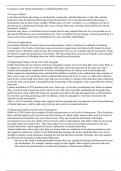
Science Reviewer 3rd Quarter
LESSON 1: NERVOUS SYSTEM Parts of the CNS
NERVOUS SYSTEM A. BRAIN
- The nervous system receives and • comprised of billions of
Relays information about activities interconnected neurons and
within the body and monitors and glia
responds to Internal and External
Changes.
Functions of the 2 Halves of the Cerebrum
Neurons
- specialized cells that carry messages
throughout the nervous system
- It is the basic functioning unit of the
Nervous System
4 FUNCTIONS:
Sensory Function - Gathers information
both from the outside world and from
inside the body.
Transmits the information to the
processing area of the brain and spinal
cord.
Integrative Function - Processes the
information to determine the best Division of the Brain
response
Motor Function - Sends information to
muscles, glands, and organs so they can
respond correctly. Muscular contraction
or glandular secretions.
2 MAJOR DIVISIONS
1. THE CENTRAL NERVOUS SYSTEM (CNS)
- Relays messages, processes
information, and compares and 1. Forebrain
analyzes information Telencephalon (Cerebrum)
- It consist of the brain and the spinal - Conscious thought processes,
cord intellectual functions
,Science Reviewer 3rd Quarter
- Conscious and Subconscious Functions of the Different Parts of the
regulation of skeletal muscle Brain
contraction.
Diencephalon
Thalamus – relay and proce-
ssing centers for sensory
information.
Hypothalamus – Centers
controlling emotions, auto-
nomic functions, and horm-
one production.
2. Midbrain
Mesencephalon (Midbrain)
Lobes of the Brain
- Processing of Visual and
Auditory data.
- Generation of reflexive soma-
tic motor responses.
3. Hindbrain
Metencephalon
(Cerebellum)
- Coordinates complex somatic
motor patterns
- Adjust output of other
somatic motor centers in the
brain and spinal cord. B. SPINAL CORD
(Pons)
- Relays sensory information to
cerebellum and thalamus
- Subconscious Somatic and
Visceral motor centers.
Myelencephalon (Medulla
Oblongata)
- Relays sensory information to
thalamus
- Autonomic centers for
regulation of visceral func-
tions such as cardiovascular,
respiratory, etc.
, Science Reviewer 3rd Quarter
2. PERIPHERAL NERVOUS SYSTEM TYPES OF NEURONS
- connects the central nervous system to 1. Sensory Neuron
the organs and other body parts
Receptor
Subdivisions bring messages to CNS
afferent neuron
a) Sensory Division - carries info to the
brain and spinal cord. 2. Motor Neuron
b) Motor Division - carries info from the
Carry impulses from the brain and spinal
brain to the bodies effectors (things that
cord to MUSCLES or GLANDS.
do the work)
Muscles contract
Somatic nerves relay commands to Glands secrete
and from skeletal muscle (VOLUNT- efferent neuron
ARY CONTROL) 3. Interneuron
Parts:
1. Spinal Nerves spinal cord and Connects sensory & motor neurons
body Found entirely within the Central
2. Cranial Nerves brain stem Nervous System
Autonomic nerves send signals to
and from smooth muscles
(INVOLUNTARY CONTROL)
Subdivision:
1. Sympathetic under stress
2. Parasympathetic return to no-
rmal or relaxed mode
PARTS OF A NEURON
Dendrites
- Receive stimulus and carries impulses
toward the cell body
Cell Body
- Contains nucleus & most of cytoplasm
- Performs most of the metabolic activity
of the cell, including the generation of
LESSON 2: NEURONS
ATP and synthesis of protein
NEURON Axon
- Basic functional cell of nervous system
- Fiber which carries impulses away from
- Messages take the form of electrical
the cell body
signals, and are known as IMPULSES.
- A Neuron carries impulses in only ONE - Ends in a series of small swellings called
direction. axon terminals
LESSON 1: NERVOUS SYSTEM Parts of the CNS
NERVOUS SYSTEM A. BRAIN
- The nervous system receives and • comprised of billions of
Relays information about activities interconnected neurons and
within the body and monitors and glia
responds to Internal and External
Changes.
Functions of the 2 Halves of the Cerebrum
Neurons
- specialized cells that carry messages
throughout the nervous system
- It is the basic functioning unit of the
Nervous System
4 FUNCTIONS:
Sensory Function - Gathers information
both from the outside world and from
inside the body.
Transmits the information to the
processing area of the brain and spinal
cord.
Integrative Function - Processes the
information to determine the best Division of the Brain
response
Motor Function - Sends information to
muscles, glands, and organs so they can
respond correctly. Muscular contraction
or glandular secretions.
2 MAJOR DIVISIONS
1. THE CENTRAL NERVOUS SYSTEM (CNS)
- Relays messages, processes
information, and compares and 1. Forebrain
analyzes information Telencephalon (Cerebrum)
- It consist of the brain and the spinal - Conscious thought processes,
cord intellectual functions
,Science Reviewer 3rd Quarter
- Conscious and Subconscious Functions of the Different Parts of the
regulation of skeletal muscle Brain
contraction.
Diencephalon
Thalamus – relay and proce-
ssing centers for sensory
information.
Hypothalamus – Centers
controlling emotions, auto-
nomic functions, and horm-
one production.
2. Midbrain
Mesencephalon (Midbrain)
Lobes of the Brain
- Processing of Visual and
Auditory data.
- Generation of reflexive soma-
tic motor responses.
3. Hindbrain
Metencephalon
(Cerebellum)
- Coordinates complex somatic
motor patterns
- Adjust output of other
somatic motor centers in the
brain and spinal cord. B. SPINAL CORD
(Pons)
- Relays sensory information to
cerebellum and thalamus
- Subconscious Somatic and
Visceral motor centers.
Myelencephalon (Medulla
Oblongata)
- Relays sensory information to
thalamus
- Autonomic centers for
regulation of visceral func-
tions such as cardiovascular,
respiratory, etc.
, Science Reviewer 3rd Quarter
2. PERIPHERAL NERVOUS SYSTEM TYPES OF NEURONS
- connects the central nervous system to 1. Sensory Neuron
the organs and other body parts
Receptor
Subdivisions bring messages to CNS
afferent neuron
a) Sensory Division - carries info to the
brain and spinal cord. 2. Motor Neuron
b) Motor Division - carries info from the
Carry impulses from the brain and spinal
brain to the bodies effectors (things that
cord to MUSCLES or GLANDS.
do the work)
Muscles contract
Somatic nerves relay commands to Glands secrete
and from skeletal muscle (VOLUNT- efferent neuron
ARY CONTROL) 3. Interneuron
Parts:
1. Spinal Nerves spinal cord and Connects sensory & motor neurons
body Found entirely within the Central
2. Cranial Nerves brain stem Nervous System
Autonomic nerves send signals to
and from smooth muscles
(INVOLUNTARY CONTROL)
Subdivision:
1. Sympathetic under stress
2. Parasympathetic return to no-
rmal or relaxed mode
PARTS OF A NEURON
Dendrites
- Receive stimulus and carries impulses
toward the cell body
Cell Body
- Contains nucleus & most of cytoplasm
- Performs most of the metabolic activity
of the cell, including the generation of
LESSON 2: NEURONS
ATP and synthesis of protein
NEURON Axon
- Basic functional cell of nervous system
- Fiber which carries impulses away from
- Messages take the form of electrical
the cell body
signals, and are known as IMPULSES.
- A Neuron carries impulses in only ONE - Ends in a series of small swellings called
direction. axon terminals