FOR MORE HIGH-QUALITY PAST PAPER MODEL ANSWERS, ONLINE TUTORING AND
ECONOMICS HELP, visit LondonEconomicsTutors.co.uk.
Discounted prices compared to all other websites
ECN226 Capital Markets 1 – 2014
Questions and Answers
Question 1
a)
Accrued interest is the interest on a bond or loan that has accumulated since the principal
investment, or since the previous coupon payment if there has been one already.
For a financial instrument such as a bond, interest is calculated and paid in set intervals (for instance
annually or semi-annually). Ownership of bonds/loans can be transferred between different
investors not just when coupons are paid, but at any time in-between coupons. Accrued interest
addresses the problem regarding the ownership of the next coupon if the bond is sold in the period
between coupons: Only the current owner can receive the coupon payment, but the investor who
sold the bond must be compensated for the period of time for which he or she owned the bond. In
other words, the previous owner must be paid the interest that accrued before the sale.
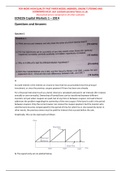
Graphically, this can be expressed as follows:
b) The opportunity set are plotted below.
, FOR MORE HIGH-QUALITY PAST PAPER MODEL ANSWERS, ONLINE TUTORING AND
ECONOMICS HELP, visit LondonEconomicsTutors.co.uk.
Discounted prices compared to all other websites
c) The efficient market hypothesis posits that security prices fully reflect all available information, so
it is impossible to make economic profits by trading on that information. It theorises that investors
will spend time and resources to gather and process information only if this activity is likely to
generate higher investment returns. Competition among analysis ensures that stock prices ought to
reflect available information.
Testing the EMT does not make much sense as the conditions in the financial markets are much
more complex than the simplified conditions of perfect competition, zero transaction costs and free
information used in the formulation of the EMH. There are a number of market anomalies which are
price and/or rate of return distortions which contradict the efficient-market hypothesis. Some
examples of these are calendar effects, a lack of market transparency, and the “small-cap effect”. All
of these mean that real-life markets deviate considerably from those assumed by the EMT. Further,
it is difficult to test whether prices deviate from their “fundamental” prices because “fundamental”
prices are a theoretical construct. These cannot be measured, and therefore deviations from these
fundamental prices also cannot be measured.
d) The capital market line equation can be written as follows:
𝐸[𝑅 ] − 𝑅
𝐸[𝑅 ] = 𝑅 + 𝑆𝐷
𝑆𝐷
The Security Market Line equation can be written as follows:
𝐸[𝑅 ] = 𝑅 + 𝛽 [𝐸[𝑅 ] − 𝑅 ]
The main differences between the two are that the CML plots the risk premium of efficient
portfolios as a function of the portfolio standard deviation. The SML, on the other hand, plots the
risk premium of an individual asset as a function of beta. Beta is the appropriate measure of risk for
an individual asset held as part of a diversified portfolio. Another difference is that the Capital
Market Line graphs define efficient portfolios, the Security Market Line graphs define both efficient
and non-efficient portfolios. Further, the CML measures the risk through standard deviation, or
through a total risk factor. On the other hand, the SML measures the risk through beta, which helps
to find the security’s risk contribution for the portfolio.
ECONOMICS HELP, visit LondonEconomicsTutors.co.uk.
Discounted prices compared to all other websites
ECN226 Capital Markets 1 – 2014
Questions and Answers
Question 1
a)
Accrued interest is the interest on a bond or loan that has accumulated since the principal
investment, or since the previous coupon payment if there has been one already.
For a financial instrument such as a bond, interest is calculated and paid in set intervals (for instance
annually or semi-annually). Ownership of bonds/loans can be transferred between different
investors not just when coupons are paid, but at any time in-between coupons. Accrued interest
addresses the problem regarding the ownership of the next coupon if the bond is sold in the period
between coupons: Only the current owner can receive the coupon payment, but the investor who
sold the bond must be compensated for the period of time for which he or she owned the bond. In
other words, the previous owner must be paid the interest that accrued before the sale.
Graphically, this can be expressed as follows:
b) The opportunity set are plotted below.
, FOR MORE HIGH-QUALITY PAST PAPER MODEL ANSWERS, ONLINE TUTORING AND
ECONOMICS HELP, visit LondonEconomicsTutors.co.uk.
Discounted prices compared to all other websites
c) The efficient market hypothesis posits that security prices fully reflect all available information, so
it is impossible to make economic profits by trading on that information. It theorises that investors
will spend time and resources to gather and process information only if this activity is likely to
generate higher investment returns. Competition among analysis ensures that stock prices ought to
reflect available information.
Testing the EMT does not make much sense as the conditions in the financial markets are much
more complex than the simplified conditions of perfect competition, zero transaction costs and free
information used in the formulation of the EMH. There are a number of market anomalies which are
price and/or rate of return distortions which contradict the efficient-market hypothesis. Some
examples of these are calendar effects, a lack of market transparency, and the “small-cap effect”. All
of these mean that real-life markets deviate considerably from those assumed by the EMT. Further,
it is difficult to test whether prices deviate from their “fundamental” prices because “fundamental”
prices are a theoretical construct. These cannot be measured, and therefore deviations from these
fundamental prices also cannot be measured.
d) The capital market line equation can be written as follows:
𝐸[𝑅 ] − 𝑅
𝐸[𝑅 ] = 𝑅 + 𝑆𝐷
𝑆𝐷
The Security Market Line equation can be written as follows:
𝐸[𝑅 ] = 𝑅 + 𝛽 [𝐸[𝑅 ] − 𝑅 ]
The main differences between the two are that the CML plots the risk premium of efficient
portfolios as a function of the portfolio standard deviation. The SML, on the other hand, plots the
risk premium of an individual asset as a function of beta. Beta is the appropriate measure of risk for
an individual asset held as part of a diversified portfolio. Another difference is that the Capital
Market Line graphs define efficient portfolios, the Security Market Line graphs define both efficient
and non-efficient portfolios. Further, the CML measures the risk through standard deviation, or
through a total risk factor. On the other hand, the SML measures the risk through beta, which helps
to find the security’s risk contribution for the portfolio.