Economics for political scientists
Test – Friday 21st December
70% - multiple choice
30% - calculations + short answers
Lecture one - Economic growth and inequality
Inequalities within and between countries
Using statistics, we can measure inequality in many ways, the most
powerful way to do it is to rank everyone in the world by income, from the
richest to the poorest.
Differences between the rich and the poor are huge within every
country;
Between states, these inequalities are rather big (Norway is the most
equal country but the poorest 10% in Norway
receive on average almost twice the income of
the richest 10% in Nigeria).
Measuring incomes (GDP)
Gross domestic product (GDP): the total/market
value of all finished goods and services produced
in a country in a given period, such as a year
(doesn’t include capital goods).
To make meaningful comparisons we need to
Divide a country’s total GDP by its population (GDP per capita);
Correct for changes in spending power, influenced by inflation, within
the country (real/ constant GDP, rather than nominal GDP);
Measure in a common unit like the US dollar;
Use Purchasing power parity (PPP) to reflect the changes across
countries and time
Economic growth
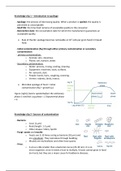
Annual growth rate of real GDP (in year t): ‘Hockey Stick’ diagram shows a
booming of the economy since 1800s. This led atmospheric CO2 to also
grow exponentially.
When we see growth reported, it is often reported as the average rate
during a period of years. This is the case whether it is the growth of the
economy (real GDP growth) or the growth of incomes (real GDP per
capita).
Economic growth increases in: natural resource discovery, physical
capital/infrastructure; population; human capital; technology; law.
Short term causes due to economic growth
, External shocks;
Government monetary or fiscal policy;
Consumer/business sentiment;
Capitalism
The explosion in growth rates correlates with the adoption of different
economic systems, predominantly capitalism. This allied with the
permanent technological revolution that the Enlightenment brought,
enhanced the affluence in the world.
Capitalism: An economic system in which private property, markets, and
firms play an important role.
Elements of capitalism
Private property (the right and expectation that one can enjoy one’s
possessions in ways of one’s own choosing, exclude others from their
use, and dispose of them by gi or sale to others who then become their
owners);
Markets (a reciprocated, voluntary and competitive way of connecting
people who may mutually benefit by exchanging goods or services
through a process of buying and selling and not trough governments)
Private firms (business organization which pays wages and salaries to
employ people, and purchases inputs, to produce and market goods
and services with the intention of making a profit).
What does capitalism give us?
Division of labour (The specialisation of producers to carry out different
tasks in the production process);
Specialisation (This takes place when an individual, country or some
other entity produces a more narrow range of goods and services than
it consumes, acquiring the goods and services that it does not produce
by trade - concerning that self sufficiency is the road to poverty);
Entrepreneurial innovators;
New technology (improves economies and living standards);
Creative destruction: old technologies and the firms that do not adapt are
swept away by the new, because they cannot compete in the market by
selling goods at a price that covers the cost of production
->
Incentivises cost-reducing innovation.
->
Leads to greater inequalities —> Capitalism is a system of winners and
losers.
Democracy
Democracy has many definitions, but generally and ideally it includes:
, Gives equal political power to all citizens: this power is defined by
individual rights such as freedom of speech, assembly, and the press;
Selects political leaders by means of elections: in these elections,
virtually all adults are eligible to vote, and the governing party leaves
office if it loses;
By giving individuals power to choose their economic system, they
generally opt to secure property rights and prevent non-competitive
forces.
In a nutshell, capitalism can be a dynamic economic system when it
combines:
Private incentives for cost-reducing innovation: these are derived from
market competition and secure private property;
Public policy supporting these conditions: governments enforce laws
and provide regulation;
Public policy that supplies essential goods and services: these may not
be provided in sufficient quantities by private firms, and include
education and basic research;
Lecture 2 – Social interactions and economic outcomes
Social interaction
Economic and political actors don’t act in isolation;
Our actions impact others and vice-versa;
This produces opportunity (gains) and conflict (losses);
Game theory
This interaction can be explained by a framework labelled as “Game
Theory” (an analytical tool of social science used to examine strategic
interaction between rational individuals or groups);
Assumes that rational individuals act strategically self-help)
People don’t act rationally all the time;
This way of modelling how people interact with each other includes:
Strategic Interaction- A situation in which my optimal decision depends
on what others do, and vice versa.
Game- Is a formal model of strategic interaction. It accounts for:
- Player - A participant in the game.
- Strategy - A detailed plan of action (it may even plan for reactions to
others’ actions in dynamic settings) for strategic interactions.
- Payoff- The final utility the player obtains in the game as a
consequence of all the players’ strategies.
Equilibrium- The analysts’ prediction for a solution of the game.
To understand social dilemmas, and how they might be avoided, we
distinguish between two classes of preferences:
Test – Friday 21st December
70% - multiple choice
30% - calculations + short answers
Lecture one - Economic growth and inequality
Inequalities within and between countries
Using statistics, we can measure inequality in many ways, the most
powerful way to do it is to rank everyone in the world by income, from the
richest to the poorest.
Differences between the rich and the poor are huge within every
country;
Between states, these inequalities are rather big (Norway is the most
equal country but the poorest 10% in Norway
receive on average almost twice the income of
the richest 10% in Nigeria).
Measuring incomes (GDP)
Gross domestic product (GDP): the total/market
value of all finished goods and services produced
in a country in a given period, such as a year
(doesn’t include capital goods).
To make meaningful comparisons we need to
Divide a country’s total GDP by its population (GDP per capita);
Correct for changes in spending power, influenced by inflation, within
the country (real/ constant GDP, rather than nominal GDP);
Measure in a common unit like the US dollar;
Use Purchasing power parity (PPP) to reflect the changes across
countries and time
Economic growth
Annual growth rate of real GDP (in year t): ‘Hockey Stick’ diagram shows a
booming of the economy since 1800s. This led atmospheric CO2 to also
grow exponentially.
When we see growth reported, it is often reported as the average rate
during a period of years. This is the case whether it is the growth of the
economy (real GDP growth) or the growth of incomes (real GDP per
capita).
Economic growth increases in: natural resource discovery, physical
capital/infrastructure; population; human capital; technology; law.
Short term causes due to economic growth
, External shocks;
Government monetary or fiscal policy;
Consumer/business sentiment;
Capitalism
The explosion in growth rates correlates with the adoption of different
economic systems, predominantly capitalism. This allied with the
permanent technological revolution that the Enlightenment brought,
enhanced the affluence in the world.
Capitalism: An economic system in which private property, markets, and
firms play an important role.
Elements of capitalism
Private property (the right and expectation that one can enjoy one’s
possessions in ways of one’s own choosing, exclude others from their
use, and dispose of them by gi or sale to others who then become their
owners);
Markets (a reciprocated, voluntary and competitive way of connecting
people who may mutually benefit by exchanging goods or services
through a process of buying and selling and not trough governments)
Private firms (business organization which pays wages and salaries to
employ people, and purchases inputs, to produce and market goods
and services with the intention of making a profit).
What does capitalism give us?
Division of labour (The specialisation of producers to carry out different
tasks in the production process);
Specialisation (This takes place when an individual, country or some
other entity produces a more narrow range of goods and services than
it consumes, acquiring the goods and services that it does not produce
by trade - concerning that self sufficiency is the road to poverty);
Entrepreneurial innovators;
New technology (improves economies and living standards);
Creative destruction: old technologies and the firms that do not adapt are
swept away by the new, because they cannot compete in the market by
selling goods at a price that covers the cost of production
->
Incentivises cost-reducing innovation.
->
Leads to greater inequalities —> Capitalism is a system of winners and
losers.
Democracy
Democracy has many definitions, but generally and ideally it includes:
, Gives equal political power to all citizens: this power is defined by
individual rights such as freedom of speech, assembly, and the press;
Selects political leaders by means of elections: in these elections,
virtually all adults are eligible to vote, and the governing party leaves
office if it loses;
By giving individuals power to choose their economic system, they
generally opt to secure property rights and prevent non-competitive
forces.
In a nutshell, capitalism can be a dynamic economic system when it
combines:
Private incentives for cost-reducing innovation: these are derived from
market competition and secure private property;
Public policy supporting these conditions: governments enforce laws
and provide regulation;
Public policy that supplies essential goods and services: these may not
be provided in sufficient quantities by private firms, and include
education and basic research;
Lecture 2 – Social interactions and economic outcomes
Social interaction
Economic and political actors don’t act in isolation;
Our actions impact others and vice-versa;
This produces opportunity (gains) and conflict (losses);
Game theory
This interaction can be explained by a framework labelled as “Game
Theory” (an analytical tool of social science used to examine strategic
interaction between rational individuals or groups);
Assumes that rational individuals act strategically self-help)
People don’t act rationally all the time;
This way of modelling how people interact with each other includes:
Strategic Interaction- A situation in which my optimal decision depends
on what others do, and vice versa.
Game- Is a formal model of strategic interaction. It accounts for:
- Player - A participant in the game.
- Strategy - A detailed plan of action (it may even plan for reactions to
others’ actions in dynamic settings) for strategic interactions.
- Payoff- The final utility the player obtains in the game as a
consequence of all the players’ strategies.
Equilibrium- The analysts’ prediction for a solution of the game.
To understand social dilemmas, and how they might be avoided, we
distinguish between two classes of preferences: