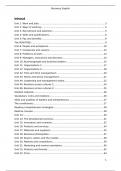
Strategy, Structure & Management of the
Multi-National Enterprises 2019-2020
Table of contents
part 1: MNE nature......................................................................................................................................... 2
1.1 essence, role and types of MNC..................................................................................................................... 2
quiz ................................................................................................................................................................ 10
1.2 MNC models: headquarter-subsidiary relations .......................................................................................... 12
1.2.1 HQ-Subsidiary relation design as a response to internal forces ........................................................... 13
1.2.2 Overview: Roles of foreign subsidiaries ................................................................................................ 14
quiz ................................................................................................................................................................ 17
1.3 traditional internationalization theories ..................................................................................................... 19
Quiz ................................................................................................................................................................ 23
part 2: MNE activities ................................................................................................................................... 24
2.1 the global factory ........................................................................................................................................ 24
2.2 market entry, growth, exit........................................................................................................................... 24
2.3 managing the global value chain ................................................................................................................ 32
2.4 innovation and international technology development .............................................................................. 32
Reading: building effective R&D capabilities abroad ........................................................................................ 42
1. adopting a global approach to R&D ........................................................................................................... 42
2. Establishing a new R&D facility .................................................................................................................. 43
3. integrating the global R&D network .......................................................................................................... 44
Reading: Outsourcing and industrial decline ..................................................................................................... 44
1. the process of decline ................................................................................................................................ 45
2. the logic of decline..................................................................................................................................... 46
3. towards a strategic view of sourcing ......................................................................................................... 47
part 3: mne relations .................................................................................................................................... 48
3.1 mne-government relations .......................................................................................................................... 48
3.2 mne competitive dynamics .......................................................................................................................... 57
3.3 international strategic alliances .................................................................................................................. 69
Exam questions example .............................................................................................................................. 76
Exam questions 2019-2020 ........................................................................................................................... 76
Quick written overiew .................................................................................................................................. 77
1
,PART 1: MNE NATURE
1.1 ESSENCE, ROLE AND TYPES OF MNC
Objectives
1. Discuss the core features of a MNE that sets it apart from purely domestic firms
2. Critically discuss the role of MNEs in contemporary societies
3. Get to know variations of the classical MNE model
• What is a Multinational Enterprise?
o “A multinational enterprise (MNE) is a business firm that sets strategy and manages operations for the
development and utilization of income-generating assets in more than one country in the pursuit of
profits over time.” (Teece, 2014: 8)
o “Corporations which have their home in one country but which operate and live under the laws and
customs of other countries as well” (Lilienthal, 1960: 119)
o Short: Multinational enterprise (MNE) - a business firm that owns income-generating assets in two or
more countries, controlled from a home base.
• Core Characteristics
o Home base – host country
o “Liability of foreignness”
§ Liability of foreignness is a core element of international firms (e.g. liability in participation
when your English in not good/ come)
§ Example: Home in Belgium, after also in Island and thus maybe a liability of foreignness in
comparison with companies in Island (they have more knowledge about doing business in
Island)
o Geographical spread of own operations and inter-organizational relations
§ HQ-subsidiary relations
§ Supplier/customer/government relations
§ Multimarket contact
• Synonym: Multi point competition
• Same industry, different multinational
o For Example: Pepsi and Coca Cola who operate and compete in same
countries (maybe not 100% overlap but most of them for sure) and are
meeting in same markets
• When you meet a rival in many different places, then you have a history of
competition. So, you know how it will react
• 2 elements
o Familiarity (you know each other)
o D…
When Pepsi lower their price in a market, then Coca Cola can lower their
price in the same market or in another market
o Diversity of pressures
§ Internal: centralized control vs. local management
• Centralized control: all control in HQ and subsidiaries have to follow
• Local management = a lot of autonomy in subsidiaries
§ External: Local adaptation vs. global scale
• Local adaption = provide specific items for each country (adapt product range)
• Global scale = same products everywhere and have scale economies
2
, • Single “normative” types of MNEs
o Heterarchy (Hedlund)
Multicentral, mix of different centers, brain metaphor, holographic orientation, lateral communication,
indirect and normative coordination mechanisms, coalitions with other organizations, etc.
§ Heteracrhy is problamatic
o Diversified Multinational Corporation (Doz & Prahalad)
Characterized by multidimensionality and heterogeneity which lead to seven distinct characteristics:
§ (1) structural undeterminacy,
§ (2) internal differentiation,
§ (3) integrative optimization,
§ (4) information intensity,
§ (5) latent linkages,
§ (6) networked organization/ fuzzy boundaries,
§ (7) learning and continuity
o Horizontal organization (White & Poynter)
Lateral decision processes, horizontal network (as opposed to hierarchy), common ground for decision
making (values and norms)
o Some parrallels between 1 and 2
o Which one would you choose as a CEO? Not clear.
• The network idea in MNE conceptualizations
White and Poynter’s Horizontal
Organization in comparison
• White and Poynter’s Horizontal Organization in comparison
Horizontal Form Vertical Form
Coordination Horizontal to other Vertical through
value adding units authority hierarchy
Basic organizing unit Value adding activity Business unit, product
group, area unit, etc.
Organizational Dynamic/flexible Static/specified
relationships
Decisions made by International teams Managers with
formal authority
Power Shared with Used over
Basis for internal Market mechanism, Plans, rules, limited
interactions trust, full disclosure disclosure
Source: White & Poynter (1989): 86.
• Classical Typologies of MNEs
7 MNE types based on criteria: SSMNE | 2019 | Albers
o Top management attitudes and management philosophy:
EPG Model (Perlmutter 1960, Heenan/Perlmutter 1979)
o Strategic orientation as response to industry forces: International, local, global, transnational (“glocal”)
(Bartlett/Ghoshal 1989)
3
,Classical typology 1: EPG model
• The EP(R)G Typology
EP(R)G Model: Type Illustration
Characteristics are: complexity, authority, incentives, communication, identification and perpetuation
• EP(R)G Model: Type Illustration
The ethnocentric firm The geocentric firm The polycentric firm
Ethnocentric polycentric (R) geocentric centric
o The ethnocentric firm = dominated by home firm
§ Headquarter and subsidiaries, where there is only a line that comes out of headquarter.
§ Home market/ what headquarter says is correct, and is determinate for elsewhere (in the
subsidiaries)
o The polycentric firm
§ Subsidiaries are structured, managed according to recommendations/ assessments/
10
evaluations of subsidiaries management à local
SSMNE management
| 2019 | Albers
§ Looser relation from headquarter to subsidiaries
o The geocentric firm
§ Arrows running around everywhere. There is a center and subsidiaries, but there is a lot of
exchange and mélange. Input from both sides, and even between subsidiaries !
o R (modern interpretation), R centric = Clusters of subsidiaries, that are coordination closely and after
going to headquarter
4
, • EP(R)G Model: Geocentrism Forces
The Bartlett & Ghoshal Typology
Classical typology 2
• The Bartlett & Ghoshal Typology
Forces for global integration (efficiency)
Global Transnational
High Organization Organization
International Multinational
Organization Organization
Low
Low High
Forces for national differentiation (responsiveness)
o Pressure/force differ by industry. Stronger forces of being responsive or weaker depending on
conditions in industry
12 o Responsiveness doesn’t go well with efficiency. SSMNE | 2019 | Albers
o How do we organize the multinational? 3 elements:
§ Downstreet part of activities (marketing, sales)
§ Upstreet part of activities (production),
§ and third element are the supporting functions (administration/HR/accounting /R&D)
o International organization: upstreet is at home because a traditional company, downstreet could be in
different host countries (in some or all, depending of relevance) but could also do a lot of marketing at
home, supporting functions is in home country. A lot in home country because it comes from home.
§ E.g. design label (limited production and high prices)
o Multinational organization: supporting functions every market gets their own mini firm, local sales and
local production and thus also local R&D. Every enterprise is a clown
§ E.g. Danone
o Global organization: downstreet, upstreet, supporting functions is everything at home to save costs
because you standardize and centralize at 1 place (more savings by spreading activities over nations, so
yes, all activities at 1 place but not necessary at home country).
§ Eg shared services at Poland, R&D in Denmark.
§ E.g. global aircraft industry (Boeing), Coca Cola etc
o Transnational organization (GLOCAL): mixture of everything where subsidiaries share competences for
some activities, and they have to share these competences to maximize efficiency (eg combination of
India and Poland etc)
§ E.g. pharmaceutical companies, technological companies (that go away from customers) à a
lot of different input
o Why is this a decision problem? We answer this question later.
5
Multi-National Enterprises 2019-2020
Table of contents
part 1: MNE nature......................................................................................................................................... 2
1.1 essence, role and types of MNC..................................................................................................................... 2
quiz ................................................................................................................................................................ 10
1.2 MNC models: headquarter-subsidiary relations .......................................................................................... 12
1.2.1 HQ-Subsidiary relation design as a response to internal forces ........................................................... 13
1.2.2 Overview: Roles of foreign subsidiaries ................................................................................................ 14
quiz ................................................................................................................................................................ 17
1.3 traditional internationalization theories ..................................................................................................... 19
Quiz ................................................................................................................................................................ 23
part 2: MNE activities ................................................................................................................................... 24
2.1 the global factory ........................................................................................................................................ 24
2.2 market entry, growth, exit........................................................................................................................... 24
2.3 managing the global value chain ................................................................................................................ 32
2.4 innovation and international technology development .............................................................................. 32
Reading: building effective R&D capabilities abroad ........................................................................................ 42
1. adopting a global approach to R&D ........................................................................................................... 42
2. Establishing a new R&D facility .................................................................................................................. 43
3. integrating the global R&D network .......................................................................................................... 44
Reading: Outsourcing and industrial decline ..................................................................................................... 44
1. the process of decline ................................................................................................................................ 45
2. the logic of decline..................................................................................................................................... 46
3. towards a strategic view of sourcing ......................................................................................................... 47
part 3: mne relations .................................................................................................................................... 48
3.1 mne-government relations .......................................................................................................................... 48
3.2 mne competitive dynamics .......................................................................................................................... 57
3.3 international strategic alliances .................................................................................................................. 69
Exam questions example .............................................................................................................................. 76
Exam questions 2019-2020 ........................................................................................................................... 76
Quick written overiew .................................................................................................................................. 77
1
,PART 1: MNE NATURE
1.1 ESSENCE, ROLE AND TYPES OF MNC
Objectives
1. Discuss the core features of a MNE that sets it apart from purely domestic firms
2. Critically discuss the role of MNEs in contemporary societies
3. Get to know variations of the classical MNE model
• What is a Multinational Enterprise?
o “A multinational enterprise (MNE) is a business firm that sets strategy and manages operations for the
development and utilization of income-generating assets in more than one country in the pursuit of
profits over time.” (Teece, 2014: 8)
o “Corporations which have their home in one country but which operate and live under the laws and
customs of other countries as well” (Lilienthal, 1960: 119)
o Short: Multinational enterprise (MNE) - a business firm that owns income-generating assets in two or
more countries, controlled from a home base.
• Core Characteristics
o Home base – host country
o “Liability of foreignness”
§ Liability of foreignness is a core element of international firms (e.g. liability in participation
when your English in not good/ come)
§ Example: Home in Belgium, after also in Island and thus maybe a liability of foreignness in
comparison with companies in Island (they have more knowledge about doing business in
Island)
o Geographical spread of own operations and inter-organizational relations
§ HQ-subsidiary relations
§ Supplier/customer/government relations
§ Multimarket contact
• Synonym: Multi point competition
• Same industry, different multinational
o For Example: Pepsi and Coca Cola who operate and compete in same
countries (maybe not 100% overlap but most of them for sure) and are
meeting in same markets
• When you meet a rival in many different places, then you have a history of
competition. So, you know how it will react
• 2 elements
o Familiarity (you know each other)
o D…
When Pepsi lower their price in a market, then Coca Cola can lower their
price in the same market or in another market
o Diversity of pressures
§ Internal: centralized control vs. local management
• Centralized control: all control in HQ and subsidiaries have to follow
• Local management = a lot of autonomy in subsidiaries
§ External: Local adaptation vs. global scale
• Local adaption = provide specific items for each country (adapt product range)
• Global scale = same products everywhere and have scale economies
2
, • Single “normative” types of MNEs
o Heterarchy (Hedlund)
Multicentral, mix of different centers, brain metaphor, holographic orientation, lateral communication,
indirect and normative coordination mechanisms, coalitions with other organizations, etc.
§ Heteracrhy is problamatic
o Diversified Multinational Corporation (Doz & Prahalad)
Characterized by multidimensionality and heterogeneity which lead to seven distinct characteristics:
§ (1) structural undeterminacy,
§ (2) internal differentiation,
§ (3) integrative optimization,
§ (4) information intensity,
§ (5) latent linkages,
§ (6) networked organization/ fuzzy boundaries,
§ (7) learning and continuity
o Horizontal organization (White & Poynter)
Lateral decision processes, horizontal network (as opposed to hierarchy), common ground for decision
making (values and norms)
o Some parrallels between 1 and 2
o Which one would you choose as a CEO? Not clear.
• The network idea in MNE conceptualizations
White and Poynter’s Horizontal
Organization in comparison
• White and Poynter’s Horizontal Organization in comparison
Horizontal Form Vertical Form
Coordination Horizontal to other Vertical through
value adding units authority hierarchy
Basic organizing unit Value adding activity Business unit, product
group, area unit, etc.
Organizational Dynamic/flexible Static/specified
relationships
Decisions made by International teams Managers with
formal authority
Power Shared with Used over
Basis for internal Market mechanism, Plans, rules, limited
interactions trust, full disclosure disclosure
Source: White & Poynter (1989): 86.
• Classical Typologies of MNEs
7 MNE types based on criteria: SSMNE | 2019 | Albers
o Top management attitudes and management philosophy:
EPG Model (Perlmutter 1960, Heenan/Perlmutter 1979)
o Strategic orientation as response to industry forces: International, local, global, transnational (“glocal”)
(Bartlett/Ghoshal 1989)
3
,Classical typology 1: EPG model
• The EP(R)G Typology
EP(R)G Model: Type Illustration
Characteristics are: complexity, authority, incentives, communication, identification and perpetuation
• EP(R)G Model: Type Illustration
The ethnocentric firm The geocentric firm The polycentric firm
Ethnocentric polycentric (R) geocentric centric
o The ethnocentric firm = dominated by home firm
§ Headquarter and subsidiaries, where there is only a line that comes out of headquarter.
§ Home market/ what headquarter says is correct, and is determinate for elsewhere (in the
subsidiaries)
o The polycentric firm
§ Subsidiaries are structured, managed according to recommendations/ assessments/
10
evaluations of subsidiaries management à local
SSMNE management
| 2019 | Albers
§ Looser relation from headquarter to subsidiaries
o The geocentric firm
§ Arrows running around everywhere. There is a center and subsidiaries, but there is a lot of
exchange and mélange. Input from both sides, and even between subsidiaries !
o R (modern interpretation), R centric = Clusters of subsidiaries, that are coordination closely and after
going to headquarter
4
, • EP(R)G Model: Geocentrism Forces
The Bartlett & Ghoshal Typology
Classical typology 2
• The Bartlett & Ghoshal Typology
Forces for global integration (efficiency)
Global Transnational
High Organization Organization
International Multinational
Organization Organization
Low
Low High
Forces for national differentiation (responsiveness)
o Pressure/force differ by industry. Stronger forces of being responsive or weaker depending on
conditions in industry
12 o Responsiveness doesn’t go well with efficiency. SSMNE | 2019 | Albers
o How do we organize the multinational? 3 elements:
§ Downstreet part of activities (marketing, sales)
§ Upstreet part of activities (production),
§ and third element are the supporting functions (administration/HR/accounting /R&D)
o International organization: upstreet is at home because a traditional company, downstreet could be in
different host countries (in some or all, depending of relevance) but could also do a lot of marketing at
home, supporting functions is in home country. A lot in home country because it comes from home.
§ E.g. design label (limited production and high prices)
o Multinational organization: supporting functions every market gets their own mini firm, local sales and
local production and thus also local R&D. Every enterprise is a clown
§ E.g. Danone
o Global organization: downstreet, upstreet, supporting functions is everything at home to save costs
because you standardize and centralize at 1 place (more savings by spreading activities over nations, so
yes, all activities at 1 place but not necessary at home country).
§ Eg shared services at Poland, R&D in Denmark.
§ E.g. global aircraft industry (Boeing), Coca Cola etc
o Transnational organization (GLOCAL): mixture of everything where subsidiaries share competences for
some activities, and they have to share these competences to maximize efficiency (eg combination of
India and Poland etc)
§ E.g. pharmaceutical companies, technological companies (that go away from customers) à a
lot of different input
o Why is this a decision problem? We answer this question later.
5