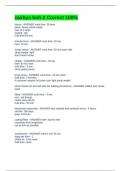
Lean Questions and Answers correct
What characteristics best describe Craft Production? (Lean Production Simplified) -
answer A workforce comprising quasi-independent tradesmen, Decentralized
organization, General-purpose machines, Low production volumes and high prices
The authors of both Lean Thinking and Lean Production Simplified demonstrate the
applicability of Lean to environments and organizations other than just manufacturing. -
answer TRUE
To which of the following does the author of Lean Production Simplified attribute what
he calls "The Growing Dysfunction" and were problems with the Mass Production
system? (Choose ALL that apply) - answer -Poor Quality - high defect rates
-Large machinery to take advantage of economies of scale
-Worker alienation
-Engineering disconnect due to specialization and removal from understanding the "big
picture" of design
In Lean Production Simplified the author provides two equations for the profit equation:
Cost + Profit margin = Price (old equation) and Price (fixed) - Cost = Profit (new
equation). He states that the new equation is the new reality because companies can no
longer simply take their costs and add profit to it to reach a price but rather they must
meet a market price. As a result the key to profitability is cost reduction. - answer
TRUE
What are examples of the waste of Overprocessing (doing more than the customer
requires) (Lean Production Simplified) - answer All of the Above
-A mountain bike produced with reflectors and other items riders immediately remove
when they get their bike home
-15 features in a software package when customers only use 7 of them
-Sanding a locker door smoother than required by the specifications
-Having a quality inspection after every toaster oven has been produced although no
defects or variations had been noted in several months
What characteristics best describe The Ford System? (Lean Production Simplified) -
answer Interchangeability and ease of assembly of parts, Reduction of actions
required by each worker, Moving assembly line
Specifying Value (Lean Principle #1) is from the perspective of the company designing
and producing the product or service. (Lean Thinking) - answer FALSE
In Lean Thinking the author uses the travel from the UK to Greece as an example of
Value from the perspective of the customer who is travelling and encompasses the
, entire Value Stream which includes multiple companies and processes. - answer
TRUE
The Eight forms of Waste (Muda) are: (Lean Production Simplified) - answer Motion,
Delay, Conveyance, Correction, Overprocessing, Inventory, Overproduction, Knowledge
Disconnection
What characteristics best describe Mass Production? (Lean Production Simplified) -
answer Standardized work, reduced cycle time, time and motion study,
measurement and analysis to continually improve the process
Taylorism is a term often synonymous with mindless and dehumanizing work and the
pioneers of lean production such as Taiichi Ohno and Shigeo Shingo completely shun
Taylor's work. (Lean Production Simplified) - answer FALSE
Specifying Value (Lean Principle #1) is not just for manufacturing but also for services
and other non-manufacturing processes. (Lean Thinking) - answer TRUE
From Lean Production Simplified, what are the Foundation, Walls, Roof, and Heart of
the Lean System - answer Stability, Standardization, Just-In-Time, Jidoka, Customer
Focus, Involvement
A central goal of the Lean System is to eliminate Waste (Muda) so as to improve
profitability (Both Texts) - answer TRUE
Taiichi Ohno thought that people were expendable and had little to offer the company.
(Lean Production Simplified) - answer FALSE
Muda or Waste is partly the idea of only that which adds value in the eyes of the
customer and everything else is Waste or non-Value Added. Which of the following is
NOT a category of Human Motion. (Lean Production Simplified) - answer Unless a
human is moving they are lazy
Overproduction can cause other wastes; one of the reasons it is considered the most
serious waste. (Lean Production Simplified) - answer TRUE
Just because an operation, step, or situation occurs that does not add value to the
product or service does not mean it is Waste (Muda), legal requirements or steps due to
outdated technology, for example. (Lean Production Simplified) - answer FALSE
Mura refers to unevenness or fluctuation in work, usually caused by fluctuating
production plans. What is NOT an example of Mura - answer Zero fluctuations in
work from shift to shift
In the section of the book Lean Production Simplified titled "A Virtue of Necessity" the
author points out that Toyota and Ohno discovered the benefits of producing smaller
What characteristics best describe Craft Production? (Lean Production Simplified) -
answer A workforce comprising quasi-independent tradesmen, Decentralized
organization, General-purpose machines, Low production volumes and high prices
The authors of both Lean Thinking and Lean Production Simplified demonstrate the
applicability of Lean to environments and organizations other than just manufacturing. -
answer TRUE
To which of the following does the author of Lean Production Simplified attribute what
he calls "The Growing Dysfunction" and were problems with the Mass Production
system? (Choose ALL that apply) - answer -Poor Quality - high defect rates
-Large machinery to take advantage of economies of scale
-Worker alienation
-Engineering disconnect due to specialization and removal from understanding the "big
picture" of design
In Lean Production Simplified the author provides two equations for the profit equation:
Cost + Profit margin = Price (old equation) and Price (fixed) - Cost = Profit (new
equation). He states that the new equation is the new reality because companies can no
longer simply take their costs and add profit to it to reach a price but rather they must
meet a market price. As a result the key to profitability is cost reduction. - answer
TRUE
What are examples of the waste of Overprocessing (doing more than the customer
requires) (Lean Production Simplified) - answer All of the Above
-A mountain bike produced with reflectors and other items riders immediately remove
when they get their bike home
-15 features in a software package when customers only use 7 of them
-Sanding a locker door smoother than required by the specifications
-Having a quality inspection after every toaster oven has been produced although no
defects or variations had been noted in several months
What characteristics best describe The Ford System? (Lean Production Simplified) -
answer Interchangeability and ease of assembly of parts, Reduction of actions
required by each worker, Moving assembly line
Specifying Value (Lean Principle #1) is from the perspective of the company designing
and producing the product or service. (Lean Thinking) - answer FALSE
In Lean Thinking the author uses the travel from the UK to Greece as an example of
Value from the perspective of the customer who is travelling and encompasses the
, entire Value Stream which includes multiple companies and processes. - answer
TRUE
The Eight forms of Waste (Muda) are: (Lean Production Simplified) - answer Motion,
Delay, Conveyance, Correction, Overprocessing, Inventory, Overproduction, Knowledge
Disconnection
What characteristics best describe Mass Production? (Lean Production Simplified) -
answer Standardized work, reduced cycle time, time and motion study,
measurement and analysis to continually improve the process
Taylorism is a term often synonymous with mindless and dehumanizing work and the
pioneers of lean production such as Taiichi Ohno and Shigeo Shingo completely shun
Taylor's work. (Lean Production Simplified) - answer FALSE
Specifying Value (Lean Principle #1) is not just for manufacturing but also for services
and other non-manufacturing processes. (Lean Thinking) - answer TRUE
From Lean Production Simplified, what are the Foundation, Walls, Roof, and Heart of
the Lean System - answer Stability, Standardization, Just-In-Time, Jidoka, Customer
Focus, Involvement
A central goal of the Lean System is to eliminate Waste (Muda) so as to improve
profitability (Both Texts) - answer TRUE
Taiichi Ohno thought that people were expendable and had little to offer the company.
(Lean Production Simplified) - answer FALSE
Muda or Waste is partly the idea of only that which adds value in the eyes of the
customer and everything else is Waste or non-Value Added. Which of the following is
NOT a category of Human Motion. (Lean Production Simplified) - answer Unless a
human is moving they are lazy
Overproduction can cause other wastes; one of the reasons it is considered the most
serious waste. (Lean Production Simplified) - answer TRUE
Just because an operation, step, or situation occurs that does not add value to the
product or service does not mean it is Waste (Muda), legal requirements or steps due to
outdated technology, for example. (Lean Production Simplified) - answer FALSE
Mura refers to unevenness or fluctuation in work, usually caused by fluctuating
production plans. What is NOT an example of Mura - answer Zero fluctuations in
work from shift to shift
In the section of the book Lean Production Simplified titled "A Virtue of Necessity" the
author points out that Toyota and Ohno discovered the benefits of producing smaller