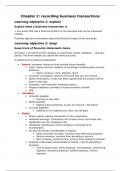
Chapter 2: recording business transactions
Learning objective 1: explain
Explain what a business transaction is
= any event that has a financial impact on the business and can be measured
reliably
Provides objective information about the financial impact of an exchange.
Learning objective 2: keep
Keep track of financial statements items
Account= a record of all the changes in a particular assets, liabilities,… during a
period. The more details you desire the more accounts.
5 elements of an financial statement:
Assets: economic resources that provide future benefits
o Cash: money and any medium of exchange including bank account
balances
Paper currency, coins, deposit, check
o Accounts receivables: amount of money that you will receive
o Notes receivables: a note has been signed that the amount will be
paid on that day
o Inventory: raw-materials, finished product,…
o Prepaid expenses: provides a future economic benefit
o PPE
Liabilities
o Accounts payable
Promise to pay debt
o Notes payable
Signed notes promising to pay an amount I the future
o Accrued liabilities
Liability for an expense you have not yet paid.
Equity
o Share capital: owners investment in the corporation
o Retained earnings: Cumulative net income minus net losses and
dividends over the company’s life.
o Dividends: Distribution of the company’s earnings to its
shareholders.
o Income (increases (shareholder’s) equity)
Sales revenue/ net sales: revenue from delivering products
Service revenue: revenue from providing a service
Rent revenue/ rental income: income from renting to tenants
o Expenses (decreases (shareholder’s) equity): cost of operating a
business
Cost of goods sold, salary expense, rent expense, advertising
expense, insurance expense, utilities expense, income
expense.
,
Learning objective 1: explain
Explain what a business transaction is
= any event that has a financial impact on the business and can be measured
reliably
Provides objective information about the financial impact of an exchange.
Learning objective 2: keep
Keep track of financial statements items
Account= a record of all the changes in a particular assets, liabilities,… during a
period. The more details you desire the more accounts.
5 elements of an financial statement:
Assets: economic resources that provide future benefits
o Cash: money and any medium of exchange including bank account
balances
Paper currency, coins, deposit, check
o Accounts receivables: amount of money that you will receive
o Notes receivables: a note has been signed that the amount will be
paid on that day
o Inventory: raw-materials, finished product,…
o Prepaid expenses: provides a future economic benefit
o PPE
Liabilities
o Accounts payable
Promise to pay debt
o Notes payable
Signed notes promising to pay an amount I the future
o Accrued liabilities
Liability for an expense you have not yet paid.
Equity
o Share capital: owners investment in the corporation
o Retained earnings: Cumulative net income minus net losses and
dividends over the company’s life.
o Dividends: Distribution of the company’s earnings to its
shareholders.
o Income (increases (shareholder’s) equity)
Sales revenue/ net sales: revenue from delivering products
Service revenue: revenue from providing a service
Rent revenue/ rental income: income from renting to tenants
o Expenses (decreases (shareholder’s) equity): cost of operating a
business
Cost of goods sold, salary expense, rent expense, advertising
expense, insurance expense, utilities expense, income
expense.
,