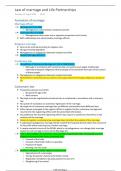
Law of marriage and Life Partnerships
Thursday, 22 August 2024 20:40
Formation of marriage
Marriage officer
Marriage Act 25 of 1961
○ Monogamous union between husband and wife.
Civil Union Act 17 of 2006
○ Monogamous union same-sex or opposite-sex partners (civil union)
Both relationships are solemnized by marriage officers.
Religious marriage
One can be married according to religious rites.
Not governed by legislation
Monogamous or polygamous between husband and wife.
Muslim Marriages Bill 2011.
Customary law
Recognition of Customary Marriage Act 120 of 1998 (RCMA)
○ Marriage in accordance with customary law, viz customs and usages traditionally
observed among the indigenous African people of SA and which form part of the culture
of those people.
Monogamous or polygamous between husband and wife.
RCMS defines customary law as customs and usages observed amongst indigenous people of
SA.
Customary law
Prospective spouses must both:
○ Be above the age of 18
○ Both consent
Marriage must be negotiated and entered into or celebrated in accordance with customary
law.
No system of mandatory or automatic registration of the marriage.
No single set of customary marriage laws as different communities have different laws.
Either spouse may apply to the register officer to register his/her customary marriage and
must furnish the registering officer with the prescribed information.
Any additional info that the registering officer may require to satisfy him-/herself as to the
existence of the marriage.
Failure to register a customary law marriage does not affect the validity of the marriage.
A subsequent polygamous marriage will be invalid if the husband did not obtain the consent of
his first wife before entering into a further marriage.
A couple married in terms of the RCMA, which is not polygamous, can change their marriage
system to civil marriage in terms of the Marriage Act.
Fanti v Boto [2008] 2 All SA 533 (C): Four essential requirements that 'inescapably must be
alleged and proved under Xhosa customary law:
○ Consent of the bride
○ Consent of the bride's father or guardian
○ Payment of lobolo
○ Handing over the bride
Southon v Moropanr (2005): Sepedi customary law
○ Appointment of a messenger
○ Visit by the groom's family to the bride's family
○ Negotiation of lobola to be paid, payment or part of it
○ Slaughtering of an animal
The "crucial element of handing over the bride", [in] the absence of which no customary
F.FP.CTI Page 1
, ○ The "crucial element of handing over the bride", [in] the absence of which no customary
marriage came into existence.
Legal consequences of marriage
The main consequence of being married is the impact on one's estate.
The consequence of the reciprocal duty of support is invariable.
Some consequences are variable in terms of antenuptial contracts
The contract must be drafted and executed by a notary and registered at the Deeds Office.
The patrimonial consequences/proprietary of a marriage are governed by the Matrimonial
Property Act 88 of 1984 (MPA).
In terms of the MPA, the marital regimes/systems provided for are:
○ Marriage in Community of Property (MICOP)
○ Marriage out of Community of Property (MOCOP)
○ Marriage out of Community of Property with Accrual (MOCOPA)
Marriage in Community of Property (MICOP)
Automatically applies if the couple did not enter into an ANC contract before solemnized their
marriage.
Applies to all forms of marriage.
In the case of customary law, the default will apply only when there is only one husband and
wife (i.e. marriage is monogamous).
If the marriage is polygamous, the law is quite complicated.
Upon marriage, both spouses' estates (assets and liabilities) are combined into one estate,
before and during marriage.
○ Assets → immovable property, moveable property, pension, funds in banks.
○ Liabilities acquired both before and during the marriage by either spouse fall into the
joint estate.
The parties are entitled to single joint administration of the estate.
Upon dissolution by death or divorce the estate is divided and each is entitled to half.
On the insolvency of one spouse, the single joint estate is sequestrated, i.e. ALL the assets are
taken over by a trustee, sold and the proceeds distributed amongst the creditors.
○ If BOTH spouses are declared insolvent by HC, which impacts contractual capacity and
also for example cannot work as an accountant.
Marriage Out of Community of Property
The parties retain separate estates, and each party administers their estate.
Upon dissolution, each spouse retains their estate.
The parties must enter into an antenuptial contract (ANC) before getting married.
○ Signed before a notary public and two witnesses.
○ Muslim marriages are automatically out of community, with no ANC needed.
○ No ANC will automatically be in community,
○ Regardless of whether it is civil or customary.
The antenuptial contract stipulates that their marriage is out of community of property and
lists their assets.
Marriage out of community of property with accrual
Same as marriage out of community of property.
However, upon dissolution, the spouse whose estate has shown the smaller accrual (growth)
during the marriage has the right to half of the value of the difference between the two
accruals at dissolution.
Inheritance, legacies, donations, liabilities, assets excluded in the ante-nuptial contract and
any amount received for non-patrimonial losses are excluded from accrual.
The accrual claim is simply a cash payment; it is not a right to co-ownership of the assets.
The parties must state the commencement value of each of their estates, if it is negative, then
NIL.
How to calculate the accrual of each spouse separately:
F.FP.CTI Page 2
Thursday, 22 August 2024 20:40
Formation of marriage
Marriage officer
Marriage Act 25 of 1961
○ Monogamous union between husband and wife.
Civil Union Act 17 of 2006
○ Monogamous union same-sex or opposite-sex partners (civil union)
Both relationships are solemnized by marriage officers.
Religious marriage
One can be married according to religious rites.
Not governed by legislation
Monogamous or polygamous between husband and wife.
Muslim Marriages Bill 2011.
Customary law
Recognition of Customary Marriage Act 120 of 1998 (RCMA)
○ Marriage in accordance with customary law, viz customs and usages traditionally
observed among the indigenous African people of SA and which form part of the culture
of those people.
Monogamous or polygamous between husband and wife.
RCMS defines customary law as customs and usages observed amongst indigenous people of
SA.
Customary law
Prospective spouses must both:
○ Be above the age of 18
○ Both consent
Marriage must be negotiated and entered into or celebrated in accordance with customary
law.
No system of mandatory or automatic registration of the marriage.
No single set of customary marriage laws as different communities have different laws.
Either spouse may apply to the register officer to register his/her customary marriage and
must furnish the registering officer with the prescribed information.
Any additional info that the registering officer may require to satisfy him-/herself as to the
existence of the marriage.
Failure to register a customary law marriage does not affect the validity of the marriage.
A subsequent polygamous marriage will be invalid if the husband did not obtain the consent of
his first wife before entering into a further marriage.
A couple married in terms of the RCMA, which is not polygamous, can change their marriage
system to civil marriage in terms of the Marriage Act.
Fanti v Boto [2008] 2 All SA 533 (C): Four essential requirements that 'inescapably must be
alleged and proved under Xhosa customary law:
○ Consent of the bride
○ Consent of the bride's father or guardian
○ Payment of lobolo
○ Handing over the bride
Southon v Moropanr (2005): Sepedi customary law
○ Appointment of a messenger
○ Visit by the groom's family to the bride's family
○ Negotiation of lobola to be paid, payment or part of it
○ Slaughtering of an animal
The "crucial element of handing over the bride", [in] the absence of which no customary
F.FP.CTI Page 1
, ○ The "crucial element of handing over the bride", [in] the absence of which no customary
marriage came into existence.
Legal consequences of marriage
The main consequence of being married is the impact on one's estate.
The consequence of the reciprocal duty of support is invariable.
Some consequences are variable in terms of antenuptial contracts
The contract must be drafted and executed by a notary and registered at the Deeds Office.
The patrimonial consequences/proprietary of a marriage are governed by the Matrimonial
Property Act 88 of 1984 (MPA).
In terms of the MPA, the marital regimes/systems provided for are:
○ Marriage in Community of Property (MICOP)
○ Marriage out of Community of Property (MOCOP)
○ Marriage out of Community of Property with Accrual (MOCOPA)
Marriage in Community of Property (MICOP)
Automatically applies if the couple did not enter into an ANC contract before solemnized their
marriage.
Applies to all forms of marriage.
In the case of customary law, the default will apply only when there is only one husband and
wife (i.e. marriage is monogamous).
If the marriage is polygamous, the law is quite complicated.
Upon marriage, both spouses' estates (assets and liabilities) are combined into one estate,
before and during marriage.
○ Assets → immovable property, moveable property, pension, funds in banks.
○ Liabilities acquired both before and during the marriage by either spouse fall into the
joint estate.
The parties are entitled to single joint administration of the estate.
Upon dissolution by death or divorce the estate is divided and each is entitled to half.
On the insolvency of one spouse, the single joint estate is sequestrated, i.e. ALL the assets are
taken over by a trustee, sold and the proceeds distributed amongst the creditors.
○ If BOTH spouses are declared insolvent by HC, which impacts contractual capacity and
also for example cannot work as an accountant.
Marriage Out of Community of Property
The parties retain separate estates, and each party administers their estate.
Upon dissolution, each spouse retains their estate.
The parties must enter into an antenuptial contract (ANC) before getting married.
○ Signed before a notary public and two witnesses.
○ Muslim marriages are automatically out of community, with no ANC needed.
○ No ANC will automatically be in community,
○ Regardless of whether it is civil or customary.
The antenuptial contract stipulates that their marriage is out of community of property and
lists their assets.
Marriage out of community of property with accrual
Same as marriage out of community of property.
However, upon dissolution, the spouse whose estate has shown the smaller accrual (growth)
during the marriage has the right to half of the value of the difference between the two
accruals at dissolution.
Inheritance, legacies, donations, liabilities, assets excluded in the ante-nuptial contract and
any amount received for non-patrimonial losses are excluded from accrual.
The accrual claim is simply a cash payment; it is not a right to co-ownership of the assets.
The parties must state the commencement value of each of their estates, if it is negative, then
NIL.
How to calculate the accrual of each spouse separately:
F.FP.CTI Page 2