VIKilill
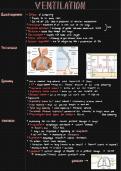
Aims & components ·
Effects of
breathing :
Supply Or to body cells
Get rid off CO2 that is produced in cellular metabolism
·
Ventilation movement of air in and out of
lungs
blood
=
the
ratio
·
alveolar diffusion of between alveai and
exchange gasses
-
Perfusion
·
flow through the
=
blood
lungs
·
Gas transport supply hole body with oxygen
=
·
Tissue diffusion of between blood sells
exchange gas and
-
·
Cellular respiration use of by cells +
production of CO2
oxygen
=
The airways
Spirometry >
-
use to measure
long volumes and capacities Static
&
> UT 'normal'
tidal volume &2500ml amount of air with
breathing
=
,
>
Inspiratory reserve volume =
extra air we can breathe in
>
Expiratory reserve volume
=
extra air we can breathe out
Residual volume-air in the lungs we can't use >
-
1100 mL
·
Capacities :
Inspiratory capacity =
tidal volume +
inspiratory reserve volume
'
Vital
Capacity max air you can breath in =
.
and out
Total vital capacity + residual volume
lung capacity
=
functional residual capacity amount of air 'usually' =
in
lungs , when you
<
Physiological dead space per breath =
150 ml start
breathing
Ventilation >
- rib case in
expending the , causes pressure changes lungs
·
Inspiration contraction & increases
diaphragm volume
=
↳ Boyle's law :
PVi =
PeVe
1
.
lungs are expended >
-
depending on compliance
air will flow resistance
.
2 -
depending on
Expiration
·
relaxese volume decreases
diaphragm
=
·
To breath : forces must overcome
> retraction forces >
-
lung (wants to be small) + thorax (Wanis to expend (
resistance forces >
- tissue +
airway
·
Compliance =
volume change in response to a
pressure change
& AU/AP
us relaxation (/ Static) volume-
pressure curve
>
-
pressures
, Static volume- pneumothorax-klaplong
pressure curve
>
- equilibrium ,
FRC = o
us transmural pressure
= 0
lung + chest wall
us transmural +5
pressure lung
=
To measure intrapleural pressure place
in the
a manometer esophagus
Lung compliance o factors involved Is alreolar
in
pressure
the
measured
mouth
· Elastin fibres
and
collagen
-
< Surface tension of alveuli
L little
layer of fluid e resultant force insidet lung gets so smal
u
Surfactand produced by type 2
lung cells -
> lowers surface tension
Airway resistanc ·
80-90 %
·
caused by friction of
gasses in airways
·
determined by :
Ohm's law: R
=Mägen-Poisevice : =
o -
Je
↳
-
8 cm MeO
intrapleural pressure
= R
Work of
breathing pressure difference put in effort
+
o to
get a
u area under the curve
expiration
·
energy that is released can be used for
·
more air flow & more resistance
·
respiratory minute volume (ventilation) =
VE =
fx VT
Part of energy of breathing lungs Triangle
·
used to expand the =
Increase in increase in and
during both breathing
&
·
resistance in work out
· Increase in compliance easier
>
- to expand the lungs
aveolar ventilation & air that
gets in awei
(Vo) Ve Va Up
Physiological
+
· deal =
space
:
↳ anatomical + alvedar => total =
150 m/
·
alveolar ventilation Va =
Fx Va
o
Gas Fick's law
exchange
:
Aims & components ·
Effects of
breathing :
Supply Or to body cells
Get rid off CO2 that is produced in cellular metabolism
·
Ventilation movement of air in and out of
lungs
blood
=
the
ratio
·
alveolar diffusion of between alveai and
exchange gasses
-
Perfusion
·
flow through the
=
blood
lungs
·
Gas transport supply hole body with oxygen
=
·
Tissue diffusion of between blood sells
exchange gas and
-
·
Cellular respiration use of by cells +
production of CO2
oxygen
=
The airways
Spirometry >
-
use to measure
long volumes and capacities Static
&
> UT 'normal'
tidal volume &2500ml amount of air with
breathing
=
,
>
Inspiratory reserve volume =
extra air we can breathe in
>
Expiratory reserve volume
=
extra air we can breathe out
Residual volume-air in the lungs we can't use >
-
1100 mL
·
Capacities :
Inspiratory capacity =
tidal volume +
inspiratory reserve volume
'
Vital
Capacity max air you can breath in =
.
and out
Total vital capacity + residual volume
lung capacity
=
functional residual capacity amount of air 'usually' =
in
lungs , when you
<
Physiological dead space per breath =
150 ml start
breathing
Ventilation >
- rib case in
expending the , causes pressure changes lungs
·
Inspiration contraction & increases
diaphragm volume
=
↳ Boyle's law :
PVi =
PeVe
1
.
lungs are expended >
-
depending on compliance
air will flow resistance
.
2 -
depending on
Expiration
·
relaxese volume decreases
diaphragm
=
·
To breath : forces must overcome
> retraction forces >
-
lung (wants to be small) + thorax (Wanis to expend (
resistance forces >
- tissue +
airway
·
Compliance =
volume change in response to a
pressure change
& AU/AP
us relaxation (/ Static) volume-
pressure curve
>
-
pressures
, Static volume- pneumothorax-klaplong
pressure curve
>
- equilibrium ,
FRC = o
us transmural pressure
= 0
lung + chest wall
us transmural +5
pressure lung
=
To measure intrapleural pressure place
in the
a manometer esophagus
Lung compliance o factors involved Is alreolar
in
pressure
the
measured
mouth
· Elastin fibres
and
collagen
-
< Surface tension of alveuli
L little
layer of fluid e resultant force insidet lung gets so smal
u
Surfactand produced by type 2
lung cells -
> lowers surface tension
Airway resistanc ·
80-90 %
·
caused by friction of
gasses in airways
·
determined by :
Ohm's law: R
=Mägen-Poisevice : =
o -
Je
↳
-
8 cm MeO
intrapleural pressure
= R
Work of
breathing pressure difference put in effort
+
o to
get a
u area under the curve
expiration
·
energy that is released can be used for
·
more air flow & more resistance
·
respiratory minute volume (ventilation) =
VE =
fx VT
Part of energy of breathing lungs Triangle
·
used to expand the =
Increase in increase in and
during both breathing
&
·
resistance in work out
· Increase in compliance easier
>
- to expand the lungs
aveolar ventilation & air that
gets in awei
(Vo) Ve Va Up
Physiological
+
· deal =
space
:
↳ anatomical + alvedar => total =
150 m/
·
alveolar ventilation Va =
Fx Va
o
Gas Fick's law
exchange
: