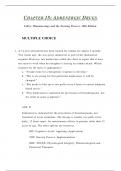
C HAPTER 18: A DRENERGIC D RUGS
Lilley: Pharmacology and the Nursing Process, 10th Edition
MULTIPLE CHOICE
1. A 14-year-old patient has been treated for asthma for almost 4 months.
Two weeks ago, she was given salmeterol as part of her medication
regimen. However, her mother has called the clinic to report that it does
not seem to work when her daughter is having an asthma attack. Which
response by the nurse is appropriate?
a. “It takes time for a therapeutic response to develop. ”
b. “She is too young for this particular medication; it will be
changed.”
c. “She needs to take up to two puffs every 4 hours to ensure adequate
blood levels. ”
d. “This medication is indicated for prevention of bronchospasms, not
for relief of acute symptoms. ”
ANS: D
Salmeterol is indicated for the prevention of bronchospasms, not
treatment of acute symptoms . The dosage is usuall y two puffs twice
dail y, 12 hours apart, for maintenance effects in patients older than 12
years of age. The other options are incorrect.
DIF: Cognitive Level: Appl ying (Application)
TOP: Nursing Process: Implementation
MSC: NC LEX: Ph ysiological Integrit y: Pharmacological and
Parenteral Therapies
, 2. A hospitalized patient is experiencing a severe anaphylactic reaction to a
dose of intravenous penicillin. Which drug will the nurse expect to use to
treat this condition?
a. Ephedra
b. Epinephrine
c. Phenylephrine
d. Pseudoephedrine
ANS: B
Epinephrine is the drug of choice for the treatment of anaphylaxis. The
other drugs listed are incorrect choices.
DIF: Cognitive Level: Understanding (Comprehension)
TOP: Nursing Process: Planning
MSC: NC LEX: Physiolo gical Integrit y: Pharmacological and
Parenteral Therapies
3. The nurse recognizes that adrenergic drugs cause relaxation of the bronchi
and bronchodilation by stimulating which t ype of receptors?
a. Dopaminergic
b. Beta1 adrenergic
c. Beta2 adrenergic
d. Alpha1 adrenergic
ANS: C
Stimulation of beta2 -adrenergic receptors results in bronchodilation.
The other choices are incorrect.
DIF: Cognitive Level: Understanding (Comprehension)
TOP: Nursing Process: Implementation
Lilley: Pharmacology and the Nursing Process, 10th Edition
MULTIPLE CHOICE
1. A 14-year-old patient has been treated for asthma for almost 4 months.
Two weeks ago, she was given salmeterol as part of her medication
regimen. However, her mother has called the clinic to report that it does
not seem to work when her daughter is having an asthma attack. Which
response by the nurse is appropriate?
a. “It takes time for a therapeutic response to develop. ”
b. “She is too young for this particular medication; it will be
changed.”
c. “She needs to take up to two puffs every 4 hours to ensure adequate
blood levels. ”
d. “This medication is indicated for prevention of bronchospasms, not
for relief of acute symptoms. ”
ANS: D
Salmeterol is indicated for the prevention of bronchospasms, not
treatment of acute symptoms . The dosage is usuall y two puffs twice
dail y, 12 hours apart, for maintenance effects in patients older than 12
years of age. The other options are incorrect.
DIF: Cognitive Level: Appl ying (Application)
TOP: Nursing Process: Implementation
MSC: NC LEX: Ph ysiological Integrit y: Pharmacological and
Parenteral Therapies
, 2. A hospitalized patient is experiencing a severe anaphylactic reaction to a
dose of intravenous penicillin. Which drug will the nurse expect to use to
treat this condition?
a. Ephedra
b. Epinephrine
c. Phenylephrine
d. Pseudoephedrine
ANS: B
Epinephrine is the drug of choice for the treatment of anaphylaxis. The
other drugs listed are incorrect choices.
DIF: Cognitive Level: Understanding (Comprehension)
TOP: Nursing Process: Planning
MSC: NC LEX: Physiolo gical Integrit y: Pharmacological and
Parenteral Therapies
3. The nurse recognizes that adrenergic drugs cause relaxation of the bronchi
and bronchodilation by stimulating which t ype of receptors?
a. Dopaminergic
b. Beta1 adrenergic
c. Beta2 adrenergic
d. Alpha1 adrenergic
ANS: C
Stimulation of beta2 -adrenergic receptors results in bronchodilation.
The other choices are incorrect.
DIF: Cognitive Level: Understanding (Comprehension)
TOP: Nursing Process: Implementation