H2: Business and IT strategy
Why would a company invest in IT?
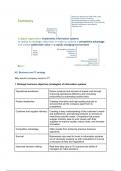
1. Strategic business objectives (strategies) of information systems
Operational excellence Deliver products and services at lowest-cost through
improving operational efficiency and increasing
productivity by automating routine tasks.
Product leadership Creating innovative and high-quality products or
services that set the company apart from its
competitors.
Customer and supplier intimacy Creating a deep understanding of the customer's needs
and preferences, and tailoring products or services to
meet those specific needs. Companies that pursue
supplier intimacy seek to work closely with their
suppliers to improve quality, reduce costs, and increase
innovation.
Competitive advantage Often results from achieving previous business
objectives.
Survival Businesses may need to invest in information systems
out of necessity: keeping up with competitors to survive
or because of laws and regulations
Improved decision making Real-time data (due to IT) improves the ability of
managers to make decisions.
,2. Porter’s competitive forces model
Five competitive forces shape strategic position of the firm
Impact of the internet
Rivalry among existing competitors Widens geographic market, increasing the number
of competitors
New market entrants Internet reduces barriers to entry, increasing the
threat of new entry
Substitute products and services Enables new substitutes to emerge (e.g. Wikipedia
competes with printed encyclopedia)
Bargaining power of customers Customers can quickly compare prices, increasing
their bargaining power
Bargaining power of suppliers Procurement (inkopen) over the Internet lowers
suppliers’ bargaining power
3. Disruptive innovation model
4. Value webs, synergies, core competencies and network-based strategies
The Business Value Chain Model views the firm as a series of activities that add value to
products or services.
- Primary activities: directly related to production and distribution of the products or
services, which create value for the customer.
- Support activities: make the primary activities possible.
Highlights activities where competitive strategies can best be applied. At each stage,
determine how information systems can improve operational efficiency, differentiate products
or improve customer and supplier intimacy
, Uit de business value chain volgt een industry value chain die de onderneming een plaats
heeft tussen de andere partijen.
The Value Web: a highly synchronized industry value chain
Collection of independent firms using highly synchronized IT to coordinate value chains to
produce product or service collectively. More customer driven, less linear operation than
traditional value chain. Synchronizes business processes of value partners.
Synergies: when an organization merges with or acquires another organization
Output of some units can be used as inputs to other units, organizations can pool
markets/expertise.Reduces costs, increases profits. Role of IS: coordinating operations of
the separate units so that they can act as a whole => ERP
Core Competencies: activity for which firm is world-class leader
Relies on knowledge that is gained over many years of practical field experience with a
technology. Any IS that encourages the sharing of knowledge across business units
enhances competency => SCM, KMS
Why would a company invest in IT?
1. Strategic business objectives (strategies) of information systems
Operational excellence Deliver products and services at lowest-cost through
improving operational efficiency and increasing
productivity by automating routine tasks.
Product leadership Creating innovative and high-quality products or
services that set the company apart from its
competitors.
Customer and supplier intimacy Creating a deep understanding of the customer's needs
and preferences, and tailoring products or services to
meet those specific needs. Companies that pursue
supplier intimacy seek to work closely with their
suppliers to improve quality, reduce costs, and increase
innovation.
Competitive advantage Often results from achieving previous business
objectives.
Survival Businesses may need to invest in information systems
out of necessity: keeping up with competitors to survive
or because of laws and regulations
Improved decision making Real-time data (due to IT) improves the ability of
managers to make decisions.
,2. Porter’s competitive forces model
Five competitive forces shape strategic position of the firm
Impact of the internet
Rivalry among existing competitors Widens geographic market, increasing the number
of competitors
New market entrants Internet reduces barriers to entry, increasing the
threat of new entry
Substitute products and services Enables new substitutes to emerge (e.g. Wikipedia
competes with printed encyclopedia)
Bargaining power of customers Customers can quickly compare prices, increasing
their bargaining power
Bargaining power of suppliers Procurement (inkopen) over the Internet lowers
suppliers’ bargaining power
3. Disruptive innovation model
4. Value webs, synergies, core competencies and network-based strategies
The Business Value Chain Model views the firm as a series of activities that add value to
products or services.
- Primary activities: directly related to production and distribution of the products or
services, which create value for the customer.
- Support activities: make the primary activities possible.
Highlights activities where competitive strategies can best be applied. At each stage,
determine how information systems can improve operational efficiency, differentiate products
or improve customer and supplier intimacy
, Uit de business value chain volgt een industry value chain die de onderneming een plaats
heeft tussen de andere partijen.
The Value Web: a highly synchronized industry value chain
Collection of independent firms using highly synchronized IT to coordinate value chains to
produce product or service collectively. More customer driven, less linear operation than
traditional value chain. Synchronizes business processes of value partners.
Synergies: when an organization merges with or acquires another organization
Output of some units can be used as inputs to other units, organizations can pool
markets/expertise.Reduces costs, increases profits. Role of IS: coordinating operations of
the separate units so that they can act as a whole => ERP
Core Competencies: activity for which firm is world-class leader
Relies on knowledge that is gained over many years of practical field experience with a
technology. Any IS that encourages the sharing of knowledge across business units
enhances competency => SCM, KMS