Unit 7.1
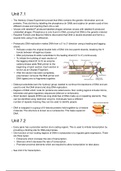
• The Hershey-Chase Experiment proved that DNA contains the genetic information and not
proteins. They did this by labelling the phosphorus (in DNA) and sulphur (in protein coat) of two
different viruses and injecting them into a cell.
• Viruses with labelled P produced labelled phages whereas viruses with labelled S produced
unlabelled phages. Phosphorus is only found in DNA, proving that DNA is the genetic material.
• Rosalind Franklin and Maurice Wilkins discovered that DNA is double stranded and forms a
double helix using X-ray diffraction.
• Prokaryotic DNA replication makes DNA from a 5’ to 3’ direction using a leading and lagging
strand.
• Helicase unzips the original double helix of DNA into two parent strands, breaking the H
bonds between nitrogenous bases.
• DNA polymerase III adds nucleotides to the leading strand (5’ to 3’) continuously.
• To initiate the building of each section of
the lagging strand (3’ to 5’) an enzyme
called primase adds RNA primer to the
beginning of each section. Each section is
known as an Okazaki Fragment.
• After the section has been completed,
polymerase I removes the RNA primer and
DNA ligase joins to fragments together.
• Dideoxynucleotides lack the hydroxyl group needed to continue the backbone of DNA and are
used to end the DNA strand and stop DNA replication.
• Regions of DNA which code for proteins are called exons. Non coding regions include introns,
telomeres and gene regulatory sequences (silencer or enhancers).
• Short tandem repeats (STR’s) are long stretches of DNA made up or repeating elements. They
can be identified using restriction enzyme. Individuals have a different
number of repeats meaning they can be used to identify people.
• DNA is wrapped in a group of 8 histone proteins held together by a histone
molecule. The structure is known as a nucleosome. This helps supercoil
DNA.
Unit 7.2
• Every gene has a promoter section (non-coding region). This is used to initiate transcription by
providing a binding site for RNA polymerase.
• One function of non-coding regions of DNA in eukaryotes is to regulate gene expression. There
are three types:
• Enhancers which increase the rate of transcription.
• Silencers which decrease the rate of transcription.
• Promoter-proximal elements which are required to allow transcription to take place.
• See Unit 2 for transcription.
• The Hershey-Chase Experiment proved that DNA contains the genetic information and not
proteins. They did this by labelling the phosphorus (in DNA) and sulphur (in protein coat) of two
different viruses and injecting them into a cell.
• Viruses with labelled P produced labelled phages whereas viruses with labelled S produced
unlabelled phages. Phosphorus is only found in DNA, proving that DNA is the genetic material.
• Rosalind Franklin and Maurice Wilkins discovered that DNA is double stranded and forms a
double helix using X-ray diffraction.
• Prokaryotic DNA replication makes DNA from a 5’ to 3’ direction using a leading and lagging
strand.
• Helicase unzips the original double helix of DNA into two parent strands, breaking the H
bonds between nitrogenous bases.
• DNA polymerase III adds nucleotides to the leading strand (5’ to 3’) continuously.
• To initiate the building of each section of
the lagging strand (3’ to 5’) an enzyme
called primase adds RNA primer to the
beginning of each section. Each section is
known as an Okazaki Fragment.
• After the section has been completed,
polymerase I removes the RNA primer and
DNA ligase joins to fragments together.
• Dideoxynucleotides lack the hydroxyl group needed to continue the backbone of DNA and are
used to end the DNA strand and stop DNA replication.
• Regions of DNA which code for proteins are called exons. Non coding regions include introns,
telomeres and gene regulatory sequences (silencer or enhancers).
• Short tandem repeats (STR’s) are long stretches of DNA made up or repeating elements. They
can be identified using restriction enzyme. Individuals have a different
number of repeats meaning they can be used to identify people.
• DNA is wrapped in a group of 8 histone proteins held together by a histone
molecule. The structure is known as a nucleosome. This helps supercoil
DNA.
Unit 7.2
• Every gene has a promoter section (non-coding region). This is used to initiate transcription by
providing a binding site for RNA polymerase.
• One function of non-coding regions of DNA in eukaryotes is to regulate gene expression. There
are three types:
• Enhancers which increase the rate of transcription.
• Silencers which decrease the rate of transcription.
• Promoter-proximal elements which are required to allow transcription to take place.
• See Unit 2 for transcription.