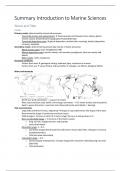
Summary Introduction to Marine Sciences
Waves and Tides
Coasts
Primary coasts: determined by terrestrial processes
- Terrestrial erosion and submergence → fluvial erosion and drowned river valleys, glacial
erosion coasts, drowned karst topography (Thailand/florida)
- Terrestrial deposition coast → glacial deposition, aeolian (duin vorming), deltaic (deposition
of rivers), landslide
Secondary coasts: determined by present-day marine or biotic processes
- Wave erosion coast: wave straightened cliffs
- Marine deposition coast: barrier islands, salt marshes (sand/gravel, what we mostly talk
about)
- Biotic coasts: reefs, mangroves
Boundary conditions
- Factors from land → geological setting: sediment type, resistance to erosion
- Factors from sea → wave climate, tide and other SL changes, ice effects, biological effects
Wave environments
- North sea: wind dominated --> waves 4-6 meters
- West coast and east coast swells: low energy, low waves --> 0.5 meter (unless storm/cyclone)
- Swell = waves that enter a coast but not influenced by the wind (dutch = deining)
Tide environments
- Large tides (northern France, Argentina) → Shape of coast determines the shape of the wave
- Determined by shape of continents and local coasts
- Tidal change is 12 hours in total → 5 meter range? Go up in 6 and go down in 6
- Non- to microtidal range, < 2 m (some of the Dutch coasts)
o long, narrow, straight barriers and beaches
o wave-dominated!
- Mesotidal range, 2 – 4 m
o drumstick-shaped (thick head thin tail) barrier island, tidal inlets: tide goes in and out
(waddeneilanden)
o Tidal and wave dominated
- macrotidal range, > 4 m
o funnel-shaped embayments, Trumpet shaped thin channels extending long into land
(tidal flat)
o Tide dominated
,Macrotidalrange but wave-dominated morphology:
→ waves so gigantic that they
overpower tidal effect → in need of better classification
Classification based on tides and waves
- Dutch coast = wave dominated. Has high stormwaves
- Mediterranean coast = wave dominated. only 50 cm waves and tides only 10 cm
- All little inlets = tide dominated
- Biarritz = high tides (6m) but still wave dominated
because of relative importance
Bio-morphodynamics (morphology changes)
Morphodynamics: Interaction between water flow → moving of
sediments → morphological changes → waves will act
differently. Just physical approach (bio assumed to have no
effect)
Bio-geomorphodynamics: inclusion of biotic factors --> e.g. cause
erosion, sediment deposition or water motion. There is a succession.
- Dunes on landslide (ecological): ecology very stable and
physical influences don’t really have influence
- Sandy beach with no vegetation (physical): physical very
powerful, organisms have a hard time
and cannot change landscape.
- Mangroves: ecology powerful, physical
has a hard time
Spatial and temporal scales
Correlation between how often behaviour
occurs, small scale changes happen often:
,Waves
Vertical bands: specifieke lengthen van waves, grijze
gebieden: kunnen verschillende lengthen worden.
Waves categorized by their period. We talk about frequency: hertz. Long period → low frequency.
Frequencies of tides exactly known:
- H = height; L = length; d or h = water depth
- T = period = time it takes to repeat itself, time for A to reach point B
- f = frequency = 1/T (in hertz)
- c = celerity = speed = L / T (not speed of particles, it is speed of the shape)
- Short wave period → high frequency. Long wave period → low frequency
- Wave propagation describes how fast the wave travels
- Above dotted line water goes up, below dotted line water goes down
- Water moves around in circles beneath waves but water itself doesn’t move
Orbital motion
- Underneath crest → motion of water in same direction as wave
- Underneath trough → motion of water in contrary direction of wave
- The deeper, the less present the orbit becomes
Type of wave (does not depend on height of the wave). Depends on:
- A deep-water wave: if d/L > ¼ (no influence of seabed)
- A intermediate/transitional water wave: if d/L is between ¼-1/20
- A shallow water wave: if d/L < 1/20 (vertical motion obf wave is less due to seabed)
Wave generation and height
Depends on: wind velocity, wind duration and fetch (area/distance wind is capable of blowing) →
one of these is the limiting factor
- Northwest storm waves 5 meters to 7 meters
- Southwest storm waves less high → smaller fetch
, Left: speed limiting factor, right: fetch limiting factor
- X-axis = duration in hours
- Y-axis = wave height in meters
- Diagonal axis = fetch
- Curved lines = wave periods in s
- U = windspeed
Example 1
- U = 15 m/s, F = 200 km, duration t = 6 hours. It takes 12 hours to reach the maximum, but we
only have 6 hours so time is limiting. So it can get 3 meters high.
Example 2:
- U = 15 m/s, F = 200 km, duration t = 18 hours. But you can only go to 12 so something else is
the limiting factor
Dispersion relationship
Relationship between wave length L, wave period T and water depth h.
- A longer period means longer wavelength.
- The celerity depends on the period and depth in shallow water, in deep water it depends
only on the period.
Waves and Tides
Coasts
Primary coasts: determined by terrestrial processes
- Terrestrial erosion and submergence → fluvial erosion and drowned river valleys, glacial
erosion coasts, drowned karst topography (Thailand/florida)
- Terrestrial deposition coast → glacial deposition, aeolian (duin vorming), deltaic (deposition
of rivers), landslide
Secondary coasts: determined by present-day marine or biotic processes
- Wave erosion coast: wave straightened cliffs
- Marine deposition coast: barrier islands, salt marshes (sand/gravel, what we mostly talk
about)
- Biotic coasts: reefs, mangroves
Boundary conditions
- Factors from land → geological setting: sediment type, resistance to erosion
- Factors from sea → wave climate, tide and other SL changes, ice effects, biological effects
Wave environments
- North sea: wind dominated --> waves 4-6 meters
- West coast and east coast swells: low energy, low waves --> 0.5 meter (unless storm/cyclone)
- Swell = waves that enter a coast but not influenced by the wind (dutch = deining)
Tide environments
- Large tides (northern France, Argentina) → Shape of coast determines the shape of the wave
- Determined by shape of continents and local coasts
- Tidal change is 12 hours in total → 5 meter range? Go up in 6 and go down in 6
- Non- to microtidal range, < 2 m (some of the Dutch coasts)
o long, narrow, straight barriers and beaches
o wave-dominated!
- Mesotidal range, 2 – 4 m
o drumstick-shaped (thick head thin tail) barrier island, tidal inlets: tide goes in and out
(waddeneilanden)
o Tidal and wave dominated
- macrotidal range, > 4 m
o funnel-shaped embayments, Trumpet shaped thin channels extending long into land
(tidal flat)
o Tide dominated
,Macrotidalrange but wave-dominated morphology:
→ waves so gigantic that they
overpower tidal effect → in need of better classification
Classification based on tides and waves
- Dutch coast = wave dominated. Has high stormwaves
- Mediterranean coast = wave dominated. only 50 cm waves and tides only 10 cm
- All little inlets = tide dominated
- Biarritz = high tides (6m) but still wave dominated
because of relative importance
Bio-morphodynamics (morphology changes)
Morphodynamics: Interaction between water flow → moving of
sediments → morphological changes → waves will act
differently. Just physical approach (bio assumed to have no
effect)
Bio-geomorphodynamics: inclusion of biotic factors --> e.g. cause
erosion, sediment deposition or water motion. There is a succession.
- Dunes on landslide (ecological): ecology very stable and
physical influences don’t really have influence
- Sandy beach with no vegetation (physical): physical very
powerful, organisms have a hard time
and cannot change landscape.
- Mangroves: ecology powerful, physical
has a hard time
Spatial and temporal scales
Correlation between how often behaviour
occurs, small scale changes happen often:
,Waves
Vertical bands: specifieke lengthen van waves, grijze
gebieden: kunnen verschillende lengthen worden.
Waves categorized by their period. We talk about frequency: hertz. Long period → low frequency.
Frequencies of tides exactly known:
- H = height; L = length; d or h = water depth
- T = period = time it takes to repeat itself, time for A to reach point B
- f = frequency = 1/T (in hertz)
- c = celerity = speed = L / T (not speed of particles, it is speed of the shape)
- Short wave period → high frequency. Long wave period → low frequency
- Wave propagation describes how fast the wave travels
- Above dotted line water goes up, below dotted line water goes down
- Water moves around in circles beneath waves but water itself doesn’t move
Orbital motion
- Underneath crest → motion of water in same direction as wave
- Underneath trough → motion of water in contrary direction of wave
- The deeper, the less present the orbit becomes
Type of wave (does not depend on height of the wave). Depends on:
- A deep-water wave: if d/L > ¼ (no influence of seabed)
- A intermediate/transitional water wave: if d/L is between ¼-1/20
- A shallow water wave: if d/L < 1/20 (vertical motion obf wave is less due to seabed)
Wave generation and height
Depends on: wind velocity, wind duration and fetch (area/distance wind is capable of blowing) →
one of these is the limiting factor
- Northwest storm waves 5 meters to 7 meters
- Southwest storm waves less high → smaller fetch
, Left: speed limiting factor, right: fetch limiting factor
- X-axis = duration in hours
- Y-axis = wave height in meters
- Diagonal axis = fetch
- Curved lines = wave periods in s
- U = windspeed
Example 1
- U = 15 m/s, F = 200 km, duration t = 6 hours. It takes 12 hours to reach the maximum, but we
only have 6 hours so time is limiting. So it can get 3 meters high.
Example 2:
- U = 15 m/s, F = 200 km, duration t = 18 hours. But you can only go to 12 so something else is
the limiting factor
Dispersion relationship
Relationship between wave length L, wave period T and water depth h.
- A longer period means longer wavelength.
- The celerity depends on the period and depth in shallow water, in deep water it depends
only on the period.