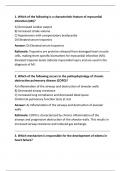
1. Which of the following is a characteristic feature of myocardial
infarction (MI)?
A) Decreased cardiac output
B) Increased stroke volume
C) Hypotension with compensatory bradycardia
D) Elevated serum troponins
Answer: D) Elevated serum troponins
Rationale: Troponins are proteins released from damaged heart muscle
cells, making them specific biomarkers for myocardial infarction (MI).
Elevated troponin levels indicate myocardial injury and are used in the
diagnosis of MI.
2. Which of the following occurs in the pathophysiology of chronic
obstructive pulmonary disease (COPD)?
A) Inflammation of the airways and destruction of alveolar walls
B) Decreased airway resistance
C) Increased lung compliance and decreased dead space
D) Normal pulmonary function tests at rest
Answer: A) Inflammation of the airways and destruction of alveolar
walls
Rationale: COPD is characterized by chronic inflammation of the
airways and progressive destruction of the alveolar walls. This results in
increased airway resistance and reduced gas exchange.
3. Which mechanism is responsible for the development of edema in
heart failure?
,A) Increased capillary permeability
B) Decreased plasma protein concentration
C) Increased capillary hydrostatic pressure
D) Lymphatic obstruction
Answer: C) Increased capillary hydrostatic pressure
Rationale: In heart failure, the heart's reduced ability to pump blood
results in increased venous pressure, which raises capillary hydrostatic
pressure. This forces fluid out of the capillaries and into the interstitial
space, leading to edema.
4. Which of the following is a hallmark of acute renal failure (ARF)?
A) Hyperkalemia
B) Hypokalemia
C) Decreased serum creatinine
D) Increased glomerular filtration rate (GFR)
Answer: A) Hyperkalemia
Rationale: In acute renal failure (ARF), the kidneys are unable to filter
waste products properly, resulting in the accumulation of potassium in
the blood, leading to hyperkalemia. This can be life-threatening if not
managed.
5. Which of the following is the primary pathophysiologic mechanism
underlying type 1 diabetes mellitus (T1DM)?
A) Insulin resistance
B) Autoimmune destruction of pancreatic beta cells
C) Increased glucose production by the liver
D) Impaired glucose uptake by muscle cells
, Answer: B) Autoimmune destruction of pancreatic beta cells
Rationale: In type 1 diabetes mellitus, the immune system mistakenly
destroys insulin-producing beta cells in the pancreas, leading to a
deficiency in insulin secretion. This results in high blood glucose levels.
6. Which of the following is a common pathophysiologic feature in
systemic lupus erythematosus (SLE)?
A) Excessive clotting leading to thrombosis
B) Chronic inflammation and immune complex deposition
C) Increased erythropoiesis
D) Inhibition of T-cell activation
Answer: B) Chronic inflammation and immune complex deposition
Rationale: In SLE, chronic inflammation is caused by an overactive
immune response that forms immune complexes. These complexes
deposit in tissues, leading to damage, particularly in the skin, joints,
kidneys, and heart.
7. Which of the following mechanisms contributes to the
pathophysiology of asthma?
A) Bronchoconstriction and airway inflammation
B) Destruction of lung tissue
C) Increased airway diameter
D) Impaired mucociliary clearance
Answer: A) Bronchoconstriction and airway inflammation
Rationale: In asthma, there is bronchoconstriction (narrowing of the
airways) and inflammation of the bronchial lining, triggered by
infarction (MI)?
A) Decreased cardiac output
B) Increased stroke volume
C) Hypotension with compensatory bradycardia
D) Elevated serum troponins
Answer: D) Elevated serum troponins
Rationale: Troponins are proteins released from damaged heart muscle
cells, making them specific biomarkers for myocardial infarction (MI).
Elevated troponin levels indicate myocardial injury and are used in the
diagnosis of MI.
2. Which of the following occurs in the pathophysiology of chronic
obstructive pulmonary disease (COPD)?
A) Inflammation of the airways and destruction of alveolar walls
B) Decreased airway resistance
C) Increased lung compliance and decreased dead space
D) Normal pulmonary function tests at rest
Answer: A) Inflammation of the airways and destruction of alveolar
walls
Rationale: COPD is characterized by chronic inflammation of the
airways and progressive destruction of the alveolar walls. This results in
increased airway resistance and reduced gas exchange.
3. Which mechanism is responsible for the development of edema in
heart failure?
,A) Increased capillary permeability
B) Decreased plasma protein concentration
C) Increased capillary hydrostatic pressure
D) Lymphatic obstruction
Answer: C) Increased capillary hydrostatic pressure
Rationale: In heart failure, the heart's reduced ability to pump blood
results in increased venous pressure, which raises capillary hydrostatic
pressure. This forces fluid out of the capillaries and into the interstitial
space, leading to edema.
4. Which of the following is a hallmark of acute renal failure (ARF)?
A) Hyperkalemia
B) Hypokalemia
C) Decreased serum creatinine
D) Increased glomerular filtration rate (GFR)
Answer: A) Hyperkalemia
Rationale: In acute renal failure (ARF), the kidneys are unable to filter
waste products properly, resulting in the accumulation of potassium in
the blood, leading to hyperkalemia. This can be life-threatening if not
managed.
5. Which of the following is the primary pathophysiologic mechanism
underlying type 1 diabetes mellitus (T1DM)?
A) Insulin resistance
B) Autoimmune destruction of pancreatic beta cells
C) Increased glucose production by the liver
D) Impaired glucose uptake by muscle cells
, Answer: B) Autoimmune destruction of pancreatic beta cells
Rationale: In type 1 diabetes mellitus, the immune system mistakenly
destroys insulin-producing beta cells in the pancreas, leading to a
deficiency in insulin secretion. This results in high blood glucose levels.
6. Which of the following is a common pathophysiologic feature in
systemic lupus erythematosus (SLE)?
A) Excessive clotting leading to thrombosis
B) Chronic inflammation and immune complex deposition
C) Increased erythropoiesis
D) Inhibition of T-cell activation
Answer: B) Chronic inflammation and immune complex deposition
Rationale: In SLE, chronic inflammation is caused by an overactive
immune response that forms immune complexes. These complexes
deposit in tissues, leading to damage, particularly in the skin, joints,
kidneys, and heart.
7. Which of the following mechanisms contributes to the
pathophysiology of asthma?
A) Bronchoconstriction and airway inflammation
B) Destruction of lung tissue
C) Increased airway diameter
D) Impaired mucociliary clearance
Answer: A) Bronchoconstriction and airway inflammation
Rationale: In asthma, there is bronchoconstriction (narrowing of the
airways) and inflammation of the bronchial lining, triggered by