1
The Chain Rule
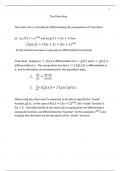
The chain rule is a formula for differentiating the composition of 2 functions.
Ex. Let 𝑓 (𝑥 ) = 𝑥 100 and let 𝑔(𝑥 ) = 5𝑥 + 2 then
𝑓(𝑔(𝑥 )) = 𝑓(5𝑥 + 2) = (5𝑥 + 2)100 .
At the moment we have no easy way to differentiate this function.
Chain Rule: Suppose 𝑦 = 𝑓(𝑢) is differentiable at 𝑢 = 𝑔(𝑥) and 𝑢 = 𝑔(𝑥) is
differentiable at 𝑥 . The composition function 𝑦 = 𝑓(𝑔(𝑥 )) is differentiable at
𝑥 , and its derivative can be expressed in two equivalent ways:
𝑑𝑦 𝑑𝑦 𝑑𝑢
1. = 𝑑𝑢 𝑑𝑥
𝑑𝑥
𝑑
2. (𝑓(𝑔(𝑥 )) = 𝑓 ′ (𝑔(𝑥 ))𝑔′(𝑥).
𝑑𝑥
When using the chain rule it’s important to be able to identify the “inside”
function 𝑔(𝑥). In the case of ℎ(𝑥 ) = (5𝑥 + 2)100 , the “inside” function is
5𝑥 + 2. One often thinks of the chain rule as saying when we differentiate a
composite function, we differentiate the “function” (in this example 𝑥 100 ) and
multiply that derivative by the derivative of the “inside” function.
, 2
Ex. Differentiate ℎ(𝑥 ) = (5𝑥 + 2)100 .
We can solve this a couple of ways:
1. 𝑦 = 𝑓 (𝑢) = 𝑢100 , and 𝑢 = 𝑔(𝑥 ) = 5𝑥 + 2
𝑑𝑦 𝑑𝑢
= 100𝑢99 , = 5.
𝑑𝑢 𝑑𝑥
dy dy du
= = (100𝑢99 )(5) = 100(5𝑥 + 2)99 (5) = 500(5𝑥 + 2)99
dx du dx
𝑑
2. ℎ′ (𝑥 ) = 100(5𝑥 + 2)99 (5𝑥 + 2)
𝑑𝑥
= 100(5𝑥 + 2)99 (5)
= 500(5𝑥 + 2)99 .
The Chain Rule for Powers of a Function.
If 𝑓 is differentiable for all 𝑥 in its domain and 𝑛 is an integer, then
𝑑
((𝑓(𝑥 ))𝑛 ) = 𝑛(𝑓(𝑥 ))𝑛−1 𝑓′(𝑥).
𝑑𝑥
Ex. Write ℎ(𝑥 ) = (𝑥 2 − 4)20 as a composite function in 2 ways: 𝑦 = 𝑓(𝑢),
𝑢 = 𝑔(𝑥); and ℎ(𝑥 ) = 𝑓(𝑔(𝑥 )).
1. 𝑢 = 𝑥 2 − 4, 𝑦 = 𝑓 (𝑢) = 𝑢20 ; thus 𝑓(𝑢) = 𝑢20 = (𝑥 2 − 4)20 .
2. 𝑔(𝑥 ) = 𝑥 2 − 4, 𝑓(𝑥 ) = 𝑥 20 ; thus 𝑓(𝑔(𝑥 )) = (𝑥 2 − 4)20 .
The Chain Rule
The chain rule is a formula for differentiating the composition of 2 functions.
Ex. Let 𝑓 (𝑥 ) = 𝑥 100 and let 𝑔(𝑥 ) = 5𝑥 + 2 then
𝑓(𝑔(𝑥 )) = 𝑓(5𝑥 + 2) = (5𝑥 + 2)100 .
At the moment we have no easy way to differentiate this function.
Chain Rule: Suppose 𝑦 = 𝑓(𝑢) is differentiable at 𝑢 = 𝑔(𝑥) and 𝑢 = 𝑔(𝑥) is
differentiable at 𝑥 . The composition function 𝑦 = 𝑓(𝑔(𝑥 )) is differentiable at
𝑥 , and its derivative can be expressed in two equivalent ways:
𝑑𝑦 𝑑𝑦 𝑑𝑢
1. = 𝑑𝑢 𝑑𝑥
𝑑𝑥
𝑑
2. (𝑓(𝑔(𝑥 )) = 𝑓 ′ (𝑔(𝑥 ))𝑔′(𝑥).
𝑑𝑥
When using the chain rule it’s important to be able to identify the “inside”
function 𝑔(𝑥). In the case of ℎ(𝑥 ) = (5𝑥 + 2)100 , the “inside” function is
5𝑥 + 2. One often thinks of the chain rule as saying when we differentiate a
composite function, we differentiate the “function” (in this example 𝑥 100 ) and
multiply that derivative by the derivative of the “inside” function.
, 2
Ex. Differentiate ℎ(𝑥 ) = (5𝑥 + 2)100 .
We can solve this a couple of ways:
1. 𝑦 = 𝑓 (𝑢) = 𝑢100 , and 𝑢 = 𝑔(𝑥 ) = 5𝑥 + 2
𝑑𝑦 𝑑𝑢
= 100𝑢99 , = 5.
𝑑𝑢 𝑑𝑥
dy dy du
= = (100𝑢99 )(5) = 100(5𝑥 + 2)99 (5) = 500(5𝑥 + 2)99
dx du dx
𝑑
2. ℎ′ (𝑥 ) = 100(5𝑥 + 2)99 (5𝑥 + 2)
𝑑𝑥
= 100(5𝑥 + 2)99 (5)
= 500(5𝑥 + 2)99 .
The Chain Rule for Powers of a Function.
If 𝑓 is differentiable for all 𝑥 in its domain and 𝑛 is an integer, then
𝑑
((𝑓(𝑥 ))𝑛 ) = 𝑛(𝑓(𝑥 ))𝑛−1 𝑓′(𝑥).
𝑑𝑥
Ex. Write ℎ(𝑥 ) = (𝑥 2 − 4)20 as a composite function in 2 ways: 𝑦 = 𝑓(𝑢),
𝑢 = 𝑔(𝑥); and ℎ(𝑥 ) = 𝑓(𝑔(𝑥 )).
1. 𝑢 = 𝑥 2 − 4, 𝑦 = 𝑓 (𝑢) = 𝑢20 ; thus 𝑓(𝑢) = 𝑢20 = (𝑥 2 − 4)20 .
2. 𝑔(𝑥 ) = 𝑥 2 − 4, 𝑓(𝑥 ) = 𝑥 20 ; thus 𝑓(𝑔(𝑥 )) = (𝑥 2 − 4)20 .