Chapter one: Introduction to Financial Statements
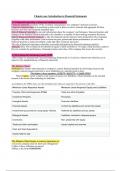
1.1 Financial reporting vs financial statement analysis
Financial statement: summary of the economic consequences of a company’s business activities.
Financial statement data: an accounting system is put in place to select, measure and aggregate all these
business activities into financial statement data.
Role of financial reporting: to provide information about the company’s performance, financial position and
changes in the financial position deemed to be valuable to a number of users making economic decisions.
Role of financial statement analysis: to take the financial reports that have been prepared by the companies
(together with other information ) and evaluate the past, present and future performance, as well as the
financial position to make investment, credit and other economic decisions.
The role of financial reporting is therefore to provide information for financial statement analysis.
Analysts: those who evaluate an investment in equity or debt securities to. To make a final decision, analysts
have to evaluate the performance, financial position and value of the company that issues the security.
1.2 Key financial statements under IFRS
IFRS stands for International Financial Reporting Framework. It is used as a framework which has as its
objective the standardisation of financial statements.
The Balance Sheet:
Definition:the balance sheet presents a company’s current financial position by disclosing resources the
company controls (assets) and what it owes (liabilities) at a specific point in time.
The balance sheet equation: ASSETS= EQUITY + LIABILITIES
Where Equity: owner’s equity is the excess of assets over liabilities, which translates to the residual
interest in the assets after deducting its liabilities.
According to the IFRS, these are the minimum lines that are required to be present in the B/S:
Minimum Lines Required: Assets Minimum Lines Required: Equity and Liabilities
Property, Plant and Equipment (PP&E) Trade and other Payables
Investment Property Provisions
Intangible Assets Financial Liabilities
Financial assets Current tax liabilities and current tax assets
Investments accounted for using equity method Deferred tax liabilities and tax assets
Biological Assets Liabilities: included in disposal groups
Inventories NCI: presented with equity
Trade and other receivables Issued capital and reserves
Cash and Cash Equivalents
Assets held for sale
The Balance Sheet hopes to answer questions as:
1) Can the company meet its short term obligations?
2) Does it have sufficient resources?
3)What is the firms POSITION?
, The Income Statement:
Definition: the income statement communicates how much revenue a company generated during a period
and what costs it has incurred with relation to that revenue.
Net Income: often referred to as the “bottom line” because it is close to the bottom of the income statement.
NET INCOME= REVENUE-EXPENSES
Minimum Line Items Required in the P/L statement
Revenue
Gains and Losses from the derecognition of financial assets
Finance costs
Share of Profit/Loss of associates and joint ventures accounted for using equity method.
Certain gains and losses associated with reclassification of financial assets.
Tax Expense
Single Amount for total of discontinued items
NCI:presented with equity
Issued Capital and Reserves
-Very important: The income statement and balance sheet are explicitly linked. The accumulated retained
earnings is shown on the balance sheet as retired earning or profit and loss of account reserve. Because the
Balance Sheet is ADDITIVE in nature, the income statement will show the annual increase or decrease in
retained earnings.
-Under IFRS, the income statement is the:Profit and Loss statement
-The Expenses under the P&L statement are classified by either function or nature.
-With the Income Statement we can answer questions such as:
1) What factors influenced growth in revenues?
2) Is the company PERFORMING better or worse than the industry average?
The Cash Flow Statement
Companies are required to publish a statement of cash flows because it shows cash based information with
relation to operations and are important because they assess whether a company is able to generate and meet
future cash flows.
Cash flow statements are divided into:
1)Operating: transactions that enter net income and compromise day to day financing
2)Investing: acquiring and disposing long term assets
3)Financing: obtaining and repaying capital
Can be presented through either the direct(cash activities only) and indirect method(non cash actions->
result).
Changes in owner’s equity:
Definition: Changes in owner’s equity show the changes in owner’s investment in business over time and
helps to understand how the financial position of the company has evolved.
This statement has to include:
1)total comprehensive income: it is the variation in a company’s net assets from non-owner sources during a
specific period. It includes net income and unrealised income such as unrealised gains and losses on
derivative financial instruments and foreign currency transactions.
2)effects of new accounting policies or restatements
3)carrying amounts(cost of an asset less accumulated depreciation) at the beginning and end of each period.
1.1 Financial reporting vs financial statement analysis
Financial statement: summary of the economic consequences of a company’s business activities.
Financial statement data: an accounting system is put in place to select, measure and aggregate all these
business activities into financial statement data.
Role of financial reporting: to provide information about the company’s performance, financial position and
changes in the financial position deemed to be valuable to a number of users making economic decisions.
Role of financial statement analysis: to take the financial reports that have been prepared by the companies
(together with other information ) and evaluate the past, present and future performance, as well as the
financial position to make investment, credit and other economic decisions.
The role of financial reporting is therefore to provide information for financial statement analysis.
Analysts: those who evaluate an investment in equity or debt securities to. To make a final decision, analysts
have to evaluate the performance, financial position and value of the company that issues the security.
1.2 Key financial statements under IFRS
IFRS stands for International Financial Reporting Framework. It is used as a framework which has as its
objective the standardisation of financial statements.
The Balance Sheet:
Definition:the balance sheet presents a company’s current financial position by disclosing resources the
company controls (assets) and what it owes (liabilities) at a specific point in time.
The balance sheet equation: ASSETS= EQUITY + LIABILITIES
Where Equity: owner’s equity is the excess of assets over liabilities, which translates to the residual
interest in the assets after deducting its liabilities.
According to the IFRS, these are the minimum lines that are required to be present in the B/S:
Minimum Lines Required: Assets Minimum Lines Required: Equity and Liabilities
Property, Plant and Equipment (PP&E) Trade and other Payables
Investment Property Provisions
Intangible Assets Financial Liabilities
Financial assets Current tax liabilities and current tax assets
Investments accounted for using equity method Deferred tax liabilities and tax assets
Biological Assets Liabilities: included in disposal groups
Inventories NCI: presented with equity
Trade and other receivables Issued capital and reserves
Cash and Cash Equivalents
Assets held for sale
The Balance Sheet hopes to answer questions as:
1) Can the company meet its short term obligations?
2) Does it have sufficient resources?
3)What is the firms POSITION?
, The Income Statement:
Definition: the income statement communicates how much revenue a company generated during a period
and what costs it has incurred with relation to that revenue.
Net Income: often referred to as the “bottom line” because it is close to the bottom of the income statement.
NET INCOME= REVENUE-EXPENSES
Minimum Line Items Required in the P/L statement
Revenue
Gains and Losses from the derecognition of financial assets
Finance costs
Share of Profit/Loss of associates and joint ventures accounted for using equity method.
Certain gains and losses associated with reclassification of financial assets.
Tax Expense
Single Amount for total of discontinued items
NCI:presented with equity
Issued Capital and Reserves
-Very important: The income statement and balance sheet are explicitly linked. The accumulated retained
earnings is shown on the balance sheet as retired earning or profit and loss of account reserve. Because the
Balance Sheet is ADDITIVE in nature, the income statement will show the annual increase or decrease in
retained earnings.
-Under IFRS, the income statement is the:Profit and Loss statement
-The Expenses under the P&L statement are classified by either function or nature.
-With the Income Statement we can answer questions such as:
1) What factors influenced growth in revenues?
2) Is the company PERFORMING better or worse than the industry average?
The Cash Flow Statement
Companies are required to publish a statement of cash flows because it shows cash based information with
relation to operations and are important because they assess whether a company is able to generate and meet
future cash flows.
Cash flow statements are divided into:
1)Operating: transactions that enter net income and compromise day to day financing
2)Investing: acquiring and disposing long term assets
3)Financing: obtaining and repaying capital
Can be presented through either the direct(cash activities only) and indirect method(non cash actions->
result).
Changes in owner’s equity:
Definition: Changes in owner’s equity show the changes in owner’s investment in business over time and
helps to understand how the financial position of the company has evolved.
This statement has to include:
1)total comprehensive income: it is the variation in a company’s net assets from non-owner sources during a
specific period. It includes net income and unrealised income such as unrealised gains and losses on
derivative financial instruments and foreign currency transactions.
2)effects of new accounting policies or restatements
3)carrying amounts(cost of an asset less accumulated depreciation) at the beginning and end of each period.