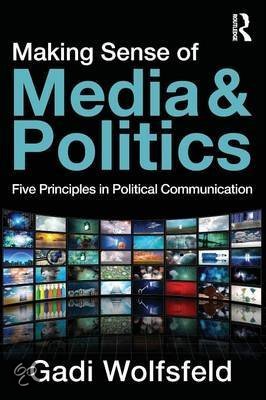
Making sense of media and politics
Lieke Brekelmans
Chapter 1: Political power and power over the media
The President has immense political power. He has constant media access with a large
number of journalists assigned to them. A less powerful politician has more challenges in
gaining media attention.
Political power = media power
Symbiotic relationship
- The close ecological relationship between members in which both members are
mutually benefited
Politicians and journalists have a symbiotic relationship (competitive symbioses)
- Politicians want publicity
- Journalists want newsworthy information
- Also competitive → both sides seek to benefit with minimal cost → politicians try to
get most coverage without revealing too much → journalists try to get juiciest stories
Indexing explains how the media largely reflects the views of political elites, which limits the
range of opinions in the news.
In authoritarian and partially free democracies, political power can be used more directly to
control the media, often through intimidation or violence,
Indexing
- A media phenomenon where coverage is primarily based on what political elites are
saying and doing, limiting the diversity of perspectives presented in the news
Digital media
- Platforms where non-professionals can create, comment, and share content
- Blogs, twitter, social media
Traditional media
- Conventional news outlets
- Traditional news outlets
- CNN, BBC
User-generated content (UGC)
- Key feature of digital media
- It’s shaped by ordinary people rather than professional journalists
,Qanon theory
- A cabal of Satan-worshipping Democrats, Hollywood celebrities and billionaires runs
the world while engaging in paedophilia, human trafficking and the harvesting of a
supposedly life-extending chemical from the blood of abused children
- Started by Trump
The media often favours coverage of more wealthy and populous regions, leading to a global
imbalance in information flow.
Spin doctor
- Expert who is skilled at manipulating or influencing the way information is presented
to the public, often with the aim of shaping perceptions in a way that benefits their
client, or themselves
- Public relations experts hired by political figures to craft favourable media stories and
manage their public image
Less powerful individuals or groups get attention through dramatic or controversial actions.
This often leads to superficial coverage focused on the spectacle rather than the message.
Law and order frame
- Media coverage often frames protest with a focus on violence or disorder, benefiting
authorities who can highlight the need for control
Back door entry
- Method by which weaker political actors or organizations gain media attention,
typically through unusual or sensational actions, often leading to superficial or
misrepresented coverage
Front door entry
- The method through which powerful political figures get media attention, often with
positive or neutral coverage where their messages are communicated without
significant challenge
Civil disobedience
- A nonviolent protest strategy that aims to disrupt normal life and gain media
attention, often by attracting dramatic responses from authorities
- Effective tactic for weaker groups
- Peaceful protest that lead to dramatic police actions which will gain sympathy for the
protesters
- Example: American civil right movement → police using attack dogs on peaceful
protesters
,Cumulative inequality
- The concept refers to how those with political and economic power naturally have
easier access to the media, while those without power struggle to get attention
Four key goals of political movements
1. Mobilizing supporters: digital media excels in helping movements attract and organize
supporters
2. Amplifying messages: going viral or gaining coverage in traditional media is essential
but increasingly competitive
3. Influencing leaders: gaining the attention of policymakers remains challenging despite
digital outreach
4. Changing policies: achieving tangible policy changes is the hardest and least
influenced by digital tools
Challenges with digital media
1. Slacktivism:
a. Digital-only activism where participants feel they have contributed enough
without taking further action
b. The concern that digital participation reduces physical activism is unfounded
c. Research shows that digital engagement often correlates with real-world
activism
2. Competition:
a. The digital space is crowded, with movements, corporations and celebrities all
vying for attention
3. Limited impact on policy:
a. Oppositional forces with equal or greater access to digital tools often block
movements’ efforts
Movements’ success depends on their resonance with the public, political environment, and
goals.
Amplification effect
- The ability of digital media to spread messages widely, increasing the visibility and
influence of a movement
Chapter 2: Political control and media independence
Leaders lose media control when they lose control over the political environment.
Political environment
- Encompasses what leaders, the public, and interest groups are doing and saying about
an issue
Elite opinion strongly influences media narratives.
, How do authoritarian regimes control media
- North Korea uses strict censorship
- China employs strategies like pro-government propaganda and limited dissent to
maintain control
Dissent
- The holding or expression of opinions at variance with those commonly or officially
held
- Holt or express opinions that are at variance with those commonly or officially held
Democracies face intense scrutiny when leaders fail to manage crises effectively.
Authoritarian regimes rely on suppressing dissent and propaganda but face challenges in the
digital age.
Indicators of success in controlling the political environment
1. Control over events:
a. Leaders lose credibility when events spiral out of control
2. Control over information:
a. Leaders who can manage leaks and maintain a monopoly on information gain
an advantage
3. Elite and public support:
a. Broad elite consensus often results in favourable media coverage, while
division leads to critical reporting
The media’s portrayal of leaders is heavily influenced by their ability to manage crisis, control
information, and secure elite and public support.
Independent media
- Outlets that operate without reliance on government or elite control
Highly dependent media (right on the continuum)
- Reliance on authorities for information
- Prominent during crisis, wars, or disasters when political leaders have strong control
over narratives
- Example:
o Rallying around the flag – effect: broad consensus (overeenstemming) among
media and digital platforms during moments of national unity or crisis. Media
and public opinions align with government narratives during crises or wars
High independent media (left on the continuum)
- Journalists or ordinary citizens initiate or uncover critical news stories independently
- Often involves investigative journalism or event-driven journalism
- Examples:
o Investigation into scandals
Lieke Brekelmans
Chapter 1: Political power and power over the media
The President has immense political power. He has constant media access with a large
number of journalists assigned to them. A less powerful politician has more challenges in
gaining media attention.
Political power = media power
Symbiotic relationship
- The close ecological relationship between members in which both members are
mutually benefited
Politicians and journalists have a symbiotic relationship (competitive symbioses)
- Politicians want publicity
- Journalists want newsworthy information
- Also competitive → both sides seek to benefit with minimal cost → politicians try to
get most coverage without revealing too much → journalists try to get juiciest stories
Indexing explains how the media largely reflects the views of political elites, which limits the
range of opinions in the news.
In authoritarian and partially free democracies, political power can be used more directly to
control the media, often through intimidation or violence,
Indexing
- A media phenomenon where coverage is primarily based on what political elites are
saying and doing, limiting the diversity of perspectives presented in the news
Digital media
- Platforms where non-professionals can create, comment, and share content
- Blogs, twitter, social media
Traditional media
- Conventional news outlets
- Traditional news outlets
- CNN, BBC
User-generated content (UGC)
- Key feature of digital media
- It’s shaped by ordinary people rather than professional journalists
,Qanon theory
- A cabal of Satan-worshipping Democrats, Hollywood celebrities and billionaires runs
the world while engaging in paedophilia, human trafficking and the harvesting of a
supposedly life-extending chemical from the blood of abused children
- Started by Trump
The media often favours coverage of more wealthy and populous regions, leading to a global
imbalance in information flow.
Spin doctor
- Expert who is skilled at manipulating or influencing the way information is presented
to the public, often with the aim of shaping perceptions in a way that benefits their
client, or themselves
- Public relations experts hired by political figures to craft favourable media stories and
manage their public image
Less powerful individuals or groups get attention through dramatic or controversial actions.
This often leads to superficial coverage focused on the spectacle rather than the message.
Law and order frame
- Media coverage often frames protest with a focus on violence or disorder, benefiting
authorities who can highlight the need for control
Back door entry
- Method by which weaker political actors or organizations gain media attention,
typically through unusual or sensational actions, often leading to superficial or
misrepresented coverage
Front door entry
- The method through which powerful political figures get media attention, often with
positive or neutral coverage where their messages are communicated without
significant challenge
Civil disobedience
- A nonviolent protest strategy that aims to disrupt normal life and gain media
attention, often by attracting dramatic responses from authorities
- Effective tactic for weaker groups
- Peaceful protest that lead to dramatic police actions which will gain sympathy for the
protesters
- Example: American civil right movement → police using attack dogs on peaceful
protesters
,Cumulative inequality
- The concept refers to how those with political and economic power naturally have
easier access to the media, while those without power struggle to get attention
Four key goals of political movements
1. Mobilizing supporters: digital media excels in helping movements attract and organize
supporters
2. Amplifying messages: going viral or gaining coverage in traditional media is essential
but increasingly competitive
3. Influencing leaders: gaining the attention of policymakers remains challenging despite
digital outreach
4. Changing policies: achieving tangible policy changes is the hardest and least
influenced by digital tools
Challenges with digital media
1. Slacktivism:
a. Digital-only activism where participants feel they have contributed enough
without taking further action
b. The concern that digital participation reduces physical activism is unfounded
c. Research shows that digital engagement often correlates with real-world
activism
2. Competition:
a. The digital space is crowded, with movements, corporations and celebrities all
vying for attention
3. Limited impact on policy:
a. Oppositional forces with equal or greater access to digital tools often block
movements’ efforts
Movements’ success depends on their resonance with the public, political environment, and
goals.
Amplification effect
- The ability of digital media to spread messages widely, increasing the visibility and
influence of a movement
Chapter 2: Political control and media independence
Leaders lose media control when they lose control over the political environment.
Political environment
- Encompasses what leaders, the public, and interest groups are doing and saying about
an issue
Elite opinion strongly influences media narratives.
, How do authoritarian regimes control media
- North Korea uses strict censorship
- China employs strategies like pro-government propaganda and limited dissent to
maintain control
Dissent
- The holding or expression of opinions at variance with those commonly or officially
held
- Holt or express opinions that are at variance with those commonly or officially held
Democracies face intense scrutiny when leaders fail to manage crises effectively.
Authoritarian regimes rely on suppressing dissent and propaganda but face challenges in the
digital age.
Indicators of success in controlling the political environment
1. Control over events:
a. Leaders lose credibility when events spiral out of control
2. Control over information:
a. Leaders who can manage leaks and maintain a monopoly on information gain
an advantage
3. Elite and public support:
a. Broad elite consensus often results in favourable media coverage, while
division leads to critical reporting
The media’s portrayal of leaders is heavily influenced by their ability to manage crisis, control
information, and secure elite and public support.
Independent media
- Outlets that operate without reliance on government or elite control
Highly dependent media (right on the continuum)
- Reliance on authorities for information
- Prominent during crisis, wars, or disasters when political leaders have strong control
over narratives
- Example:
o Rallying around the flag – effect: broad consensus (overeenstemming) among
media and digital platforms during moments of national unity or crisis. Media
and public opinions align with government narratives during crises or wars
High independent media (left on the continuum)
- Journalists or ordinary citizens initiate or uncover critical news stories independently
- Often involves investigative journalism or event-driven journalism
- Examples:
o Investigation into scandals