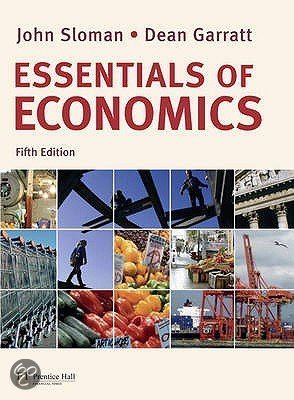
Summary of
‘ESSENTIALS OF ECONOMICS’ (5 th
ed.)
by
John Sloman
Dean Garratt
Summarized by
Dawid Szarawdorz
Christian Reiter
Marie Geest
Navina Scherschel
Nina Ueltzen
Maarten Schoonbeg
Sisi & Bojun
Jan, 2013
, Table of Contents
CHAPTER
1
ECONOMIC
ISSUES
4
1.1
THE
ECONOMIC
PROBLEM
4
1.2
DIVIDING
UP
THE
SUBJECT
5
1.3
MODELLING
ECONOMIC
RELATIONSHIPS
7
1.4
ECONOMIC
SYSTEMS
12
CHAPTER
2
MARKETS,
DEMANDS
AND
SUPPLY
17
2.1
ECONOMIC
SYSTEMS
17
2.2
DEMAND
19
2.3
SUPPLY
21
2.4
THE
DETERMINATION
OF
PRICE
24
2.5
THE
FREE-‐MARKET
ECONOMY
26
CHAPTER
3
MARKETS
IN
ACTION
28
3.1
PRICE
ELASTICITY
OF
DEMAND
28
3.2
PRICE
ELASTICITY
OF
DEMAND
AND
CONSUMER
EXPENDITURE
30
3.3
PRICE
ELASTICITY
OF
SUPPLY
31
3.4
OTHER
ELASTICITIES
32
3.5
MARKETS
AND
ADJUSTMENT
OVER
TIME
33
3.6
MARKETS
WHERE
PRICES
ARE
CONTOLLED
35
CHAPTER
4
THE
SUPPLY
DECISION
38
4.1
PRODUCTION
AND
COSTS:
SHORT-‐RUN
38
4.2
PRODUCTION
AND
COSTS:
LONG-‐RUN
39
4.3
REVENUE
42
4.4
PROFIT
MAXIMIZATION
42
CHAPTER
5
MARKET
STRUCTURES
44
5.1
THE
DEGREE
OF
COMPETITION
44
5.2
PERFECT
COMPETITION
45
5.3
MONOPOLY
47
5.4
MONOPOLISTIC
COMPETITION
51
5.5
OLIGOPOLY
54
5.6
GAME
THEORY
61
5.7
PRICE
DISCRIMINATION
65
CHAPTER
6
WAGES
AND
THE
DISTRIBUTION
OF
INCOME
67
6.1
LABOUR
MARKET
TRENDS
67
6.2
WAGE
DETERMINATION
IN
A
PERFECT
MARKET
67
6.3
WAGES
DETERMINATION
IN
IMPERFECT
MARKETS
70
6.4
CAUSE
OF
INEQUALTY
75
6.5
THE
REDISTRIBUTION
OF
INCOME
77
CHAPTER
9
AGGREGATE
SUPPLY
AND
GROWTH
79
9.1
THE
AD-‐AS
MODEL
79
9.2
INTRODUCING
ECONOMIC
GROWTH
82
9.3
SHORT-‐TERM
ECONOMIC
GROWTH
AND
THE
BUSINESS
CYCLE
82
9.4
EXPLANATIONS
OF
THE
BUSINESS
CYCLE
84
9.5
LONG
TERM
ECONOMIC
GROWTH
85
9.6
EXPLANATIONS
OF
ECONOMIC
GROWTH
86
CHAPTER
10
BANKING,
MONEY
AND
INTEREST
RATES
90
10.1
THE
MEANING
AND
FUNCTIONS
OF
MONEY
90
,10.2
THE
FINANCIAL
SYSTEM
90
10.3
THE
SUPPLY
OF
MONEY
94
10.4
THE
DEMAND
FOR
MONEY
96
10.5
EQUILIBRIUM
98
CHAPTER
11
INFLATION
AND
UNEMPLOYMENT
101
11.1
INFLATION
101
11.2
MONEY
SUPPLY,
AGGREGATE
DEMAND
AND
INFLATION
104
11.3
UNEMPLOYMENT.
106
11.4
THE
RELATIONSHIP
BETWEEN
INFLATION
AND
UNEMPLOYMENT:
THE
SHORT
RUN.
111
11.5
THE
RELATIONSHIP
BETWEEN
INFLATION
AND
UNEMPLOYMENT:
INTRODUCING
EXPECTATIONS
115
11.6
INFLATION
RATE
TARGETING
AND
UNEMPLOYMENT
118
, CHAPTER 1 ECONOMIC ISSUES
1.1 THE ECONOMIC PROBLEM
What is economics all about?
- Economics is concerned with the following:
- Production: The transformation of inputs into outputs by firms in order to earn profit
(or meet some other objective).
- Consumption: The act of using goods and services to satisfy wants. This will
normally involve purchasing the goods and services.
- The central economic problem is scarcity.
The problem of scarcity
- Human wants are virtually unlimited, whereas the resources available to satisfy these
wants are limited
- These resources are called factors of production and there are 3 broad types:
- Factors of production (or resources): The inputs into the production of goods and
services: labour, land, raw materials and capital.
o Human resources: Labour: All forms of human input, both physical and
mental, into current production.
o Natural resources: Land (and raw materials): Inputs into production that are
provided by nature: e.g. unimproved land and mineral deposits in the ground.
o Manufactured resources: Capital: All inputs into production that have
themselves been produced: e.g. factories, machines and tools.
- Scarcity: The excess of human wants over what can actually be produced to fulfil
these wants. Because of scarcity, various choices have to be made between
alternatives.
- Humans do not all face an equal problem of scarcity (a poor person is unable to afford
enough food; a rich person is unable to afford a second Ferrari; but given that people,
both rich and poor, want more than they can have, this makes them behave in certain
ways)
- Therefore, it is important to know:
o How resources are distributed, whether between different individuals, regions
or countries
- Economics studies anything to do with the process of satisfying human wants.
Demand and supply
- Demand is related to wants; virtually boundless (perhaps limited only by people’s
imagination)
- Supply is related to resources; limited
- Potential demands will exceed potential supplies; society therefore has to find some
way of dealing with this problem
- It applies at the level of economy overall: aggregate demand will need to be balanced
against aggregate supply
- aggregate = dt. Gesamt, Zusammengesetzt, Angehäuft, Insgesamt
, Recap:
1. The central economic problem is that of scarcity.
2. Given that there is a limited supply of factors of production (labour, land and capital),
it is impossible to provide everybody with everything they want.
3. Potential demands exceed potential supplies.
1.2 DIVIDING UP THE SUBJECT
What is meant by ‘macroeconomics’ and ‘microeconomics’?
- macro = big
- micro = small
- Macroeconomics: The branch of economics that studies economic aggregates (grand
totals): e.g. the overall level of prices, output and employment in the economy.
o Aggregate demand: The total level of spending in the economy (whether by
consumers, customers outside the country for our exports, by the government
etc.)
o Aggregate supply: The total amount of output in the economy (total national
output of goods and services)
- Microeconomics: The branch of economics that studies individual units; concerned
with the demand and supply of particular goods and services and resources; studies
the interrelationship between these units in determining the pattern of production and
distribution of goods and services.
Macroeconomics
- things are scarce, so societies are concerned that their resources should be used as
fully as possible, and that over time their national output should grow
- Economies are inherently unstable and display what are known as business cycles:
periods of high growth followed by periods of low or even negative growth
- Macroeconomics studies the determination of national output and its growth over
time; also studies the problems of recession, unemployment, inflation, the balance of
international payments and cyclical instability, and the policies adopted by
governments to deal with these problems
- Macroeconomic problems are closely related to the balance between aggregate
demand and aggregate supply
- If aggregate demand is too high relative to aggregate supply, inflation and balance of
trade deficits are likely to result
o Inflation refers to a general rise in the level of prices throughout the economy.
o Balance of trade deficits are the excess of imports over exports.
- Rate of inflation: The percentage increase in the level of prices over a 12-month
period.
- Balance of trade: Exports of goods and services minus imports of goods and
services. If exports exceed imports, there is a ‘balance of trade surplus’ (a positive
‘ESSENTIALS OF ECONOMICS’ (5 th
ed.)
by
John Sloman
Dean Garratt
Summarized by
Dawid Szarawdorz
Christian Reiter
Marie Geest
Navina Scherschel
Nina Ueltzen
Maarten Schoonbeg
Sisi & Bojun
Jan, 2013
, Table of Contents
CHAPTER
1
ECONOMIC
ISSUES
4
1.1
THE
ECONOMIC
PROBLEM
4
1.2
DIVIDING
UP
THE
SUBJECT
5
1.3
MODELLING
ECONOMIC
RELATIONSHIPS
7
1.4
ECONOMIC
SYSTEMS
12
CHAPTER
2
MARKETS,
DEMANDS
AND
SUPPLY
17
2.1
ECONOMIC
SYSTEMS
17
2.2
DEMAND
19
2.3
SUPPLY
21
2.4
THE
DETERMINATION
OF
PRICE
24
2.5
THE
FREE-‐MARKET
ECONOMY
26
CHAPTER
3
MARKETS
IN
ACTION
28
3.1
PRICE
ELASTICITY
OF
DEMAND
28
3.2
PRICE
ELASTICITY
OF
DEMAND
AND
CONSUMER
EXPENDITURE
30
3.3
PRICE
ELASTICITY
OF
SUPPLY
31
3.4
OTHER
ELASTICITIES
32
3.5
MARKETS
AND
ADJUSTMENT
OVER
TIME
33
3.6
MARKETS
WHERE
PRICES
ARE
CONTOLLED
35
CHAPTER
4
THE
SUPPLY
DECISION
38
4.1
PRODUCTION
AND
COSTS:
SHORT-‐RUN
38
4.2
PRODUCTION
AND
COSTS:
LONG-‐RUN
39
4.3
REVENUE
42
4.4
PROFIT
MAXIMIZATION
42
CHAPTER
5
MARKET
STRUCTURES
44
5.1
THE
DEGREE
OF
COMPETITION
44
5.2
PERFECT
COMPETITION
45
5.3
MONOPOLY
47
5.4
MONOPOLISTIC
COMPETITION
51
5.5
OLIGOPOLY
54
5.6
GAME
THEORY
61
5.7
PRICE
DISCRIMINATION
65
CHAPTER
6
WAGES
AND
THE
DISTRIBUTION
OF
INCOME
67
6.1
LABOUR
MARKET
TRENDS
67
6.2
WAGE
DETERMINATION
IN
A
PERFECT
MARKET
67
6.3
WAGES
DETERMINATION
IN
IMPERFECT
MARKETS
70
6.4
CAUSE
OF
INEQUALTY
75
6.5
THE
REDISTRIBUTION
OF
INCOME
77
CHAPTER
9
AGGREGATE
SUPPLY
AND
GROWTH
79
9.1
THE
AD-‐AS
MODEL
79
9.2
INTRODUCING
ECONOMIC
GROWTH
82
9.3
SHORT-‐TERM
ECONOMIC
GROWTH
AND
THE
BUSINESS
CYCLE
82
9.4
EXPLANATIONS
OF
THE
BUSINESS
CYCLE
84
9.5
LONG
TERM
ECONOMIC
GROWTH
85
9.6
EXPLANATIONS
OF
ECONOMIC
GROWTH
86
CHAPTER
10
BANKING,
MONEY
AND
INTEREST
RATES
90
10.1
THE
MEANING
AND
FUNCTIONS
OF
MONEY
90
,10.2
THE
FINANCIAL
SYSTEM
90
10.3
THE
SUPPLY
OF
MONEY
94
10.4
THE
DEMAND
FOR
MONEY
96
10.5
EQUILIBRIUM
98
CHAPTER
11
INFLATION
AND
UNEMPLOYMENT
101
11.1
INFLATION
101
11.2
MONEY
SUPPLY,
AGGREGATE
DEMAND
AND
INFLATION
104
11.3
UNEMPLOYMENT.
106
11.4
THE
RELATIONSHIP
BETWEEN
INFLATION
AND
UNEMPLOYMENT:
THE
SHORT
RUN.
111
11.5
THE
RELATIONSHIP
BETWEEN
INFLATION
AND
UNEMPLOYMENT:
INTRODUCING
EXPECTATIONS
115
11.6
INFLATION
RATE
TARGETING
AND
UNEMPLOYMENT
118
, CHAPTER 1 ECONOMIC ISSUES
1.1 THE ECONOMIC PROBLEM
What is economics all about?
- Economics is concerned with the following:
- Production: The transformation of inputs into outputs by firms in order to earn profit
(or meet some other objective).
- Consumption: The act of using goods and services to satisfy wants. This will
normally involve purchasing the goods and services.
- The central economic problem is scarcity.
The problem of scarcity
- Human wants are virtually unlimited, whereas the resources available to satisfy these
wants are limited
- These resources are called factors of production and there are 3 broad types:
- Factors of production (or resources): The inputs into the production of goods and
services: labour, land, raw materials and capital.
o Human resources: Labour: All forms of human input, both physical and
mental, into current production.
o Natural resources: Land (and raw materials): Inputs into production that are
provided by nature: e.g. unimproved land and mineral deposits in the ground.
o Manufactured resources: Capital: All inputs into production that have
themselves been produced: e.g. factories, machines and tools.
- Scarcity: The excess of human wants over what can actually be produced to fulfil
these wants. Because of scarcity, various choices have to be made between
alternatives.
- Humans do not all face an equal problem of scarcity (a poor person is unable to afford
enough food; a rich person is unable to afford a second Ferrari; but given that people,
both rich and poor, want more than they can have, this makes them behave in certain
ways)
- Therefore, it is important to know:
o How resources are distributed, whether between different individuals, regions
or countries
- Economics studies anything to do with the process of satisfying human wants.
Demand and supply
- Demand is related to wants; virtually boundless (perhaps limited only by people’s
imagination)
- Supply is related to resources; limited
- Potential demands will exceed potential supplies; society therefore has to find some
way of dealing with this problem
- It applies at the level of economy overall: aggregate demand will need to be balanced
against aggregate supply
- aggregate = dt. Gesamt, Zusammengesetzt, Angehäuft, Insgesamt
, Recap:
1. The central economic problem is that of scarcity.
2. Given that there is a limited supply of factors of production (labour, land and capital),
it is impossible to provide everybody with everything they want.
3. Potential demands exceed potential supplies.
1.2 DIVIDING UP THE SUBJECT
What is meant by ‘macroeconomics’ and ‘microeconomics’?
- macro = big
- micro = small
- Macroeconomics: The branch of economics that studies economic aggregates (grand
totals): e.g. the overall level of prices, output and employment in the economy.
o Aggregate demand: The total level of spending in the economy (whether by
consumers, customers outside the country for our exports, by the government
etc.)
o Aggregate supply: The total amount of output in the economy (total national
output of goods and services)
- Microeconomics: The branch of economics that studies individual units; concerned
with the demand and supply of particular goods and services and resources; studies
the interrelationship between these units in determining the pattern of production and
distribution of goods and services.
Macroeconomics
- things are scarce, so societies are concerned that their resources should be used as
fully as possible, and that over time their national output should grow
- Economies are inherently unstable and display what are known as business cycles:
periods of high growth followed by periods of low or even negative growth
- Macroeconomics studies the determination of national output and its growth over
time; also studies the problems of recession, unemployment, inflation, the balance of
international payments and cyclical instability, and the policies adopted by
governments to deal with these problems
- Macroeconomic problems are closely related to the balance between aggregate
demand and aggregate supply
- If aggregate demand is too high relative to aggregate supply, inflation and balance of
trade deficits are likely to result
o Inflation refers to a general rise in the level of prices throughout the economy.
o Balance of trade deficits are the excess of imports over exports.
- Rate of inflation: The percentage increase in the level of prices over a 12-month
period.
- Balance of trade: Exports of goods and services minus imports of goods and
services. If exports exceed imports, there is a ‘balance of trade surplus’ (a positive