Lectures Adolescent Development – Exam 2
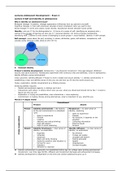
Lecture 6 Self and identity in adolescence
Why is identity an adolescent issue?
Biological changes puberty; changes appearance (influences how you perceive yourself)
Cognitive changes more self-conscious; develop a future orientation (who you want to be)
Social changes norms and values; social choices; educational choices (broader social world)
Identity: who am I? Can be distinguished in: (1) terms of a sense of self: identifying as someone who…;
central is the process of figuring out who one is = personal identity; (2) terms of group membership:
identifying with…; central is one’s sense of belonging to social groups = social identity. Identity self-concept
Self-concept: views about the self, including values; attributes; goals; self-esteem; competence; self-
concept clarity (having a clear sense of who one is).
A. Personal identity
Erikson’s identity development. Adolescence = psychosocial moratorium: time gap between childhood
security and adult autonomy. Adolescents experiment with numerous roles and identities. Crisis in adolescence:
identity diffusion versus achievement.
Crisis outcomes: identity diffusion failure to form a stable and secure identity <> identity achievement
establishing a clear and definite sense of who you are and how you fit into the world around you.
Today: exploration, identity development as a lifelong process.
Achieving identity requires:
- Mental and emotional capacity children can’t do it
- Interactions with others others inform who you are, what you should and should not be like = crucial to
figure out who you are
- Exploration trying out possibilities, more interactions = more exploring
- Commitment making choices among alternatives, what is important to you, what fits you
Marcia’s 4 stages model
Commitment
Present Absent
Presen Identity achievement = did explore, Moratorium = no clear sense of
t at the end commitment to a standard/ identity; exploring
rules - Open to experience
- Open to experience - Flexible
Crisis/exploration
- Flexible - No direction, it depends on the
- Creative situation
- Abstract and critical thinking - Collecting information
- High self-esteem - External doubt
- High in moral reasoning - Anxious
Absent Identity foreclosure = clear sense of Identity diffusion = no clear sense of
identity; no exploration identity; no exploration
- Dogmatic - No direction
- Inflexible - It does not matter
- Intolerant - Unstable self-esteem
- Black and white thinking - Feeling alienated
- Authority sensitive (the situation is - Apathy
formed for you) - Hopelessness
- Obedient - Suicidal thoughts
- Sensitive to rejection
Identity achievement is generally not established before age 18; college years prolong psychosocial
moratorium; over time (age 30/35), diffusion and moratorium decrease and achievement increases.
Identity development is dependent on the time and context adolescents grow up in.
,Dual cycle models view identity development as dynamic and interactive
Adolescents do not begin with a blank slate = already some commitment with who you are. Identity is not a
static process but a cyclic process. Identity formation is a process of continuous interplay between
commitment, reconsideration and in-depth exploration. Identity formation occurs in several domains (e.g.
educational and interpersonal) and becomes increasingly complex over time.
Crocetti et al. model
You stick to current commitments Alternatives = reconsider and change commitments
Reconsider and change commitments
Personal identity: summary
- Refers to identity search and commitment
- Goal is a coherent sense of self
- Continuous process (across time and place)
- Develops through exploration and commitment on various domains
B. Social identity
Social identity theory
Gender; peer group; ethnicity; religion; teams; SES; humanity etc. Belongingness to a group affects self-
definition. Beliefs, interests and actions are aligned with those of the group. Strive to positive self and group
evaluation drives group comparisons and favorable bias towards ingroup.
Identity & gender
Gender identity: one’s sense of oneself as male, female, or transgender. Sexual orientation: whether one is
sexually attracted to individuals of the same sex, other sex, or both. Gender-role behavior: the extent to
which an individual behaves in traditionally ‘masculine’ or ‘feminine’ ways.
These concepts are not related, the outcome can be totally different
What do we see in development?
Childhood: labelling around 2, preference for gender-congruent toys, play mates, future professions,
accomplishments; compared to girls, boys have stronger gender-identity, are more content with their gender,
place more pressure on themselves to conform to the expected gender roles.
Adolescence: sexual orientation (i.e. gay, lesbian, bisexual, or heterosexual) develops; beliefs about gender
roles become more flexible, more and more androgynous, but… societal pressure for gender-stereotypic
behavior increases (gender intensification hypothesis). During adolescence, boys show a drop in emotional
expressiveness (e.g. being gentle, helpful), but girls do not show a similar decline in instrumentality (e.g. being
competitive, adventurous). For girls it may be more accepted to show this behavior than for boys.
Peer identity. Benefits: secure environment for exploration; more diverse peer groups = more exploration and
smoother transition into adulthood; pathway from external regulation by others to self-determination.
Article Tanti et al: 3 adolescent groups (early; mid; late). Types of ingroups: gender and peer (popular, normal,
nerd). Outcome variables: self-
typicality (how much self is
perceived typical of ingroup) and
ingroup favoritism (allocating
money to ingroup versus
outgroup). Bias towards gender
or peer group.
, Bright side of social identities: increase in sense of identity and sense of belonging; uncertainty reduction;
higher self-esteem. Down side of social identities: exclusion (discrimination, outcast lash-out effect=aggression
when rejected); stereotype threat (performance drops); little autonomy (level of individual voice).
Social identity: summary
- Defining the self in terms of group membership
- Beliefs, interests, and actions are aligned with those of the group
- Identification with social groups increases during adolescence
- Can have both positive and negative effects
C. Self-concept
During adolescence self-concepts become more:
- Abstract, complex and linked to specific situations (related to both traits and personality characteristics)
- Consistent between self-concept descriptions and actual behavior (larger in adolescents than in children)
- Hypothetical and future-oriented (possible selves)
- Able to view themselves from a distance
Due to the capacity of abstract thinking, adolescents can distinguish between the actual self (who I am) and
possible selves (who I might become).
Possible selves – 2 types: (1) positive, hoped-for, or ideal selves (Who I would like to become); (2) negative,
or feared selves (who I wish to avoid becoming).
Possible self categories:
- Achievement relates to school and school interactions with teachers, achievement-related activities;
- Interpersonal relationships involve family, friends, relationships, and social interactions;
- Personality traits relates to personality characteristics, self-descriptions of traits;
- Physical/health-related relates to physical health, weight, height;
- Material/lifestyles relates to material possessions and living situation, including moving.
Possible selves motivate action. Possible selves improve well-being and performance because they: articulate
goals; link goals to behavior; provide potential incentives for actions. However, everyone has aspirations and
wants to do well, but not everyone succeeds = aspiration-attainment gap.
Possible selves work best when positive and negative possible selves are balanced (from the same domain);
individuals have incorporated strategies; they are identity-congruent; they fit the context.
Immersed self: self through own eyes; using singular pronouns. Distal self: self through the eyes of others;
using third person pronouns; particularly salient in adolescence; can have negative and positive effects.
Self-concept: summary
- Self-concept refers to beliefs about the self (goals, values, attributes, (perceived) ability)
- Develops in adolescence (more abstract, complex, consistent with behavior, future oriented, distal)
- Possible selves motivate action, but work best under certain conditions
- Imaging a distal self can be adaptive in emotional situations
Lecture 6 Self and identity in adolescence
Why is identity an adolescent issue?
Biological changes puberty; changes appearance (influences how you perceive yourself)
Cognitive changes more self-conscious; develop a future orientation (who you want to be)
Social changes norms and values; social choices; educational choices (broader social world)
Identity: who am I? Can be distinguished in: (1) terms of a sense of self: identifying as someone who…;
central is the process of figuring out who one is = personal identity; (2) terms of group membership:
identifying with…; central is one’s sense of belonging to social groups = social identity. Identity self-concept
Self-concept: views about the self, including values; attributes; goals; self-esteem; competence; self-
concept clarity (having a clear sense of who one is).
A. Personal identity
Erikson’s identity development. Adolescence = psychosocial moratorium: time gap between childhood
security and adult autonomy. Adolescents experiment with numerous roles and identities. Crisis in adolescence:
identity diffusion versus achievement.
Crisis outcomes: identity diffusion failure to form a stable and secure identity <> identity achievement
establishing a clear and definite sense of who you are and how you fit into the world around you.
Today: exploration, identity development as a lifelong process.
Achieving identity requires:
- Mental and emotional capacity children can’t do it
- Interactions with others others inform who you are, what you should and should not be like = crucial to
figure out who you are
- Exploration trying out possibilities, more interactions = more exploring
- Commitment making choices among alternatives, what is important to you, what fits you
Marcia’s 4 stages model
Commitment
Present Absent
Presen Identity achievement = did explore, Moratorium = no clear sense of
t at the end commitment to a standard/ identity; exploring
rules - Open to experience
- Open to experience - Flexible
Crisis/exploration
- Flexible - No direction, it depends on the
- Creative situation
- Abstract and critical thinking - Collecting information
- High self-esteem - External doubt
- High in moral reasoning - Anxious
Absent Identity foreclosure = clear sense of Identity diffusion = no clear sense of
identity; no exploration identity; no exploration
- Dogmatic - No direction
- Inflexible - It does not matter
- Intolerant - Unstable self-esteem
- Black and white thinking - Feeling alienated
- Authority sensitive (the situation is - Apathy
formed for you) - Hopelessness
- Obedient - Suicidal thoughts
- Sensitive to rejection
Identity achievement is generally not established before age 18; college years prolong psychosocial
moratorium; over time (age 30/35), diffusion and moratorium decrease and achievement increases.
Identity development is dependent on the time and context adolescents grow up in.
,Dual cycle models view identity development as dynamic and interactive
Adolescents do not begin with a blank slate = already some commitment with who you are. Identity is not a
static process but a cyclic process. Identity formation is a process of continuous interplay between
commitment, reconsideration and in-depth exploration. Identity formation occurs in several domains (e.g.
educational and interpersonal) and becomes increasingly complex over time.
Crocetti et al. model
You stick to current commitments Alternatives = reconsider and change commitments
Reconsider and change commitments
Personal identity: summary
- Refers to identity search and commitment
- Goal is a coherent sense of self
- Continuous process (across time and place)
- Develops through exploration and commitment on various domains
B. Social identity
Social identity theory
Gender; peer group; ethnicity; religion; teams; SES; humanity etc. Belongingness to a group affects self-
definition. Beliefs, interests and actions are aligned with those of the group. Strive to positive self and group
evaluation drives group comparisons and favorable bias towards ingroup.
Identity & gender
Gender identity: one’s sense of oneself as male, female, or transgender. Sexual orientation: whether one is
sexually attracted to individuals of the same sex, other sex, or both. Gender-role behavior: the extent to
which an individual behaves in traditionally ‘masculine’ or ‘feminine’ ways.
These concepts are not related, the outcome can be totally different
What do we see in development?
Childhood: labelling around 2, preference for gender-congruent toys, play mates, future professions,
accomplishments; compared to girls, boys have stronger gender-identity, are more content with their gender,
place more pressure on themselves to conform to the expected gender roles.
Adolescence: sexual orientation (i.e. gay, lesbian, bisexual, or heterosexual) develops; beliefs about gender
roles become more flexible, more and more androgynous, but… societal pressure for gender-stereotypic
behavior increases (gender intensification hypothesis). During adolescence, boys show a drop in emotional
expressiveness (e.g. being gentle, helpful), but girls do not show a similar decline in instrumentality (e.g. being
competitive, adventurous). For girls it may be more accepted to show this behavior than for boys.
Peer identity. Benefits: secure environment for exploration; more diverse peer groups = more exploration and
smoother transition into adulthood; pathway from external regulation by others to self-determination.
Article Tanti et al: 3 adolescent groups (early; mid; late). Types of ingroups: gender and peer (popular, normal,
nerd). Outcome variables: self-
typicality (how much self is
perceived typical of ingroup) and
ingroup favoritism (allocating
money to ingroup versus
outgroup). Bias towards gender
or peer group.
, Bright side of social identities: increase in sense of identity and sense of belonging; uncertainty reduction;
higher self-esteem. Down side of social identities: exclusion (discrimination, outcast lash-out effect=aggression
when rejected); stereotype threat (performance drops); little autonomy (level of individual voice).
Social identity: summary
- Defining the self in terms of group membership
- Beliefs, interests, and actions are aligned with those of the group
- Identification with social groups increases during adolescence
- Can have both positive and negative effects
C. Self-concept
During adolescence self-concepts become more:
- Abstract, complex and linked to specific situations (related to both traits and personality characteristics)
- Consistent between self-concept descriptions and actual behavior (larger in adolescents than in children)
- Hypothetical and future-oriented (possible selves)
- Able to view themselves from a distance
Due to the capacity of abstract thinking, adolescents can distinguish between the actual self (who I am) and
possible selves (who I might become).
Possible selves – 2 types: (1) positive, hoped-for, or ideal selves (Who I would like to become); (2) negative,
or feared selves (who I wish to avoid becoming).
Possible self categories:
- Achievement relates to school and school interactions with teachers, achievement-related activities;
- Interpersonal relationships involve family, friends, relationships, and social interactions;
- Personality traits relates to personality characteristics, self-descriptions of traits;
- Physical/health-related relates to physical health, weight, height;
- Material/lifestyles relates to material possessions and living situation, including moving.
Possible selves motivate action. Possible selves improve well-being and performance because they: articulate
goals; link goals to behavior; provide potential incentives for actions. However, everyone has aspirations and
wants to do well, but not everyone succeeds = aspiration-attainment gap.
Possible selves work best when positive and negative possible selves are balanced (from the same domain);
individuals have incorporated strategies; they are identity-congruent; they fit the context.
Immersed self: self through own eyes; using singular pronouns. Distal self: self through the eyes of others;
using third person pronouns; particularly salient in adolescence; can have negative and positive effects.
Self-concept: summary
- Self-concept refers to beliefs about the self (goals, values, attributes, (perceived) ability)
- Develops in adolescence (more abstract, complex, consistent with behavior, future oriented, distal)
- Possible selves motivate action, but work best under certain conditions
- Imaging a distal self can be adaptive in emotional situations