Section 2: Culture and Health
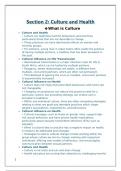
What is Culture
Culture and Health
• Culture can legitimise harmful behaviours and practices,
particularly those that are not desirable to change.
• These practices can have detrimental effects on women and
minority groups.
• For instance, young men in urban towns often justify the practice
of having multiple partners, a tradition that has been prevalent in
the past.
Cultural Influence on HIV Transmission
• Heterosexual transmission is a major infection route for HIV in
South Africa, which can be fuelled by multiple partners.
• Polygamy, where relationships are stable, is different from
multiple, concurrent partners, which are often not permanent.
• The likelihood of passing the virus on multiple, concurrent partners
is exponentially increased.
Cultural Influence on Health
• Culture does not imply that prescribed behaviours and norms are
not changeable.
• Changing circumstances can reduce the practical need for a
particular custom, but prevailing ideology can endure and is
encoded in traditions.
• Within one individual culture, there are often competing ideologies
relating to what are good and desirable practices which shape
people's assumptions, expectations, and behaviours.
Cultural Influence on Health
• Cultural messages, such as those on gender roles, support high-
risk sexual behaviour and have proven health implications,
particularly about sexually transmitted infections (STIs) such as
HIV/AIDS.
• When a cultural idea or practice has a negative impact on health,
it needs to be addressed and changed.
• Strategies to lead to cultural change include working within the
group whose culture we aim to change, working with respected
individuals, offering new models of behaviour, and encouraging
communication between sexual partners.
Culture and Health
• Culture is not static and can and does change.
• Health educators are turning their attention to challenging harmful
1
, cultural norms, as seen in educational campaigns to combat
HIV/AIDS.
Culture's Role in Society
i. Culture distinguishes humans from animals and is linked to
cognition, symbols, language, and material artefacts.
ii. Material artefacts, such as medical stethoscopes, carry meaning and
represent prestige, authority, and specialised knowledge.
iii. Culture is socially constructed and learned through enculturation, or
transmission of beliefs, norms, values, and practices from one
generation to the next.
Culture's Influence on Behaviour and Emotional Responses
i. Culture shapes our behaviour and is tied to traditions, customs, and
beliefs.
ii. Culture influences how we convey these emotions to others and
gives indications of beauty standards, ideal weight, desirable and
undesirable behaviours, values, and norms in a particular
community.
Culture's Variability and Change
i. Culture varies from community to community, and within
communities.
ii. Within complex modern societies, there are many cultures, sub-
cultures, and even countercultures which can coexist or compete.
iii. Culture is never static; it is a process rather than being fixed, and it
continuously changes.
Defining Terms of Culture
i. Norms: Widely agreed-upon principles or rules people are expected
to see.
ii. Values: Abstract ideals, such as monogamy.
iii. Religion: A set of beliefs adhered to by the members of a
community, incorporating symbols regarded with a sense of awe or
wonder together with ritual practices.
iv. Traditions: A set of social practices which look to celebrate and
inculcate certain behavioural norms and values.
Culture's Influence on Life Aspects
i. Culture influences all aspects of our lives, including everyday
behaviour, the way we dress or speak, and the meaning,
importance, and social behaviour around life-cycle events.
2
What is Culture
Culture and Health
• Culture can legitimise harmful behaviours and practices,
particularly those that are not desirable to change.
• These practices can have detrimental effects on women and
minority groups.
• For instance, young men in urban towns often justify the practice
of having multiple partners, a tradition that has been prevalent in
the past.
Cultural Influence on HIV Transmission
• Heterosexual transmission is a major infection route for HIV in
South Africa, which can be fuelled by multiple partners.
• Polygamy, where relationships are stable, is different from
multiple, concurrent partners, which are often not permanent.
• The likelihood of passing the virus on multiple, concurrent partners
is exponentially increased.
Cultural Influence on Health
• Culture does not imply that prescribed behaviours and norms are
not changeable.
• Changing circumstances can reduce the practical need for a
particular custom, but prevailing ideology can endure and is
encoded in traditions.
• Within one individual culture, there are often competing ideologies
relating to what are good and desirable practices which shape
people's assumptions, expectations, and behaviours.
Cultural Influence on Health
• Cultural messages, such as those on gender roles, support high-
risk sexual behaviour and have proven health implications,
particularly about sexually transmitted infections (STIs) such as
HIV/AIDS.
• When a cultural idea or practice has a negative impact on health,
it needs to be addressed and changed.
• Strategies to lead to cultural change include working within the
group whose culture we aim to change, working with respected
individuals, offering new models of behaviour, and encouraging
communication between sexual partners.
Culture and Health
• Culture is not static and can and does change.
• Health educators are turning their attention to challenging harmful
1
, cultural norms, as seen in educational campaigns to combat
HIV/AIDS.
Culture's Role in Society
i. Culture distinguishes humans from animals and is linked to
cognition, symbols, language, and material artefacts.
ii. Material artefacts, such as medical stethoscopes, carry meaning and
represent prestige, authority, and specialised knowledge.
iii. Culture is socially constructed and learned through enculturation, or
transmission of beliefs, norms, values, and practices from one
generation to the next.
Culture's Influence on Behaviour and Emotional Responses
i. Culture shapes our behaviour and is tied to traditions, customs, and
beliefs.
ii. Culture influences how we convey these emotions to others and
gives indications of beauty standards, ideal weight, desirable and
undesirable behaviours, values, and norms in a particular
community.
Culture's Variability and Change
i. Culture varies from community to community, and within
communities.
ii. Within complex modern societies, there are many cultures, sub-
cultures, and even countercultures which can coexist or compete.
iii. Culture is never static; it is a process rather than being fixed, and it
continuously changes.
Defining Terms of Culture
i. Norms: Widely agreed-upon principles or rules people are expected
to see.
ii. Values: Abstract ideals, such as monogamy.
iii. Religion: A set of beliefs adhered to by the members of a
community, incorporating symbols regarded with a sense of awe or
wonder together with ritual practices.
iv. Traditions: A set of social practices which look to celebrate and
inculcate certain behavioural norms and values.
Culture's Influence on Life Aspects
i. Culture influences all aspects of our lives, including everyday
behaviour, the way we dress or speak, and the meaning,
importance, and social behaviour around life-cycle events.
2