Introduction to Microeconomics
Class 1 – Introduction
Chapter 1: What is Economics?
What is Economics About?
• Economist?
o Managing money
o Investing in stock market
→ Much broader
o Study of human action
§ How ppl make choices
§ How ppl respond to incentives
§ The interaction between households and firms → exchange
• Economy:
o Economy: all the production and exchange activities that take place (in a
particular region)
o Economic activity: how much buying and selling goes on in the economy over a
period of time
§ The more buying and selling, the higher the level of economic activity
o Interactions → exchange → medium of exchange (money/service)
o Households: individuals purchase final goods and services + provide the input
into production (land, labor, capital)
o Firms: organizations which buy these production factors and use them to
produce goods and services
A Quick Journey Through Time
• Xenophon: Oeconomicus (ca. 362 BC)
o Economics < “Oikonomos” (Greek, = the one who manages a
household)
o Treatise on (sexual) division of labor in agriculture
• Plato: The Republic (ca. 370 BC)
o Discussion of justice and ideal soc
o Important economic question
§ “What goods and services should be produced in soc?”
o Importance of specialization
-1-
, o Soc starts to be formed when individuals find that they aren’t self-sufficient,
but have plenty requirements which they can’t fulfil on their own
§ Ppl get involved w others to fulfil needs
Ø Cause: neediness
ª Most basic & important: need for food and water
ª Second most important: place to live
ª Third: clothes
ª …
• Richard Cantillon: Essay on the nature of trade in general (1755),
posthumously (produced after his death)
o Mysterious person
§ Made fortune by being banker & speculator
Ø Some clients sued him w lawsuits & criminal
charges
o Price of good or service: amount of land + labor required to
produce it
o Notion of entrepreneurship
§ Farmer is entrepreneur, pays the owner fixed sum of money for
farm/land, without any certainty about what advantages he will derive
from the enterprise
o Notion of trade-offs
§ Son of laborer can
Ø Learn certain trade/craft
Ø Remain carrying out rural works that don’t require art or skill
• Adam Smith: The Wealth of Nations (1767)
o The Invisible Hand – A landmark in economics
§ Intellectual basis for market economy
§ Every individual intends only his own gain and is led by an
invisible hand to promote an end which was no part of his
intention
Ø By pursuing own interest, frequently promotes
that of soc more than intended
§ Key idea: individuals are best left to their own devices, without gov
guiding their actions
Ø Motivated by self-interest
Ø Invisible hand in market guides self-interest into promoting
general economic well-being
Ø Markets are good way to organize economic activity → self-
interested individuals’ actions produce socially desirable results
-2-
, • William Stanley Jevons: Theory of Political Economy (1871)
o Importance of math
§ It deals w quantities
o Introduction of “utility”
§ The addition made to a person’s happiness
§ Total utility: the satisfaction gained from the consumption of a good
§ Marginal utility: the addition to total utility as a result of consuming
one extra unit of a good
§ Contrast Cantillon (1755) and Jevons (1871)
Ø Cantillon: price of good/service depends on labor + land
Ø Jevons: price of good/service depends entirely on utility
• Alfred Marshall: Principles of Economics (1890)
o Several decades most important book in propagation of
economics, lot of influence on modern mainstream economics
o Price depends on both utility and costs of production
o Consumer surplus:
§ Buyer’s willingness to pay minus the amount the buyer
actually pays
o Producer surplus:
§ Amount a seller is paid minus seller’s cost
Economics Today
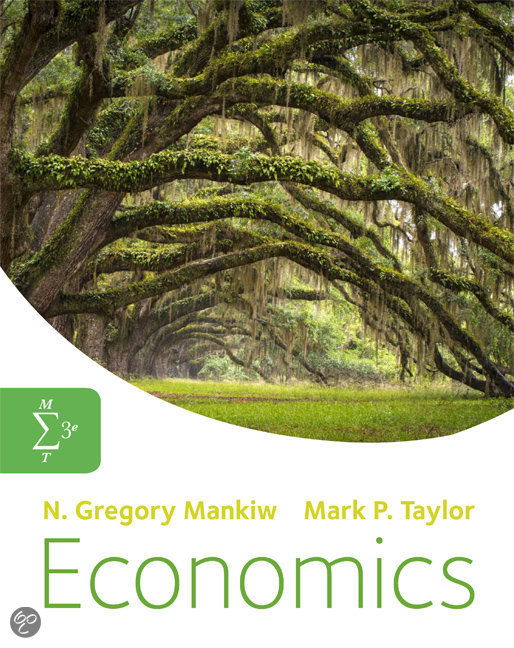
• Mankiw and Taylor: Economics (2017)
• The economic problem → 3 questions
o What goods and services should be produced?
o How should these goods and services be produced?
o Who should get the goods and services that have been produced?
§ To satisfy these: RESOURCES
• Society’s resources (production factors)
o Land: all the natural resources of earth
§ E.g. minerals (iron ore, coal, gold), oil & gas, food and raw materials
o Labor: human effort that goes into production (mental and physical)
§ E.g. factory worker producing tools, investment banker, teacher, …
o Capital: the equipment & structures used to produce goods and services
§ E.g. machinery, buildings, tractors, computers, ovens, …
Ø Good is not used for its own sake but for its contribution to
production
-3-
, • Scarcity
o Scarcity: the limited nature of society’s resources
§ Can’t produce everything the ppl desire
o Wants and needs
§ Needs: what we need to survive (food, clothes, shelter)
§ Wants: things that make life more comfortable (holidays, phones,
leisure)
§ Demand > ability to satisfy them
Ø Tension btwn wants, needs and scarcity
→ decisions about how to allocate incomes and resources
o Economics: the study of how soc manages its scarce resources
• Microeconomics: the study of how households and firms make decisions and how
they interact in markets
• Macroeconomics: the study of economy-wide phenomena, including inflation,
unemployment and economic growth
• Market: a group of buyers and sellers of a particular good or service (or production
factor)
Economics: How People Make Decisions
• Microeconomics: the study of how households and firms make decisions and how
they interact in markets
• Principles:
o Ppl face trade-offs
§ To get one thing, we usually have to give up another thing
§ Making decisions requires trading off one goal against another
§ E.g. food vs clothes, study vs leisure, …
§ Trade-off btwn efficiency and equity
Ø Efficiency: ways in which soc gets the most it can from its scarce
resources
ª Size of economic cake
-4-
, Ø Equity: the property of distributing economic prosperity fairly
among the members of soc
ª How cake is divided
Ø Two goals often conflict in gov policies
o Opportunity cost
§ Whatever must be given up to obtain some item
§ Making decisions requires individuals to compare the benefits and
costs of alternatives
Ø Go to uni or start working?
Ø Go to class or sleep?
§ Measure of the options sacrificed in making a decision; the value of the
benefits foregone
o Thinking at the margin
§ A framework/principle on which to base decision-making
§ Ppl make decisions by comparing benefits and costs at the margin
(e.g. incremental decisions)
§ Marginal changes: small incremental adjustments to a plan of action
Ø Examples:
ª Should I take another course this semester?
ª Should I study an additional hour for the exam?
§ Marginal utility: the addition to total utility as a result of consuming
one extra unit of a good
§ Marginal analysis: assumption that economic agents are seeking to
maximize/minimize outcomes when making decisions
Ø Economic agents: indiv, firm or organization that has an impact
on an economy
ª Behave rationally
§ Thinking at the margin: decision makers choose a course of action
→ marginal cost = marginal benefit
§ “Marginalist school”: e.g. W. S. Jevons, Menger
Ø Assumptions of rational economic behaviour
Ø Critique: if these assumptions are relaxed, outcomes may be
very different
o Ppl respond to incentives
§ Rational ppl make rational decisions → weighing costs and benefits
§ Marginal changes in costs/benefits motivates ppl to respond
Ø Behaviour may change when costs/benefits change
§ Public policies can create (dis)incentives that alter behaviour
-5-
, § Sometimes policymakers fail to understand how policies may alter
behavior
Ø “Unintended consequences”
§ Examples:
Ø Prisoners transport, putting price on plastic bags in
supermarket, sports club: membership incentives
Microeconomics: How People Interact
• Microeconomics: the study of how households and firms make decisions and how
they interact in markets
• Trade can make everyone better off
o Trade allows indiv, firms and countries to specialize in activities they do best
§ W income they receive from specializing they can trade w others and
improve standard of living
§ Access to cheap, good quality goods and services
§ Also costs and losers
Ø E.g. competition of very cheap production in developing
countries → unemployment in developed countries
• Markets Can Be a Good Way to Organize Economic Activity
o 3 economic questions → determined by the economic system
o Economic system: the way in which resources are organized and allocated to
provide for the needs of an economy’s citizens
o Capitalist economic system: system which relies on the private ownership of
factors of production to produce goods and services which are exchanged
through a price mechanism and where production is operated primarily for
profit
§ Based on markets
§ Relies on laws & regulations to ensure property rights are enforced
§ Capable of raising standard of living (→ measured by income)
§ Not everyone benefits equally
Ø Some countries become very rich, others remain poor
§ Profit motive: incentive for entrepreneurs to take risks to organize
factors of production
Ø Dynamism → developments in technology & capital efficiency
→ generate profits and increase knowledge & information →
contributes to economic development
-6-
, § Critiques
Ø Inherently unstable
Ø Exploit workers and favor those in charge → distorts resource
allocation
o Market economy (capitalist system): an economy that addresses the 3 key
economic questions by allocating resources through the decentralized
decisions of many firms and households as they interact in markets for goods
and services
§ Pure market economy: no gov intervention, no one considers the
economic well-being of soc as a whole
§ Free markets: many buyers and sellers, focused on own well-being,
successful in promoting overall economic well-being
o Planned economic systems (communist systems - command economies):
economic activity organized by central planners who decide on the answers to
the fundamental economic questions
§ Gov could organize economic activity that promoted economic well-
being for the entire country, more equitable outcome
o Market: a group of buyers & sellers (households and firms) of a particular good
or service (or production factor)
o Can be good way to organize economic activity
o Market failure: a situation where scarce resources are not allocated to their
most efficient use
§ Public goods and common resources
§ Externalities (cause 1)
Ø Cost/benefit of one person’s decision on the well-being of a
third party which the decision maker does not take into account
§ Asymmetric information
§ Monopoly/market power (cause 2)
Ø Ability of a single economic agent (or small group of agents) to
have substantial influence on market prices or output
• Governments
o Gov and public agencies can sometimes improve market outcomes
§ Provide goods & services that might not be sufficiently provided in
market system + set legal and regulatory framework
o Aim: promote efficiency and equity (e.g. income tax, social security system)
-7-
Class 1 – Introduction
Chapter 1: What is Economics?
What is Economics About?
• Economist?
o Managing money
o Investing in stock market
→ Much broader
o Study of human action
§ How ppl make choices
§ How ppl respond to incentives
§ The interaction between households and firms → exchange
• Economy:
o Economy: all the production and exchange activities that take place (in a
particular region)
o Economic activity: how much buying and selling goes on in the economy over a
period of time
§ The more buying and selling, the higher the level of economic activity
o Interactions → exchange → medium of exchange (money/service)
o Households: individuals purchase final goods and services + provide the input
into production (land, labor, capital)
o Firms: organizations which buy these production factors and use them to
produce goods and services
A Quick Journey Through Time
• Xenophon: Oeconomicus (ca. 362 BC)
o Economics < “Oikonomos” (Greek, = the one who manages a
household)
o Treatise on (sexual) division of labor in agriculture
• Plato: The Republic (ca. 370 BC)
o Discussion of justice and ideal soc
o Important economic question
§ “What goods and services should be produced in soc?”
o Importance of specialization
-1-
, o Soc starts to be formed when individuals find that they aren’t self-sufficient,
but have plenty requirements which they can’t fulfil on their own
§ Ppl get involved w others to fulfil needs
Ø Cause: neediness
ª Most basic & important: need for food and water
ª Second most important: place to live
ª Third: clothes
ª …
• Richard Cantillon: Essay on the nature of trade in general (1755),
posthumously (produced after his death)
o Mysterious person
§ Made fortune by being banker & speculator
Ø Some clients sued him w lawsuits & criminal
charges
o Price of good or service: amount of land + labor required to
produce it
o Notion of entrepreneurship
§ Farmer is entrepreneur, pays the owner fixed sum of money for
farm/land, without any certainty about what advantages he will derive
from the enterprise
o Notion of trade-offs
§ Son of laborer can
Ø Learn certain trade/craft
Ø Remain carrying out rural works that don’t require art or skill
• Adam Smith: The Wealth of Nations (1767)
o The Invisible Hand – A landmark in economics
§ Intellectual basis for market economy
§ Every individual intends only his own gain and is led by an
invisible hand to promote an end which was no part of his
intention
Ø By pursuing own interest, frequently promotes
that of soc more than intended
§ Key idea: individuals are best left to their own devices, without gov
guiding their actions
Ø Motivated by self-interest
Ø Invisible hand in market guides self-interest into promoting
general economic well-being
Ø Markets are good way to organize economic activity → self-
interested individuals’ actions produce socially desirable results
-2-
, • William Stanley Jevons: Theory of Political Economy (1871)
o Importance of math
§ It deals w quantities
o Introduction of “utility”
§ The addition made to a person’s happiness
§ Total utility: the satisfaction gained from the consumption of a good
§ Marginal utility: the addition to total utility as a result of consuming
one extra unit of a good
§ Contrast Cantillon (1755) and Jevons (1871)
Ø Cantillon: price of good/service depends on labor + land
Ø Jevons: price of good/service depends entirely on utility
• Alfred Marshall: Principles of Economics (1890)
o Several decades most important book in propagation of
economics, lot of influence on modern mainstream economics
o Price depends on both utility and costs of production
o Consumer surplus:
§ Buyer’s willingness to pay minus the amount the buyer
actually pays
o Producer surplus:
§ Amount a seller is paid minus seller’s cost
Economics Today
• Mankiw and Taylor: Economics (2017)
• The economic problem → 3 questions
o What goods and services should be produced?
o How should these goods and services be produced?
o Who should get the goods and services that have been produced?
§ To satisfy these: RESOURCES
• Society’s resources (production factors)
o Land: all the natural resources of earth
§ E.g. minerals (iron ore, coal, gold), oil & gas, food and raw materials
o Labor: human effort that goes into production (mental and physical)
§ E.g. factory worker producing tools, investment banker, teacher, …
o Capital: the equipment & structures used to produce goods and services
§ E.g. machinery, buildings, tractors, computers, ovens, …
Ø Good is not used for its own sake but for its contribution to
production
-3-
, • Scarcity
o Scarcity: the limited nature of society’s resources
§ Can’t produce everything the ppl desire
o Wants and needs
§ Needs: what we need to survive (food, clothes, shelter)
§ Wants: things that make life more comfortable (holidays, phones,
leisure)
§ Demand > ability to satisfy them
Ø Tension btwn wants, needs and scarcity
→ decisions about how to allocate incomes and resources
o Economics: the study of how soc manages its scarce resources
• Microeconomics: the study of how households and firms make decisions and how
they interact in markets
• Macroeconomics: the study of economy-wide phenomena, including inflation,
unemployment and economic growth
• Market: a group of buyers and sellers of a particular good or service (or production
factor)
Economics: How People Make Decisions
• Microeconomics: the study of how households and firms make decisions and how
they interact in markets
• Principles:
o Ppl face trade-offs
§ To get one thing, we usually have to give up another thing
§ Making decisions requires trading off one goal against another
§ E.g. food vs clothes, study vs leisure, …
§ Trade-off btwn efficiency and equity
Ø Efficiency: ways in which soc gets the most it can from its scarce
resources
ª Size of economic cake
-4-
, Ø Equity: the property of distributing economic prosperity fairly
among the members of soc
ª How cake is divided
Ø Two goals often conflict in gov policies
o Opportunity cost
§ Whatever must be given up to obtain some item
§ Making decisions requires individuals to compare the benefits and
costs of alternatives
Ø Go to uni or start working?
Ø Go to class or sleep?
§ Measure of the options sacrificed in making a decision; the value of the
benefits foregone
o Thinking at the margin
§ A framework/principle on which to base decision-making
§ Ppl make decisions by comparing benefits and costs at the margin
(e.g. incremental decisions)
§ Marginal changes: small incremental adjustments to a plan of action
Ø Examples:
ª Should I take another course this semester?
ª Should I study an additional hour for the exam?
§ Marginal utility: the addition to total utility as a result of consuming
one extra unit of a good
§ Marginal analysis: assumption that economic agents are seeking to
maximize/minimize outcomes when making decisions
Ø Economic agents: indiv, firm or organization that has an impact
on an economy
ª Behave rationally
§ Thinking at the margin: decision makers choose a course of action
→ marginal cost = marginal benefit
§ “Marginalist school”: e.g. W. S. Jevons, Menger
Ø Assumptions of rational economic behaviour
Ø Critique: if these assumptions are relaxed, outcomes may be
very different
o Ppl respond to incentives
§ Rational ppl make rational decisions → weighing costs and benefits
§ Marginal changes in costs/benefits motivates ppl to respond
Ø Behaviour may change when costs/benefits change
§ Public policies can create (dis)incentives that alter behaviour
-5-
, § Sometimes policymakers fail to understand how policies may alter
behavior
Ø “Unintended consequences”
§ Examples:
Ø Prisoners transport, putting price on plastic bags in
supermarket, sports club: membership incentives
Microeconomics: How People Interact
• Microeconomics: the study of how households and firms make decisions and how
they interact in markets
• Trade can make everyone better off
o Trade allows indiv, firms and countries to specialize in activities they do best
§ W income they receive from specializing they can trade w others and
improve standard of living
§ Access to cheap, good quality goods and services
§ Also costs and losers
Ø E.g. competition of very cheap production in developing
countries → unemployment in developed countries
• Markets Can Be a Good Way to Organize Economic Activity
o 3 economic questions → determined by the economic system
o Economic system: the way in which resources are organized and allocated to
provide for the needs of an economy’s citizens
o Capitalist economic system: system which relies on the private ownership of
factors of production to produce goods and services which are exchanged
through a price mechanism and where production is operated primarily for
profit
§ Based on markets
§ Relies on laws & regulations to ensure property rights are enforced
§ Capable of raising standard of living (→ measured by income)
§ Not everyone benefits equally
Ø Some countries become very rich, others remain poor
§ Profit motive: incentive for entrepreneurs to take risks to organize
factors of production
Ø Dynamism → developments in technology & capital efficiency
→ generate profits and increase knowledge & information →
contributes to economic development
-6-
, § Critiques
Ø Inherently unstable
Ø Exploit workers and favor those in charge → distorts resource
allocation
o Market economy (capitalist system): an economy that addresses the 3 key
economic questions by allocating resources through the decentralized
decisions of many firms and households as they interact in markets for goods
and services
§ Pure market economy: no gov intervention, no one considers the
economic well-being of soc as a whole
§ Free markets: many buyers and sellers, focused on own well-being,
successful in promoting overall economic well-being
o Planned economic systems (communist systems - command economies):
economic activity organized by central planners who decide on the answers to
the fundamental economic questions
§ Gov could organize economic activity that promoted economic well-
being for the entire country, more equitable outcome
o Market: a group of buyers & sellers (households and firms) of a particular good
or service (or production factor)
o Can be good way to organize economic activity
o Market failure: a situation where scarce resources are not allocated to their
most efficient use
§ Public goods and common resources
§ Externalities (cause 1)
Ø Cost/benefit of one person’s decision on the well-being of a
third party which the decision maker does not take into account
§ Asymmetric information
§ Monopoly/market power (cause 2)
Ø Ability of a single economic agent (or small group of agents) to
have substantial influence on market prices or output
• Governments
o Gov and public agencies can sometimes improve market outcomes
§ Provide goods & services that might not be sufficiently provided in
market system + set legal and regulatory framework
o Aim: promote efficiency and equity (e.g. income tax, social security system)
-7-