3.2 Particles and Radiation
3.2.1 Particles
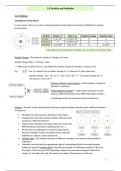
Constituents of the Atom:
In every atom, there’s a nucleus containing protons and neutrons (nucleons). Orbiting the nucleus
are electrons.
Particle Charge / C Mass / kg Relative Charge Relative Mass
Proton +1.6 x 10⁻¹⁹ 1.67(3) x 10-27 +1 1
Neutron 0 1.67(5) x 10-27 0 1
Electron -1.6 x 10⁻¹⁹ 9.11 x 10⁻³¹ -1 5 x 10⁻⁴
Only need to know relative charge and relative mass – the others are on the data sheet.
Specific Charge = The ratio of a particle’s charge to its mass.
Specific charge (Ckg-1) = Charge / Mass
--> Make sure to check if you’re calculating the specific charge of a particle, nucleus or ion.
E.g. Ion: (2- means it has a relative charge of -2, s there are 2 extra electrons).
Specific charge = (2 x -1.6 x 10⁻¹⁹ ) / (32 x 1.67 x 10-27 ) --> If we had a charge of +2,
we’d do (2 x +1.6 x 10⁻¹⁹)
Nucleon (Atomic Mass) Number = Total number of nucleons
(protons + neutrons)
Proton (Atomic) Number = Total number of protons in the
nucleus. Different elements have different proton numbers.
(A hydrogen atom has one proton and one electron.)
Isotope = An atom of the same element that has an equal number of protons but a different number
of neutrons.
Hydrogen has two isotopes: deuterium and tritium.
Isotopes have the same proton number otherwise they
would we a different element.
Isotopes have identical chemistry (react the same), but
different physics (densities, boiling points, etc...)
As they have an imbalance of neutrons and protons,
they are unstable, so they constantly decay and emit
radiation to achieve a more stable form.
Isotopic Data = The relative amounts of different isotopes of an element found within a
substance.
Scientists can calculate the approximate age of archaeological finds from dead organic
matter by using the isotopic data to find the percentage of radioactive carbon-14 that’s in
the object. This is because all living things contain the same percentage of radioactive
carbon-14, but after they die, the amount of carbon-14 decreases as it decays.
1
, Stable and Unstable Nuclei:
In the nucleus, there are several different forces acting on the nucleons. There are electrostatic
forces from the proton’s electric charges, and gravitational forces due to the masses of the particles.
The repulsion from the electrostatic force is much bigger than the gravitational attraction, so the
strong nuclear force is what holds the nucleus together (otherwise nucleons would fly apart):
It is an attractive force stronger than the electrostatic force.
It has a very short range, only when nucleons are below approximately 3 fm (x10 -15) apart
will they be affected.
It becomes repulsive at approximately 0.5 fm, otherwise the nucleus would be crushed to a
point.
It works equally between all nucleons.
Types of
Decay
When an isotope has too many nucleons/neutrons or too few neutrons, it will be radioactive and
unstable and will need to decay to become stable.
Alpha decay: Occurs in heavy/very big nuclei (e.g. uranium, radium).
The nucleus emits an alpha particle (a fast moving helium nucleus), 2 protons
and 2 neutrons.
Alpha particles have a very short range (few cm in air). This can be seen by
observing the tracks left by alpha particles in a cloud chamber, or by moving a Geiger
counter away from an alpha source.
Beta decay: Beta-minus decay occurs if the nucleus has too many neutrons.
One of the neutrons in the nucleus is changed into a proton, and the nucleus
emits a beta particle (a fast-moving electron) and an antineutrino.
Beta particles have a greater range than alpha particles.
Scientists originally thought the only particle emitted from the nucleus during beta
decay was the electron. However, observations showed the energy of the particles after the beta
decay was less than before, which didn’t fit with the principle of conservation of energy. A scientists
suggested another particle was being emitted which carried away the missing energy, the particle
has to be neutral (charge) and have zero/almost zero mass as it hasn’t been detected. This was
named the neutrino (now we know it’s an antineutrino).
Particles, Antiparticles and Photons:
For every particle, there’s a corresponding antiparticle.
Particles and antiparticles have the same: mass and rest mass-energy.
Particles and antiparticles have opposite: charge, baryon number, lepton numbers 2
3.2.1 Particles
Constituents of the Atom:
In every atom, there’s a nucleus containing protons and neutrons (nucleons). Orbiting the nucleus
are electrons.
Particle Charge / C Mass / kg Relative Charge Relative Mass
Proton +1.6 x 10⁻¹⁹ 1.67(3) x 10-27 +1 1
Neutron 0 1.67(5) x 10-27 0 1
Electron -1.6 x 10⁻¹⁹ 9.11 x 10⁻³¹ -1 5 x 10⁻⁴
Only need to know relative charge and relative mass – the others are on the data sheet.
Specific Charge = The ratio of a particle’s charge to its mass.
Specific charge (Ckg-1) = Charge / Mass
--> Make sure to check if you’re calculating the specific charge of a particle, nucleus or ion.
E.g. Ion: (2- means it has a relative charge of -2, s there are 2 extra electrons).
Specific charge = (2 x -1.6 x 10⁻¹⁹ ) / (32 x 1.67 x 10-27 ) --> If we had a charge of +2,
we’d do (2 x +1.6 x 10⁻¹⁹)
Nucleon (Atomic Mass) Number = Total number of nucleons
(protons + neutrons)
Proton (Atomic) Number = Total number of protons in the
nucleus. Different elements have different proton numbers.
(A hydrogen atom has one proton and one electron.)
Isotope = An atom of the same element that has an equal number of protons but a different number
of neutrons.
Hydrogen has two isotopes: deuterium and tritium.
Isotopes have the same proton number otherwise they
would we a different element.
Isotopes have identical chemistry (react the same), but
different physics (densities, boiling points, etc...)
As they have an imbalance of neutrons and protons,
they are unstable, so they constantly decay and emit
radiation to achieve a more stable form.
Isotopic Data = The relative amounts of different isotopes of an element found within a
substance.
Scientists can calculate the approximate age of archaeological finds from dead organic
matter by using the isotopic data to find the percentage of radioactive carbon-14 that’s in
the object. This is because all living things contain the same percentage of radioactive
carbon-14, but after they die, the amount of carbon-14 decreases as it decays.
1
, Stable and Unstable Nuclei:
In the nucleus, there are several different forces acting on the nucleons. There are electrostatic
forces from the proton’s electric charges, and gravitational forces due to the masses of the particles.
The repulsion from the electrostatic force is much bigger than the gravitational attraction, so the
strong nuclear force is what holds the nucleus together (otherwise nucleons would fly apart):
It is an attractive force stronger than the electrostatic force.
It has a very short range, only when nucleons are below approximately 3 fm (x10 -15) apart
will they be affected.
It becomes repulsive at approximately 0.5 fm, otherwise the nucleus would be crushed to a
point.
It works equally between all nucleons.
Types of
Decay
When an isotope has too many nucleons/neutrons or too few neutrons, it will be radioactive and
unstable and will need to decay to become stable.
Alpha decay: Occurs in heavy/very big nuclei (e.g. uranium, radium).
The nucleus emits an alpha particle (a fast moving helium nucleus), 2 protons
and 2 neutrons.
Alpha particles have a very short range (few cm in air). This can be seen by
observing the tracks left by alpha particles in a cloud chamber, or by moving a Geiger
counter away from an alpha source.
Beta decay: Beta-minus decay occurs if the nucleus has too many neutrons.
One of the neutrons in the nucleus is changed into a proton, and the nucleus
emits a beta particle (a fast-moving electron) and an antineutrino.
Beta particles have a greater range than alpha particles.
Scientists originally thought the only particle emitted from the nucleus during beta
decay was the electron. However, observations showed the energy of the particles after the beta
decay was less than before, which didn’t fit with the principle of conservation of energy. A scientists
suggested another particle was being emitted which carried away the missing energy, the particle
has to be neutral (charge) and have zero/almost zero mass as it hasn’t been detected. This was
named the neutrino (now we know it’s an antineutrino).
Particles, Antiparticles and Photons:
For every particle, there’s a corresponding antiparticle.
Particles and antiparticles have the same: mass and rest mass-energy.
Particles and antiparticles have opposite: charge, baryon number, lepton numbers 2