Transport in Plants Revision Notes
1. Transport in plants
Need for a transport system
- All living things need to take substances from, and return waste to, their environment
- Animals and larger plants have a smaller sa:v so need specialised exchange surfaces and transport system
- All plant cells need a regular supply of oxygen, water, nutrients, minerals
- Lower demand of oxygen as plants quite inactive and low respiration rate, hence can be met by diffusion
- Demand for water and sugars is high – water and minerals can be absorbed from the roots but they cant
absorb sugars from the soil
- The leaves can perform gaseous exchange but can’t absorb water from air, so need a transport system to:
1. Transport water and minerals from the roots to the leaves
2. Transport sugars from the leaves to the rest of the plant
Vascular tissues
- Water and soluble mineral ions travel upwards in xylem vessel
- Assimilates, e.g. sugars, travel up or down in phloem tissue
- Both xylem and phloem are highly specialised to carry out their transport system but have no pump, like
animals do, and they don’t carry respiratory gases
Distribution of vascular tissue
- Dicotyledonous plants have 2 seed leaves and a branching pattern of veins in the leaf
- Vascular tissue is distributed throughout the plant, xylem and phloem found together in vascular bundles that
can also contain other tissues e.g. collenchyma and sclerenchyma that give strength and support
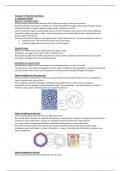
Xylem and phloem in the young root
- Vascular bundle is found at the centre of a young root with a central core of xylem in an x, and phloem is
found in between the arms of the x
- This arrangement provides strength to withstand the pulling forces to which roots are exposed
- Around the vascular bundle is a special sheath of cells – the endodermis – and just inside this is a layer of
meristem cells (a layer of dividing cells) here called the pericycle
Xylem and phloem in the stem
- The vascular bundles are found near the edge of the stem
- Non-woody plants: bundles are separate and discrete vs woody plants: separate in young stems but become a
continuous ring in older stems, so there is a complete ring of vascular tissue under the bark
- This ring provides strength and flexibility to withstand bending forces on stems/branches
- The xylem is found towards the inside of each vascular bundle and the phloem towards the outside
- In between xylem and phloem is a layer of cambium – a layer of meristem cells that divide to produce new
xylem and phloem
Xylem and phloem in the leaf
- The vascular bundles form the midrib and veins of a leaf
, - A dicotyledonous leaf has a branching network of veins, get smaller as they spread away from the midrib
- In each vein the xylem is on top of the phloem
2. Transport tissues
Xylem
Structure and function of xylem
- Xylem is a tissue used to transport water and mineral ions from the roots up to the leaves and elsewhere
- Xylem tissue consists of:
1. Vessels to carry the water and dissolved mineral ions
2. Fibres to help support the plant
3. Living parenchyma cells which act as packing tissue to separate and support the vessels
Xylem vessels
1. Lignin to waterproof and support
- As xylem vessels develop, lignin impregnates the cell walls to make them waterproof but also kills the cells
- The end walls and contents of the cells decay, leaving a long column of dead cells with no content
- Lignin strengthens this vessel’s walls and prevents collapse -> this keeps xylem vessels open at all times even if
water supply is short
2. Lignin to form patterns
- Lignin thickening forms patterns in the cell wall that can be spiral, annular (rings) or reticulate (network of
broken rings) -> this prevents the vessel from being too rigid, allows some flexibility of the stem/branch
3. Incomplete lignification to form bordered pits
- If lignification is incomplete in some places, there are gaps in the cell wall that form pits
- Bordered pits in adjacent vessels are aligned to allow water to leave on vessel and pass into the next
- They also allow water to leave the xylem and pass into the living parts of the plant
Adaptations of xylem to its function
1. Dead cells align end to end to form a continuous column
2. Tubes are narrow so the water column does not break easily and capillary action can be effective
3. Bordered pits in the lignified walls allow water to move sideways from one vessel to another
4. Lignin deposited in the walls in spiral, annular or reticulate patterns allows the xylem to stretch as the
plant grows and the stem/branch to bend
5. The flow of water is not impeded because:
a) No cross-walls
b) No cell contents, nucleus or cytoplasm
c) Lignin thickening prevents the walls from collapsing
Phloem
Structure and function of phloem
1. Transport in plants
Need for a transport system
- All living things need to take substances from, and return waste to, their environment
- Animals and larger plants have a smaller sa:v so need specialised exchange surfaces and transport system
- All plant cells need a regular supply of oxygen, water, nutrients, minerals
- Lower demand of oxygen as plants quite inactive and low respiration rate, hence can be met by diffusion
- Demand for water and sugars is high – water and minerals can be absorbed from the roots but they cant
absorb sugars from the soil
- The leaves can perform gaseous exchange but can’t absorb water from air, so need a transport system to:
1. Transport water and minerals from the roots to the leaves
2. Transport sugars from the leaves to the rest of the plant
Vascular tissues
- Water and soluble mineral ions travel upwards in xylem vessel
- Assimilates, e.g. sugars, travel up or down in phloem tissue
- Both xylem and phloem are highly specialised to carry out their transport system but have no pump, like
animals do, and they don’t carry respiratory gases
Distribution of vascular tissue
- Dicotyledonous plants have 2 seed leaves and a branching pattern of veins in the leaf
- Vascular tissue is distributed throughout the plant, xylem and phloem found together in vascular bundles that
can also contain other tissues e.g. collenchyma and sclerenchyma that give strength and support
Xylem and phloem in the young root
- Vascular bundle is found at the centre of a young root with a central core of xylem in an x, and phloem is
found in between the arms of the x
- This arrangement provides strength to withstand the pulling forces to which roots are exposed
- Around the vascular bundle is a special sheath of cells – the endodermis – and just inside this is a layer of
meristem cells (a layer of dividing cells) here called the pericycle
Xylem and phloem in the stem
- The vascular bundles are found near the edge of the stem
- Non-woody plants: bundles are separate and discrete vs woody plants: separate in young stems but become a
continuous ring in older stems, so there is a complete ring of vascular tissue under the bark
- This ring provides strength and flexibility to withstand bending forces on stems/branches
- The xylem is found towards the inside of each vascular bundle and the phloem towards the outside
- In between xylem and phloem is a layer of cambium – a layer of meristem cells that divide to produce new
xylem and phloem
Xylem and phloem in the leaf
- The vascular bundles form the midrib and veins of a leaf
, - A dicotyledonous leaf has a branching network of veins, get smaller as they spread away from the midrib
- In each vein the xylem is on top of the phloem
2. Transport tissues
Xylem
Structure and function of xylem
- Xylem is a tissue used to transport water and mineral ions from the roots up to the leaves and elsewhere
- Xylem tissue consists of:
1. Vessels to carry the water and dissolved mineral ions
2. Fibres to help support the plant
3. Living parenchyma cells which act as packing tissue to separate and support the vessels
Xylem vessels
1. Lignin to waterproof and support
- As xylem vessels develop, lignin impregnates the cell walls to make them waterproof but also kills the cells
- The end walls and contents of the cells decay, leaving a long column of dead cells with no content
- Lignin strengthens this vessel’s walls and prevents collapse -> this keeps xylem vessels open at all times even if
water supply is short
2. Lignin to form patterns
- Lignin thickening forms patterns in the cell wall that can be spiral, annular (rings) or reticulate (network of
broken rings) -> this prevents the vessel from being too rigid, allows some flexibility of the stem/branch
3. Incomplete lignification to form bordered pits
- If lignification is incomplete in some places, there are gaps in the cell wall that form pits
- Bordered pits in adjacent vessels are aligned to allow water to leave on vessel and pass into the next
- They also allow water to leave the xylem and pass into the living parts of the plant
Adaptations of xylem to its function
1. Dead cells align end to end to form a continuous column
2. Tubes are narrow so the water column does not break easily and capillary action can be effective
3. Bordered pits in the lignified walls allow water to move sideways from one vessel to another
4. Lignin deposited in the walls in spiral, annular or reticulate patterns allows the xylem to stretch as the
plant grows and the stem/branch to bend
5. The flow of water is not impeded because:
a) No cross-walls
b) No cell contents, nucleus or cytoplasm
c) Lignin thickening prevents the walls from collapsing
Phloem
Structure and function of phloem