REASERCH AND STATISTICS (7U9X0)
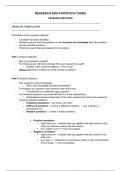
RESEARCH METHODS
PROBLEM FORMULATION
Formulation of the research objective
- A problem has been identified
- Research cannot solve the problem, but will increase the knowledge about the problem
and the possible solutions
- Which can lead to the best solution for the problem
Part I: research objective
- Why is the research needed?
- For what purpose will the knowledge from your research be used?
o Related to the recommendations -> how to act?
- Without objective it is difficult to make choices in research
Part II: research question
- This question is about knowledge
o Which new knowledge should be generated?
- Formulation as a question (with question mark at the end)
o The objective is a statement, not a question
- The research question is accompanied with 2 or more subquestions
o Subquestions are the components of the main question that need to be answered
- Types of research questions:
o Frequency questions – how many, how often
o Difference questions – is there a difference between … (e.g. 2 groups, 2
instruments etc.)
o Relation questions – is there a relation between …
Positive correlation
High scores on 1 variable often go together with high scores on the
other one (and low scores with low scores)
E.g. weight of car <+> fuel consumption
Negative correlation
High scores on 1 variable often go together with low scores on the
other one
E.g. price <-> willingness to purchase a project // year of introduction
of car model <-> fuel consumption
,CONCEPTUAL MODEL
Assumed relationships between variables
- What? – which variables must be considered
- How? – are the variables related to each other? Based on theory/experience/literature etc.
- Function? – helps formulate hypothesis and specific research questions -> determines
which analyses are conducted
Some guidelines for determining a conceptual model
- The unit of analysis - all variables should have the same unit of analysis
- Relationships – links represent causal relationships AND all boxes represent varieties
o X happens earlier in time than Y and X has an influence on Y
- There must be a correspondence between the conceptual model and the research
questions
1. The dependent variable(s) correspond(s) to the subject of the main question
2. Every relationship corresponds to a subquestion
- Check the consistency between research questions and the conceptual model
o Dependent variable(s): subject main Q
o In principle, every box occurs as a subquestion
o Every relationship occurs as a subquestion
- If not, then either change the conceptual model or change the questions
CAUSALITY
- X causes Y
o If we change X -> Y will change too
o X = cause, independent variable, predictor
o Y = effect, dependent, explained or predicted variable
- Why important?
o Understand – scientific
o Predict consequences of policy measures
- Condition for causality: X proceeds Y in time
Spurious relationship
- Two or more events or variables are associated but not causally related
- A correlation exists between X and Y
- This disappears after controlling for Z (3rd variable)
- Condition of causality: no 3rd variable exists that can explain away the correlation
Conditions for causality
1. Statistical correlation – can be measured
2. Cause before effect – time dependence can be a problem
3. No spurious relationship – measure all potential alternative causes and test if correlation
still exists
4. Theory: causal mechanism – how does the cause generate the effect
, RESEARCH DESIGN
Two important ideal types
- Experiment
o Typically – 1 group gets treatment, another group does not
o Much control by researchers – best design for ruling out alternative explanations –
statistical analysis is often simple
o Used for measuring effects of treatment and evaluative research (testing a
hypothesis)
o Main characteristics:
Control on independent variables – researcher decides which case gets
treatment; time order control
Randomization – cases are randomly assigned to control group and
experimental group
the design allows finding the effect of X, taking into account
autonomous change
o effect due to cause (experimental group) = Y2 – Y1
o autonomous change (control group) = Y4 – Y3
net effect = (Y2-Y1) – (Y4-Y3)
Before and after measurement – how much has changed
Control group – group that does not get treatment
- Survey
o Typically – large group of respondents completes a questionnaire
o Less control by researcher – ruling out of alternative explanations needs to e done
by using advanced statistics
o Often used for explorative and descriptive research
o Main characteristics:
Systematic interviewing or observation – all cases gets same questions
and same response possibilities
One moment measurement – no before/after measurement; problems with
time control
Large numbers – many cases to have reliable measurements; many
variables – testing for possible alternative causes (spurious relationship)
o When to apply? – predictors that can be controlled (age, gender etc.) // non-
observable variables (motives, attitudes, preferences, perceptions, wishes, needs
and plans / reasons for behaviour / behaviour in past)
o But problems with identification of causality
No time control – due to 1 measurement moment & no control on
predictor // does cause come before effect? *theory necessary
Spurious relations – in an experiment potential alternative explanations
are ruled out // this does not apply for a survey *explicitly test for spurious
correlations
VALIDITY
- Internal validity – are casual interpretations in research valid // are an alternative
explanation ruled
- External validity – are results generalizable to different places, times, groups and
circumstances
RESEARCH METHODS
PROBLEM FORMULATION
Formulation of the research objective
- A problem has been identified
- Research cannot solve the problem, but will increase the knowledge about the problem
and the possible solutions
- Which can lead to the best solution for the problem
Part I: research objective
- Why is the research needed?
- For what purpose will the knowledge from your research be used?
o Related to the recommendations -> how to act?
- Without objective it is difficult to make choices in research
Part II: research question
- This question is about knowledge
o Which new knowledge should be generated?
- Formulation as a question (with question mark at the end)
o The objective is a statement, not a question
- The research question is accompanied with 2 or more subquestions
o Subquestions are the components of the main question that need to be answered
- Types of research questions:
o Frequency questions – how many, how often
o Difference questions – is there a difference between … (e.g. 2 groups, 2
instruments etc.)
o Relation questions – is there a relation between …
Positive correlation
High scores on 1 variable often go together with high scores on the
other one (and low scores with low scores)
E.g. weight of car <+> fuel consumption
Negative correlation
High scores on 1 variable often go together with low scores on the
other one
E.g. price <-> willingness to purchase a project // year of introduction
of car model <-> fuel consumption
,CONCEPTUAL MODEL
Assumed relationships between variables
- What? – which variables must be considered
- How? – are the variables related to each other? Based on theory/experience/literature etc.
- Function? – helps formulate hypothesis and specific research questions -> determines
which analyses are conducted
Some guidelines for determining a conceptual model
- The unit of analysis - all variables should have the same unit of analysis
- Relationships – links represent causal relationships AND all boxes represent varieties
o X happens earlier in time than Y and X has an influence on Y
- There must be a correspondence between the conceptual model and the research
questions
1. The dependent variable(s) correspond(s) to the subject of the main question
2. Every relationship corresponds to a subquestion
- Check the consistency between research questions and the conceptual model
o Dependent variable(s): subject main Q
o In principle, every box occurs as a subquestion
o Every relationship occurs as a subquestion
- If not, then either change the conceptual model or change the questions
CAUSALITY
- X causes Y
o If we change X -> Y will change too
o X = cause, independent variable, predictor
o Y = effect, dependent, explained or predicted variable
- Why important?
o Understand – scientific
o Predict consequences of policy measures
- Condition for causality: X proceeds Y in time
Spurious relationship
- Two or more events or variables are associated but not causally related
- A correlation exists between X and Y
- This disappears after controlling for Z (3rd variable)
- Condition of causality: no 3rd variable exists that can explain away the correlation
Conditions for causality
1. Statistical correlation – can be measured
2. Cause before effect – time dependence can be a problem
3. No spurious relationship – measure all potential alternative causes and test if correlation
still exists
4. Theory: causal mechanism – how does the cause generate the effect
, RESEARCH DESIGN
Two important ideal types
- Experiment
o Typically – 1 group gets treatment, another group does not
o Much control by researchers – best design for ruling out alternative explanations –
statistical analysis is often simple
o Used for measuring effects of treatment and evaluative research (testing a
hypothesis)
o Main characteristics:
Control on independent variables – researcher decides which case gets
treatment; time order control
Randomization – cases are randomly assigned to control group and
experimental group
the design allows finding the effect of X, taking into account
autonomous change
o effect due to cause (experimental group) = Y2 – Y1
o autonomous change (control group) = Y4 – Y3
net effect = (Y2-Y1) – (Y4-Y3)
Before and after measurement – how much has changed
Control group – group that does not get treatment
- Survey
o Typically – large group of respondents completes a questionnaire
o Less control by researcher – ruling out of alternative explanations needs to e done
by using advanced statistics
o Often used for explorative and descriptive research
o Main characteristics:
Systematic interviewing or observation – all cases gets same questions
and same response possibilities
One moment measurement – no before/after measurement; problems with
time control
Large numbers – many cases to have reliable measurements; many
variables – testing for possible alternative causes (spurious relationship)
o When to apply? – predictors that can be controlled (age, gender etc.) // non-
observable variables (motives, attitudes, preferences, perceptions, wishes, needs
and plans / reasons for behaviour / behaviour in past)
o But problems with identification of causality
No time control – due to 1 measurement moment & no control on
predictor // does cause come before effect? *theory necessary
Spurious relations – in an experiment potential alternative explanations
are ruled out // this does not apply for a survey *explicitly test for spurious
correlations
VALIDITY
- Internal validity – are casual interpretations in research valid // are an alternative
explanation ruled
- External validity – are results generalizable to different places, times, groups and
circumstances