Abstract: unistratified coatings epithelia and multilaminated coatings
epithelia
1.1.0) Definition
1.1.1) Unistratified (or single): 8 types
1) Squamous U.C.E.
2) Cubic U.C.E.
3) Cylindrical U.C.E. without apical differentiation
4) Cylindrical U.C.E. with glandular differentiation
5) Cylindrical U.C.E. with microvilli
6) Cylindrical U.C.E. with cilia
7) Cylindrical U.C.E. with stereocilia
8) Pseudostratified cylindrical C.E. with hair cells and glandular cells
1.1.2) Multi-laminated (or laminated): 5 types
1) Epidermal or keratinized squamous M.C.E.
2) Squamous or non-keratinized squamous M.C.E.
3) Cubic M.C.E.
4) Cylindrical M.C.E.
5) Urinary or transitional (or urothelium) C.E.
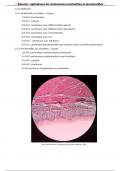
Histology Lab photo by Jeanne Przedborski, 2024
, 1.1.0) Definition
A coating epithelia limits a cavity, on a chorion (connective tissues + fibers).
It is non-vacsularized, united to cells, attached to desmosomes, + mechanical
resistance.
https://www.histology.be/atlas/HG/index.html
1.1.1) Unistratified (or single): 8 types
Differences in shape and apical differentiation
(apical: faces the cavity)
1) Squamous U.C.E.
= 1 layer of squamous (flattened) cells
Vessels (endothelium), serous (pericardium, pleura, peritoneum =
mesothelium), pulmonerous alveoli
Found in all histological sections!
https://www.histology.be/atlas/HG/index.html
2) Cubic U.C.E.
= a layer of cubic cells
Excretory ducts of exocrine glands, bronchioles (small bore)
https://histologique.univ-lille.fr/etude/co/chap2_1_1.html
3) Cylindrical U.C.E. without apical differentiation
= 1 polarized cylindrical cell layer (basal side nucleus), bordering frame/ junction
at the apical pole
Large excretory ducts of exocrine glands (salivary glands), distal convoluted
tubes of nephrons
epithelia
1.1.0) Definition
1.1.1) Unistratified (or single): 8 types
1) Squamous U.C.E.
2) Cubic U.C.E.
3) Cylindrical U.C.E. without apical differentiation
4) Cylindrical U.C.E. with glandular differentiation
5) Cylindrical U.C.E. with microvilli
6) Cylindrical U.C.E. with cilia
7) Cylindrical U.C.E. with stereocilia
8) Pseudostratified cylindrical C.E. with hair cells and glandular cells
1.1.2) Multi-laminated (or laminated): 5 types
1) Epidermal or keratinized squamous M.C.E.
2) Squamous or non-keratinized squamous M.C.E.
3) Cubic M.C.E.
4) Cylindrical M.C.E.
5) Urinary or transitional (or urothelium) C.E.
Histology Lab photo by Jeanne Przedborski, 2024
, 1.1.0) Definition
A coating epithelia limits a cavity, on a chorion (connective tissues + fibers).
It is non-vacsularized, united to cells, attached to desmosomes, + mechanical
resistance.
https://www.histology.be/atlas/HG/index.html
1.1.1) Unistratified (or single): 8 types
Differences in shape and apical differentiation
(apical: faces the cavity)
1) Squamous U.C.E.
= 1 layer of squamous (flattened) cells
Vessels (endothelium), serous (pericardium, pleura, peritoneum =
mesothelium), pulmonerous alveoli
Found in all histological sections!
https://www.histology.be/atlas/HG/index.html
2) Cubic U.C.E.
= a layer of cubic cells
Excretory ducts of exocrine glands, bronchioles (small bore)
https://histologique.univ-lille.fr/etude/co/chap2_1_1.html
3) Cylindrical U.C.E. without apical differentiation
= 1 polarized cylindrical cell layer (basal side nucleus), bordering frame/ junction
at the apical pole
Large excretory ducts of exocrine glands (salivary glands), distal convoluted
tubes of nephrons