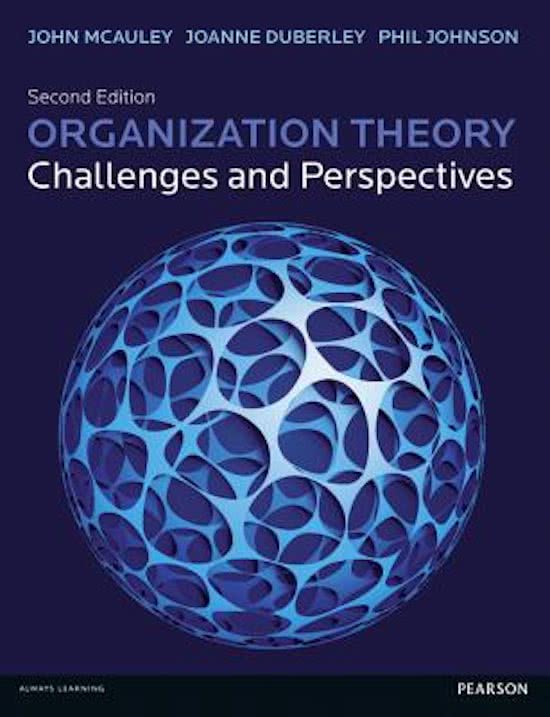
Organization theory
Lecture 1
Content:
- What is organization theory
- Why is it useful?
- Theoretical perspectives
- Design of the course
Two starter questions:
1. What do we mean with the term organization?
People working together to make a product of service. Combining different
processes. About relationships between people and how they organize there selfs.
2. What do you expect to learn?
Theoretical concepts about organizations. Theory’s about relationships between
people: organization. Structurers of organization.
What is organization
- ‘an’ organization is not a material object (no reification)
- ‘an’ organization is not a number of people
- The verb is a ‘to organize’
- ‘organization refers to:
o The way a number of people work together, interact
o Structure, order
o Goals, functions (=people who work, have a function in the structure)
- Etymology: organs in the human body
Organization exists at different levels
- Micro level: small group, classroom
- Mezzo level: school, company
- Macro level: society, economic sectors, organization transport
Many forms of organization
- Informal, temporary
- Formal, institutionalized
A trend is formalization: life is more and more organized.
Formalization = work roles are structured in an organization, and the activities of the
employees are governed by rules and procedures.
What will you learn?
- Theory organization
o Concepts
o Single theories about how organizations function
o Different theoretical perspectives
- Application
- Reflection
A theory doesn’t have to be the truth.
If you have different theories, you will have different perspectives.
Why would you want to learn theory
- Intrinsic value:
, o Understanding organizations
- Instrumental value:
o Analysing, evaluating organisations
o Predicting
o Making decisions, acting
o Communicating
“There is nothing more practical than a good theory”
A classic example of organizational theory:
Adam Smith (1776): the wealth of nations
To what does the west owe it’s wealth?
To answer this question, Adim Smith regards a new phenomenon: the factory system
How does a factory function?
How does a factory produce wealth?
Smith’s first answer: Division of labour
Different people doing different tasks
Divisions of labour increases efficiency, because:
- People do not have to change what they are doing
- Repetition enhances skill
- People can use different talents specialization
- Development of specific tools/ machines
Smith applies this theory to Western societies
- Western societies produce so much wealth, because they too divide labour: among
farmers, blacksmiths, bakers, butchers
- All these ‘specialists’ can work more efficiently than when a single man tries to perform all
these crafts himself
Furthermore, Smith develops a theory about why divisions of labour is stronger in
western societies
- He argues that specialization is produced by the freedom of people to trade an barter on
markets
- Markets guide behaviour as an invisible hand: YouTube
- According to Adam Smith, this mechanism is more effective than central planning
So, this theory… now: think…
How can Adam Smith’s theory be of value to you as a future manager.
Examples:
- Understand how a workplace functions together
- Plan complex work processes: divide it into tasks
- Communicate within a firm: “we need more divisions of labour”
- Think about the position of your firm in a market
Theories affect your observations and your thinking
Recall: what was the Wilson football video about? What would you concentrate on when you
would see it again
Perspectives in Organization Theory
- Different “schools”
- Ontology and epistemology
- Positivism and subjectivism
Lecture 1
Content:
- What is organization theory
- Why is it useful?
- Theoretical perspectives
- Design of the course
Two starter questions:
1. What do we mean with the term organization?
People working together to make a product of service. Combining different
processes. About relationships between people and how they organize there selfs.
2. What do you expect to learn?
Theoretical concepts about organizations. Theory’s about relationships between
people: organization. Structurers of organization.
What is organization
- ‘an’ organization is not a material object (no reification)
- ‘an’ organization is not a number of people
- The verb is a ‘to organize’
- ‘organization refers to:
o The way a number of people work together, interact
o Structure, order
o Goals, functions (=people who work, have a function in the structure)
- Etymology: organs in the human body
Organization exists at different levels
- Micro level: small group, classroom
- Mezzo level: school, company
- Macro level: society, economic sectors, organization transport
Many forms of organization
- Informal, temporary
- Formal, institutionalized
A trend is formalization: life is more and more organized.
Formalization = work roles are structured in an organization, and the activities of the
employees are governed by rules and procedures.
What will you learn?
- Theory organization
o Concepts
o Single theories about how organizations function
o Different theoretical perspectives
- Application
- Reflection
A theory doesn’t have to be the truth.
If you have different theories, you will have different perspectives.
Why would you want to learn theory
- Intrinsic value:
, o Understanding organizations
- Instrumental value:
o Analysing, evaluating organisations
o Predicting
o Making decisions, acting
o Communicating
“There is nothing more practical than a good theory”
A classic example of organizational theory:
Adam Smith (1776): the wealth of nations
To what does the west owe it’s wealth?
To answer this question, Adim Smith regards a new phenomenon: the factory system
How does a factory function?
How does a factory produce wealth?
Smith’s first answer: Division of labour
Different people doing different tasks
Divisions of labour increases efficiency, because:
- People do not have to change what they are doing
- Repetition enhances skill
- People can use different talents specialization
- Development of specific tools/ machines
Smith applies this theory to Western societies
- Western societies produce so much wealth, because they too divide labour: among
farmers, blacksmiths, bakers, butchers
- All these ‘specialists’ can work more efficiently than when a single man tries to perform all
these crafts himself
Furthermore, Smith develops a theory about why divisions of labour is stronger in
western societies
- He argues that specialization is produced by the freedom of people to trade an barter on
markets
- Markets guide behaviour as an invisible hand: YouTube
- According to Adam Smith, this mechanism is more effective than central planning
So, this theory… now: think…
How can Adam Smith’s theory be of value to you as a future manager.
Examples:
- Understand how a workplace functions together
- Plan complex work processes: divide it into tasks
- Communicate within a firm: “we need more divisions of labour”
- Think about the position of your firm in a market
Theories affect your observations and your thinking
Recall: what was the Wilson football video about? What would you concentrate on when you
would see it again
Perspectives in Organization Theory
- Different “schools”
- Ontology and epistemology
- Positivism and subjectivism