Social Cognition Study Guide with 100% correct answers
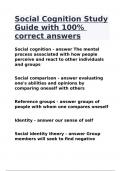
Social cognition The mental process associated with how people perceive and react to other individuals and groups Social comparison evaluating one's abilities and opinions by comparing oneself with others Reference groups groups of people with whom one compares oneself Identity our sense of self Social identity theory Group members will seek to find negative characteristics of "other" groups in order to improve self esteem Self-schema The mental representations that people form of themselves; how you define yourself Social perception The mental processes through which people interpret information about others, draw inferences about people and develop mental representations of them Self-fulfilling prophecy an expectation that causes you to act in ways that make that expectation come true. Attribution The process people go through to explain the causes of others' behavior Attributional biases Tendencies to systematically distort one's view of behavior Fundamental attribution error The widespread tendency to attribute the behavior of others to internal factors Actor-observer bias The tendency to attribute others' behavior to internal factors, but our own to external factors Matching Hypothesis the tendency to develop relationships with people who are similar in attractiveness Triangular theory intimacy, passion, commitment Attitude A predisposition to respond cognitively, emotionally, or behaviorally to a particular object in a particular way Cognitive Dissonance Theory Argues when our behaviors don't match our beliefs, we are motivated to either change our behavior or change our beliefs Stereotypes Impressions or schemas of entire groups of people Prejudice A positive or negative attitude toward an individual based on their membership in a group Social Identity the "we" aspect of our self-concept; the part of our answer to "Who am I?" that comes from our group memberships Social categorization The mental process of categorizing people into groups (or social categories) on the basis of their shared characteristics. Discrimination Unfair treatment of a member of a certain group based on their membership in that group Why are first impressions so important? They are easily formed yet hard to change. What is the difference between internal and external causes of behavior when making attributions? Internal is characteristics such as unfriendly, lazy, and insensitive. External is situational such as tragedy, illness, and abuse. What is interdependence in a relationship? Thoughts emotions, behaviors of one affect thoughts, emotions, and behavior of the other What are the components of attitudes? Identify and describe each. Affective component: the feeling. Behavioral component: the action. Cognitive component: the belief. Why are attitudes important? They guide people into how they react to other people, things, and events. What factors can often determine whether or not you will act on a belief or attitude? What people in your life will think of your actions, will your actions produce results, direct experience, self- awareness.
École, étude et sujet
- Établissement
- Social Cognition
- Cours
- Social Cognition
Infos sur le Document
- Publié le
- 11 juillet 2024
- Nombre de pages
- 11
- Écrit en
- 2023/2024
- Type
- Examen
- Contient
- Questions et réponses
Sujets
-
social cognition study guide

Document également disponible en groupe