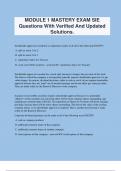
MODULE 1 MASTERY EXAM SIE Questions With Verified And Updated Solutions.
MODULE 1 MASTERY EXAM SIE Questions With Verified And Updated Solutions. Stockholder approval is needed if a corporation wishes to do all of the following EXCEPT: A. split its stock 1 for 2 B. split its stock 2 for 1 C. repurchase shares for Treasury D. issue convertible securities - answerC. repurchase shares for Treasury Stockholder approval is needed for a stock split, because it changes the par value of the stock. The State in which the company is incorporated typically requires shareholder approval of a par value change. In contrast, dividend decisions, either in cash or stock, do not require shareholder approval because they are "paid" out of retained earnings and do not affect par value per share. They are made solely by the Board of Directors of the company. Issuance of convertible securities requires shareholder approval because it is potentially "dilutive" (if the securities are converted, there will be more common shares outstanding, and earnings per common share will fall). The repurchase of shares for Treasury will boost earnings per share, because there will be fewer shares outstanding. This boosts the value of the existing common shares, so no shareholder approval is required. This is another decision that is made solely by the Board of Directors. Corporate dividend payments can be made in all of the following ways EXCEPT: A. cash or company products B. additional common shares of that company C. additional common shares of another company D. listed options of that company - answerD. listed options of that company Corporations can pay dividends as cash or in stock, and can also distribute products produced by that company as a dividend to shareholders. For example, Proctor & Gamble used to send soap products to shareholders. A company can make a distribution of additional shares of that company (a stock dividend); or can issue a dividend consisting of shares of another company (typically a wholly owned subsidiary whose shares are distributed to owners of the parent company). Corporations cannot make dividend distributions consisting of listed options in that company, since the contracts are created and issued by the Options Clearing Corporation - NOT the company. Common stockholders have all of the following rights EXCEPT: A. voting for the Board of Directors B. transferring share ownership without restriction by the issuer C. inspecting minutes of executive meetings D. maintaining proportionate ownership in the company - answerC. inspecting minutes of executive meetings Common stockholders do not get to inspect the minutes of executive meetings. They do have the right to vote; to sell their shares without issuer restriction; and to maintain proportionate ownership in the company. The market price of common stock will be influenced by which of the following? I The par value of the shares II Expectations for future earnings of the company III Expectations for future dividends to be paid by the company IV Book value of the company A. I and IV B. II and III C. I, II, III D. II and IV - answerB. II and III The market price of common stock is determined by investor expectations about the future of the company. Par value and book value have no bearing on the market price of the common. Which of the following statements are TRUE regarding cumulative voting? Cumulative voting: I gives the shareholders disproportionate voting weight as compared to statutory voting II gives the shareholders proportionate voting weight as compared to statutory voting III is considered to be an advantage to the small investor IV is considered to be an advantage to the large investor A. I and III B. I and IV C. II and III D. II and IV - answerA. I and III Cumulative voting gives the shareholders disproportionate voting weight as compared to statutory voting and is considered to be an advantage for the small investor. Under the statutory method, the number of shares held is the number of votes that the shareholder can apply to each directorship. Under the cumulative method, the shareholder can accumulate all votes that he has for all directorships and apply them to favored individuals. Thus, cumulative voting is considered to be an advantage to the small investor. XYZ Company has issued 10%, $100 par cumulative preferred stock. Two years ago, XYZ omitted its preferred dividend. Last year, it paid a preferred dividend of $5 per share. This year, XYZ wishes to pay a common dividend. In order to make the distribution to common shareholders, each preferred share must be paid a dividend of: A. $5 B. $15 C. $20 D. $25 - answerD. $25 Since the preferred stock is cumulative, to make a dividend distribution to common shareholders, the company needs to pay all back, unpaid dividends plus this year's dividend (before a common dividend can be paid). The stated dividend rate on the preferred is 10% based on $100 par. Two years ago the entire dividend was omitted, so $10 per share must be paid. Last year, the corporation only paid $5, so there is another $5 that must be paid. Also, this year's dividend of $10 must be paid. The total dividend that must be paid is $25 per preferred share before a common dividend can be paid. A customer buys 100 shares of preferred at $80 per share. The par value is $100. The dividend rate is 10%. The customer will receive how much in each dividend payment? A. $400 B. $500 C. $800 D. $1,000 - answerB. $500 SEMI ANNUALLY ($1,000/2=$500) ABC 8% $100 par preferred is trading at $105 in the market. The current yield is: A. 6.6% B. 7.6% C. 8.6% D. 10.6% - answerB. 7.6% Annual income/Market price = Current Yield $8/$105= 7.6% Which of the following statements are TRUE when comparing convertible preferred stock and non-convertible preferred stock? I Convertible preferred stock will have a higher yield than non-convertible preferred stock II Convertible preferred stock will have a lower yield than non-convertible preferred stock III Convertible preferred stockholders benefit as the market price of the common stock rises IV Convertible preferred stockholders benefit as the market price of the common stock falls A. I and III B. I and IV C. II and III D. II and IV - answerC. II and III Non-convertible preferred yields are higher than convertible yields. A non-convertible preferred stockholder gets a fixed rate of return without any growth potential. A convertible preferred stockholder can convert to common if the common's price rises, so growth potential is included. Because of this, yields for convertible preferred are lower than for non-convertible preferred. A middle-aged widowed customer has an investment objective of stable income and would also like to receive occasional "extra" income to help pay unexpected bills. What type of preferred stock would be the best recommendation? A. Participating preferred B. Convertible preferred C. Straight preferred D. Variable rate preferred - answerA. Participating preferred Preferred stock that pays a fixed dividend rate is "stra
École, étude et sujet
- Établissement
- SIE Mastery
- Cours
- SIE Mastery
Infos sur le Document
- Publié le
- 3 juillet 2024
- Nombre de pages
- 34
- Écrit en
- 2023/2024
- Type
- Examen
- Contient
- Questions et réponses
Sujets
-
module 1 mastery exam sie questions with verified

Document également disponible en groupe