INVESTMENT
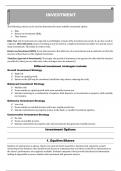
The following criteria can be used to determine the most suitable investment option:
➢ Risk.
➢ Return on Investment (ROI).
➢ Time frames.
Risk: High risk investments are expected to yield higher returns if the investment succeeds. It can also result in
a big loss. Diversification means everything is not invested in a single investment but rather it is spread across
many investments. This helps to reduce risks.
Return on Investment (ROI): A tool that measures the efficiency of an investment and an indicator of what the
investor will get back on the original investment.
Timelines (period of investment): The longer the period of investment, the greater the risks that the investor
can afford to take (you can take more risks on longer term investments).
Different investment strategies include:
Growth Investment Strategy
High risk.
Focus on capital growth.
Shares on the JSE may be considered (with blue-chip shares reducing the risk).
Balanced Investment Strategy
Medium risk.
Focus mainly on capital growth with some monthly income too.
Includes investing in a combination of equities, fixed deposits, or investments in property with monthly
rent income.
Defensive Investment Strategy
Low risk.
Focus mainly on monthly income with some capital growth too.
Includes investments in property, money in the bank, or smaller investment equities.
Conservative Investment Strategy
No risk.
Focus on monthly income.
Includes investment in property and cash instruments that generate monthly income.
Investment Options
1. Equities/Shares
Equities are also known as shares. Shares are units of stocks issued by a business that represent a small
ownership of the business. One should invest shares in companies that are listed on the JSE as information on
the share’s performance are regularly available. Unlisted companies don’t provide this financial information
making it impossible to assess whether the investment will generate returns.
, Shares can be obtained in 2 ways:
1. The shares were bought when they were issued the first time, thus this person contributes to the capital
of the business.
2. The shares were bought on the JSE from a previous shareholder. The person who sold this share gets
this money, not the business.
The share price is affected by supply and demand. Supply and demand of shares can be affected by:
➢ The level of confidence in the economy. If people feel the economy is doing well, they will be confident
about investing on the JSE and will be eager to buy shares (bull market). If investors are pessimistic and
anticipate losses, they will sell shares (bear market).
➢ Government policies/new legislation affect the confidence in the economy.
➢ Industry performance of the business. Some industries are more attractive to investors than others.
➢ Financial performance of the business, the better the performance, the more likely it is to generate good
dividends.
➢ The public’s confidence in the management team of the business. Higher confidence leads to higher
demand.
➢ Social issues around the business.
➢ Legal issues such as pending lawsuits, price fixing allegations, etc can negatively impact share price.
➢ Media coverage of the business, a positive coverage will give investors more confidence in the business.
Risk: Moderate/High risk. The JSE does however have rules to protect investors which decreases the risk.
ROI: Two factors affect ROI:
1. Increase in share price.
2. Dividends.
Shareholders buy shares in a company with the expectation that the share price will increase over time (capital
growth), or good dividends will be generated.
Dividends are the profits of the company and are divided amongst shareholders and are not taxed.
Time Frame: Short-term but investment in blue-chip shares are long-term investments. Speculators buy shares
in companies that they feel will have quick increases in share price and then sell these shares when there is an
opportunity to make profit.
Blue-chip shares are shares in high-end companies that have proven to be stable in the long run, such as Nike
and Adidas.
2. Debentures
A debenture (also called bonds) is a letter of credit that a business sells to raise capital. People that buy
debentures of a business will give the business money and the business will pay back this money with interest
at a later date. If the business issuing the debenture is considered high risk, there will be higher interest rates
offered to convince people to buy the debenture.
Types of Debentures:
Redeemable Debentures: They are repayable on a predetermined date.
Irredeemable Debentures: The debenture is never paid back by the company but will last indefinitely with
the debenture holder getting interest.
Convertible Debentures: The debenture will be converted into shares at a predetermined date.
Risk: Higher risk than investments in banks but lower risk than investment in shares. If debentures are sold at
fixed interest rates, they can have be positive or negative.
The following criteria can be used to determine the most suitable investment option:
➢ Risk.
➢ Return on Investment (ROI).
➢ Time frames.
Risk: High risk investments are expected to yield higher returns if the investment succeeds. It can also result in
a big loss. Diversification means everything is not invested in a single investment but rather it is spread across
many investments. This helps to reduce risks.
Return on Investment (ROI): A tool that measures the efficiency of an investment and an indicator of what the
investor will get back on the original investment.
Timelines (period of investment): The longer the period of investment, the greater the risks that the investor
can afford to take (you can take more risks on longer term investments).
Different investment strategies include:
Growth Investment Strategy
High risk.
Focus on capital growth.
Shares on the JSE may be considered (with blue-chip shares reducing the risk).
Balanced Investment Strategy
Medium risk.
Focus mainly on capital growth with some monthly income too.
Includes investing in a combination of equities, fixed deposits, or investments in property with monthly
rent income.
Defensive Investment Strategy
Low risk.
Focus mainly on monthly income with some capital growth too.
Includes investments in property, money in the bank, or smaller investment equities.
Conservative Investment Strategy
No risk.
Focus on monthly income.
Includes investment in property and cash instruments that generate monthly income.
Investment Options
1. Equities/Shares
Equities are also known as shares. Shares are units of stocks issued by a business that represent a small
ownership of the business. One should invest shares in companies that are listed on the JSE as information on
the share’s performance are regularly available. Unlisted companies don’t provide this financial information
making it impossible to assess whether the investment will generate returns.
, Shares can be obtained in 2 ways:
1. The shares were bought when they were issued the first time, thus this person contributes to the capital
of the business.
2. The shares were bought on the JSE from a previous shareholder. The person who sold this share gets
this money, not the business.
The share price is affected by supply and demand. Supply and demand of shares can be affected by:
➢ The level of confidence in the economy. If people feel the economy is doing well, they will be confident
about investing on the JSE and will be eager to buy shares (bull market). If investors are pessimistic and
anticipate losses, they will sell shares (bear market).
➢ Government policies/new legislation affect the confidence in the economy.
➢ Industry performance of the business. Some industries are more attractive to investors than others.
➢ Financial performance of the business, the better the performance, the more likely it is to generate good
dividends.
➢ The public’s confidence in the management team of the business. Higher confidence leads to higher
demand.
➢ Social issues around the business.
➢ Legal issues such as pending lawsuits, price fixing allegations, etc can negatively impact share price.
➢ Media coverage of the business, a positive coverage will give investors more confidence in the business.
Risk: Moderate/High risk. The JSE does however have rules to protect investors which decreases the risk.
ROI: Two factors affect ROI:
1. Increase in share price.
2. Dividends.
Shareholders buy shares in a company with the expectation that the share price will increase over time (capital
growth), or good dividends will be generated.
Dividends are the profits of the company and are divided amongst shareholders and are not taxed.
Time Frame: Short-term but investment in blue-chip shares are long-term investments. Speculators buy shares
in companies that they feel will have quick increases in share price and then sell these shares when there is an
opportunity to make profit.
Blue-chip shares are shares in high-end companies that have proven to be stable in the long run, such as Nike
and Adidas.
2. Debentures
A debenture (also called bonds) is a letter of credit that a business sells to raise capital. People that buy
debentures of a business will give the business money and the business will pay back this money with interest
at a later date. If the business issuing the debenture is considered high risk, there will be higher interest rates
offered to convince people to buy the debenture.
Types of Debentures:
Redeemable Debentures: They are repayable on a predetermined date.
Irredeemable Debentures: The debenture is never paid back by the company but will last indefinitely with
the debenture holder getting interest.
Convertible Debentures: The debenture will be converted into shares at a predetermined date.
Risk: Higher risk than investments in banks but lower risk than investment in shares. If debentures are sold at
fixed interest rates, they can have be positive or negative.