1 2 3 4 5
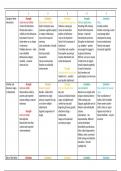
Caregiver-infant Strength Limitation Limitation Strength Limitation
interactions Good internal validity Observation of babies Developmental importance Practical applications Ethics
Control of distractions Hard to interpret cause Feldman: merely give Parenting skills training Socially sensitive
Filmed observations - (unknown cognitive aspect) names to observable Parent-Child Interaction Mothers returning to work
unlikely to miss behaviour, or nature of behaviour, patterns of behaviour – therapy – improved may damage baby’s
baby doesn’t know of may not have special may not be important interactional synchrony development causing
observation so no change meaning Doesn’t tell us purpose of Disruption in attachment insecure attachments
in behaviour Lack coordination, virtually behaviours e.g. adoption – parents Parents may appear
Multiple observers – inter- immobile Correlation not causation encouraged to engage in incorrectly neglectful
rater reliability Small and subtle Presumptive assuming it reciprocal behaviour
Behavioural category movements impacts attachment and Still face: can use to assess
checklist – prevents Cannot communicate moral development if child at risk of neglect –
observer bias Reaction to unfamiliar should respond negatively
environments Strength if used to interaction
Developmental importance Social workers and
Isabella et al. – predicts psychologists can intervene
good quality attachment
Schaffer and Strength Strength Strength Limitation Limitation
Emerson: stages External validity Research support Real-world applications Generalisability Poor evidence for asocial
of attachment Observations made by Bowlby – babies form Day care Based on one sample with stage
parents and reported - attachment to single Asocial and indiscriminate – unique contextual factors – Poor coordination of
natural setting so natural primary caregiver then go stages: straightforward, 1960s working class babies, fairly immobile
behaviour on to form multiple comfort by any adult Glasgow, applicable only to Shown anxiety subtly –
attachments Beginning it during specific Western and individualist didn’t notice or report
Strength Supports progression of attachment stage – cultures Appear asocial due to
External validity stages problematic Cultural bias – not flawed methods – may be
Not objective Usage can be planned representative, different incorrect
Biased with what they according to stages rearing techniques
noticed and reported - Nomothetic and devalues
misremembered other cultural approaches
Kibbutz, Israel: communal
child rearing and collective
education – formed
multiple first
Role of the father Limitation Limitation Limitation Limitation Limitation
, Inconsistency in research Conflicting evidence Socially sensitive Economy Biological reductionist
Some research: as Grossmann – play and Demoralising for father – Change rights e.g. increase Essentialist arguments –
secondary attachment stimulation, important role devalues role in family paternity leave – support for Grossmann’s
figures, others as primary Would expect children in Social pressure on mother government funded, affects findings
Some: different role to single-mother/lesbian to stay home, father to employers Biological: women more
mothers, others they can families to be different to work Gender pay gap reduce if caring due to oestrogen –
take on a ‘maternal’ role those in two-parent Stereotypes roles regarded as more naturally primary
Difficult to answer if no heterosexual families Reassuring advice for single equal Biologically deterministic –
consensus on what is being McCallum and Golombok: parents and Opportunity to stay at differences could be due to
discussed do not develop differently homosexual/lesbian home for longer and gender stereotypes and
May take distinctive roles families – not vital, can take become primary caregiver roles
in two-parent heterosexual on different/dual roles and Challenge stereotypes Instead: socially
families but can adapt to accommodate for missing Comforting for working constructive explanation –
accommodate role played parent mothers (contribute more) more optimistic about easy
by fathers and stay-at-home fathers change in role of father
Stereotypes (contribute less)
Role could be result of Legal matters – custody,
stereotypes rather than not automatically to
factual mother
Preconceptions –
unintentional observer bias
Animal studies: Strength Strength Limitation Strength Limitation
Lorenz Research support Real-world applications Contradicting research Supports Bowlby Generalisability to humans
Regolin and Vallortigara – Seebach: computer users Guiton et al. – chickens Innate need to form Cannot generalise
chicks followed original have ‘baby duck syndrome’ imprinted on yellow attachments (imprinting) Mammalian attachment
moving shape combination – attachment to first washing-up glove, later Bowlby: primary more complex than birds
the most closely computer operating tried to mate with them attachment type influences Two-way process:
Innate mechanism to system, reject others Learned to mate with other later relationships, poor mammalian mothers show
imprint in critical window Skin to skin contact with chickens instead attachments have negative emotional attachment to
parents after childbirth on Imprinting overcome – not consequences, sensitive young
chests irreversible period More complex brain
Development of babies and Animal research structures and
young animals contributed to evolutionary neurochemistry
Farming: wrap fleece from theory
dead lamb around orphan
lamb – mother looks after
as if own offspring –
survives
Caregiver-infant Strength Limitation Limitation Strength Limitation
interactions Good internal validity Observation of babies Developmental importance Practical applications Ethics
Control of distractions Hard to interpret cause Feldman: merely give Parenting skills training Socially sensitive
Filmed observations - (unknown cognitive aspect) names to observable Parent-Child Interaction Mothers returning to work
unlikely to miss behaviour, or nature of behaviour, patterns of behaviour – therapy – improved may damage baby’s
baby doesn’t know of may not have special may not be important interactional synchrony development causing
observation so no change meaning Doesn’t tell us purpose of Disruption in attachment insecure attachments
in behaviour Lack coordination, virtually behaviours e.g. adoption – parents Parents may appear
Multiple observers – inter- immobile Correlation not causation encouraged to engage in incorrectly neglectful
rater reliability Small and subtle Presumptive assuming it reciprocal behaviour
Behavioural category movements impacts attachment and Still face: can use to assess
checklist – prevents Cannot communicate moral development if child at risk of neglect –
observer bias Reaction to unfamiliar should respond negatively
environments Strength if used to interaction
Developmental importance Social workers and
Isabella et al. – predicts psychologists can intervene
good quality attachment
Schaffer and Strength Strength Strength Limitation Limitation
Emerson: stages External validity Research support Real-world applications Generalisability Poor evidence for asocial
of attachment Observations made by Bowlby – babies form Day care Based on one sample with stage
parents and reported - attachment to single Asocial and indiscriminate – unique contextual factors – Poor coordination of
natural setting so natural primary caregiver then go stages: straightforward, 1960s working class babies, fairly immobile
behaviour on to form multiple comfort by any adult Glasgow, applicable only to Shown anxiety subtly –
attachments Beginning it during specific Western and individualist didn’t notice or report
Strength Supports progression of attachment stage – cultures Appear asocial due to
External validity stages problematic Cultural bias – not flawed methods – may be
Not objective Usage can be planned representative, different incorrect
Biased with what they according to stages rearing techniques
noticed and reported - Nomothetic and devalues
misremembered other cultural approaches
Kibbutz, Israel: communal
child rearing and collective
education – formed
multiple first
Role of the father Limitation Limitation Limitation Limitation Limitation
, Inconsistency in research Conflicting evidence Socially sensitive Economy Biological reductionist
Some research: as Grossmann – play and Demoralising for father – Change rights e.g. increase Essentialist arguments –
secondary attachment stimulation, important role devalues role in family paternity leave – support for Grossmann’s
figures, others as primary Would expect children in Social pressure on mother government funded, affects findings
Some: different role to single-mother/lesbian to stay home, father to employers Biological: women more
mothers, others they can families to be different to work Gender pay gap reduce if caring due to oestrogen –
take on a ‘maternal’ role those in two-parent Stereotypes roles regarded as more naturally primary
Difficult to answer if no heterosexual families Reassuring advice for single equal Biologically deterministic –
consensus on what is being McCallum and Golombok: parents and Opportunity to stay at differences could be due to
discussed do not develop differently homosexual/lesbian home for longer and gender stereotypes and
May take distinctive roles families – not vital, can take become primary caregiver roles
in two-parent heterosexual on different/dual roles and Challenge stereotypes Instead: socially
families but can adapt to accommodate for missing Comforting for working constructive explanation –
accommodate role played parent mothers (contribute more) more optimistic about easy
by fathers and stay-at-home fathers change in role of father
Stereotypes (contribute less)
Role could be result of Legal matters – custody,
stereotypes rather than not automatically to
factual mother
Preconceptions –
unintentional observer bias
Animal studies: Strength Strength Limitation Strength Limitation
Lorenz Research support Real-world applications Contradicting research Supports Bowlby Generalisability to humans
Regolin and Vallortigara – Seebach: computer users Guiton et al. – chickens Innate need to form Cannot generalise
chicks followed original have ‘baby duck syndrome’ imprinted on yellow attachments (imprinting) Mammalian attachment
moving shape combination – attachment to first washing-up glove, later Bowlby: primary more complex than birds
the most closely computer operating tried to mate with them attachment type influences Two-way process:
Innate mechanism to system, reject others Learned to mate with other later relationships, poor mammalian mothers show
imprint in critical window Skin to skin contact with chickens instead attachments have negative emotional attachment to
parents after childbirth on Imprinting overcome – not consequences, sensitive young
chests irreversible period More complex brain
Development of babies and Animal research structures and
young animals contributed to evolutionary neurochemistry
Farming: wrap fleece from theory
dead lamb around orphan
lamb – mother looks after
as if own offspring –
survives