Cells To Systems - Cell Membranes
Cell Membranes
Membranes:
Acts as a barrier
Enclose a reaction compartment
Maintain concentration gradients (certain molecules have to be outside or inside the cell)
Determines what enters and leaves the compartment
Provides an interaction surface with the environment e.g mitochondrial inner membrane has a large surface
area and costs enzymes that are necessary for energy production
Barrier In Aqueous Environment:
2 Types Of Molecules:
1. Hydrophilic - Water loving, interaction with water is thermodynamically favourable
2. Hydrophobic - Water hating, apolar molecules unable to interact with water
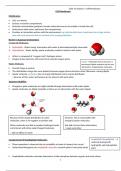
Water is composed of 1 oxygen and 2 hydrogen atoms
Oxygen draws electrons with more force towards oxygen atoms
Apolar - Molecules that do not have a
Water Molecule: permanent dipole moment and are not
attracted to charged/polar molecules
Overall charge is neutral
The distribution charge has some polarity because oxygen draws electrons closer (becomes a strong dipole
Apolar molecule e.g hexane has no charge distribution and is evenly distributed
= because of this, water and hexane do not interact with each other
Aqueous Solubility:
Charged or polar molecules are highly soluble through interactions with water dipole
Apolar molecules are highly insoluble as there are no interaction with the water dipole
Because of this charge distribution in water However, this is not possible with
molecules, there is no negative or positive side inorganic/apolar molecules.
Water molecules are able to produce hydrogen bonds Not able to form these interactions
and interact with other polar/charged molecules = repel each other
= able to diffuse in water
Comportment Of Amphiphatic Molecules: Amphiphilic/Amphiphatic - A
molecule having both
Phase separation is observed due to insolubility of water in hexane (vice versa) hydrophilic and hydrophobic
Surfactants/detergents are amphiphilic molecules (contain polar & non-polar parts) parts
Amphiphatic molecules orientate themselves at the interphase between organic and water phase
1
Cell Membranes
Membranes:
Acts as a barrier
Enclose a reaction compartment
Maintain concentration gradients (certain molecules have to be outside or inside the cell)
Determines what enters and leaves the compartment
Provides an interaction surface with the environment e.g mitochondrial inner membrane has a large surface
area and costs enzymes that are necessary for energy production
Barrier In Aqueous Environment:
2 Types Of Molecules:
1. Hydrophilic - Water loving, interaction with water is thermodynamically favourable
2. Hydrophobic - Water hating, apolar molecules unable to interact with water
Water is composed of 1 oxygen and 2 hydrogen atoms
Oxygen draws electrons with more force towards oxygen atoms
Apolar - Molecules that do not have a
Water Molecule: permanent dipole moment and are not
attracted to charged/polar molecules
Overall charge is neutral
The distribution charge has some polarity because oxygen draws electrons closer (becomes a strong dipole
Apolar molecule e.g hexane has no charge distribution and is evenly distributed
= because of this, water and hexane do not interact with each other
Aqueous Solubility:
Charged or polar molecules are highly soluble through interactions with water dipole
Apolar molecules are highly insoluble as there are no interaction with the water dipole
Because of this charge distribution in water However, this is not possible with
molecules, there is no negative or positive side inorganic/apolar molecules.
Water molecules are able to produce hydrogen bonds Not able to form these interactions
and interact with other polar/charged molecules = repel each other
= able to diffuse in water
Comportment Of Amphiphatic Molecules: Amphiphilic/Amphiphatic - A
molecule having both
Phase separation is observed due to insolubility of water in hexane (vice versa) hydrophilic and hydrophobic
Surfactants/detergents are amphiphilic molecules (contain polar & non-polar parts) parts
Amphiphatic molecules orientate themselves at the interphase between organic and water phase
1