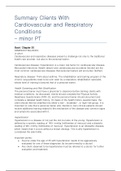
Summary Clients With
Cardiovascular and Respiratory
Conditions
– minor PT
Book: Chapter 20
SAMENVATTING BOEK:
In short
Cardiovascular and respiratory diseases present a challenge not only to the traditional
health care provider, but also to the personal trainer.
Cardiovascular disease: Hypertension is a major risk factor for cardiovascular disease.
Myocardial infarctions (hearth attack) and cerebrovascular accidents (stroke) are the
most common cardiovascular diseases that personal trainers will encounter (treffen).
Respiratory disease: Think about asthma. The rehabilitation and training program of the
chronic lung patients need to be over seen by a respiratory rehabilitation specialist,
whose level of training is beyond that of a personal trainer.
Health Screening and Risk Stratification
The personal trainer must have a physician’s clearance before training clients with
medical conditions. As discussed, clients should complete the Physical Activity
Readiness Questionnaire (PAR-Q), and the personal trainer should document and
complete a detailed health history. On basis of the health history questionnaire, the
client should then be stratified into either a low-, moderate-, or high-risk group. It is
important to note that a personal trainer who intends to train clinical patients should
receive additional training related to the mechanism of the disease and common signs
and symptoms associated with it.
Hypertension
Hypertension is a disease of not just the old, but also of the young. Hypertension is
defined by a systolic reading of 140+ mmHg (millimetres of mercury) and a diastolic
reading of 90+ mmHg (millimetres of mercury). Hypertension is an idiopathic disease,
which means that it occurs without a known etiology. This is why hypertension is
considered the silent killer.
Important points:
Anyone under the age of 35 with hypertension needs to be aggressively
evaluated for one of these diagnoses (to be performed by a doctor)
Any client observed to be hypertensive must be referred to a doctor for further
evaluation and treatment.
, Elevated blood pressure puts and individual at risk for a heart attack, stroke or both.
Mildly elevated blood pressure (over time) can lead to kidney disease and generalized
vascular disease. People cannot determine how high their blood pressure is based on
how they feel.
Symptoms when the blood pressure is to high:
Chest pain
Visual blurring
Neurologic deficits
See the next picture. The stages are stratified into normal, prehypertension and stage 1
and stage 2 hypertension. These stratifications are based on the presence of major risk
factors (remember: smoking, dyslipidaemia, diabetes mellitus, age greater than 60,
men and postmenopausal women and family history) as well as target organ damage
(TOD) and clinical cardiovascular disease (CCD). Any client with stage 1 or greater
readings should not begin an exercise program until a physician has his or her pressure
controlled and has cleared him for exercise.
Target organ damage includes:
Cardiac disease
Brain disease
Kidney disease
Peripheral vascular disease
Retinal disease
A client with high normal readings (no major risk factors; no TOD or CCD) is treated
with lifestyle modification.
A client with prehypertension (at least one major risk factor, no including diabetes: no
TOD or CCD) is treated with lifestyle modification.
A client with stage 1 and stage 2 have TOD, CCD and/or diabetes with or without other
risk factors, thereby necessitating physician intervention for treatment and clearance.
Cardiovascular and Respiratory
Conditions
– minor PT
Book: Chapter 20
SAMENVATTING BOEK:
In short
Cardiovascular and respiratory diseases present a challenge not only to the traditional
health care provider, but also to the personal trainer.
Cardiovascular disease: Hypertension is a major risk factor for cardiovascular disease.
Myocardial infarctions (hearth attack) and cerebrovascular accidents (stroke) are the
most common cardiovascular diseases that personal trainers will encounter (treffen).
Respiratory disease: Think about asthma. The rehabilitation and training program of the
chronic lung patients need to be over seen by a respiratory rehabilitation specialist,
whose level of training is beyond that of a personal trainer.
Health Screening and Risk Stratification
The personal trainer must have a physician’s clearance before training clients with
medical conditions. As discussed, clients should complete the Physical Activity
Readiness Questionnaire (PAR-Q), and the personal trainer should document and
complete a detailed health history. On basis of the health history questionnaire, the
client should then be stratified into either a low-, moderate-, or high-risk group. It is
important to note that a personal trainer who intends to train clinical patients should
receive additional training related to the mechanism of the disease and common signs
and symptoms associated with it.
Hypertension
Hypertension is a disease of not just the old, but also of the young. Hypertension is
defined by a systolic reading of 140+ mmHg (millimetres of mercury) and a diastolic
reading of 90+ mmHg (millimetres of mercury). Hypertension is an idiopathic disease,
which means that it occurs without a known etiology. This is why hypertension is
considered the silent killer.
Important points:
Anyone under the age of 35 with hypertension needs to be aggressively
evaluated for one of these diagnoses (to be performed by a doctor)
Any client observed to be hypertensive must be referred to a doctor for further
evaluation and treatment.
, Elevated blood pressure puts and individual at risk for a heart attack, stroke or both.
Mildly elevated blood pressure (over time) can lead to kidney disease and generalized
vascular disease. People cannot determine how high their blood pressure is based on
how they feel.
Symptoms when the blood pressure is to high:
Chest pain
Visual blurring
Neurologic deficits
See the next picture. The stages are stratified into normal, prehypertension and stage 1
and stage 2 hypertension. These stratifications are based on the presence of major risk
factors (remember: smoking, dyslipidaemia, diabetes mellitus, age greater than 60,
men and postmenopausal women and family history) as well as target organ damage
(TOD) and clinical cardiovascular disease (CCD). Any client with stage 1 or greater
readings should not begin an exercise program until a physician has his or her pressure
controlled and has cleared him for exercise.
Target organ damage includes:
Cardiac disease
Brain disease
Kidney disease
Peripheral vascular disease
Retinal disease
A client with high normal readings (no major risk factors; no TOD or CCD) is treated
with lifestyle modification.
A client with prehypertension (at least one major risk factor, no including diabetes: no
TOD or CCD) is treated with lifestyle modification.
A client with stage 1 and stage 2 have TOD, CCD and/or diabetes with or without other
risk factors, thereby necessitating physician intervention for treatment and clearance.