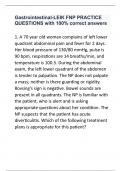
Gastrointestinal-LEIK FNP PRACTICE QUESTIONS with 100% correct answers
1. A 70 year old woman complains of left lower quadrant abdominal pain and fever for 2 days. Her blood pressure of 130/80 mmHg, pulse is 90 bpm, respirations are 14 breaths/min, and temperature is 100.5. During the abdominal exam, the left lower quadrant of the abdomen is tender to palpation. The NP does not palpate a mass; neither is there guarding or rigidity. Rovsing's sign is negative. Bowel sounds are present in all quadrants. The NP is familiar with the patient, who is alert and is asking appropriate questions about her condition. The NP suspects that the patient has acute diverticulitis. Which of the following treatment plans is appropriate for this patient? A. The patient should be referred to the physician as soon as possible B. The patient has a mild case of acute diverticulitis and can be treated with antibiotics in the outpatient setting with close follow-up C. The patient has a moderate to severe case B) The patient has a mild case of acute diverticulitis and can be treated with antibiotics in the outpatient setting with close follow-up The patient has a mild case of acute diverticulitis and can be treated as an outpatient with antibiotics and a clear fluid diet. If outpatient treatment is selected, close follow-up (within 24 to 48 hours) is very important. Instruct patients to go to the hospital if symptoms get worse, if fever increases, if unable to tolerate PO treatment, and if pain worsens. Order CBC (leukocytosis, neutrophils, and possible shift to the left), chemistry profile, and urinalysis (to rule out renal causes) 2. Rovsing's sign is associated with which of the following? A. An acute abdomen, such as during a ruptured appendix B. Knee instability C. Damage to the meniscus of the knee D. Acute cholelithiasis A) An acute abdomen, such as during a ruptured appendix Rovsing's sign identifies an acute abdomen, such as acute appendicitis. Rovsing's maneuver is per- formed with the patient in the supine position, palpating deep into the left lower quadrant of the abdomen and having referred pain to the right lower quadrant. 3. An adult patient was recently discharged from the hospital with a prescription of clindamycin. The patient reports that he took his last dose yesterday. He presents in the primary care clinic with complaints of the recent onset of watery diarrhea from 10 to 15 times a dat with abdominal cramping. He denies fever and chills. Which of the following conditions is most likely in this patient? A. Clostridium difficile-associated diarrhea B. Giardiasis C. Pseudomembranous colitis D. IBS A) Clostridium difficile-associated diarrhea (CDAD) An important risk factor for Clostridium difficile-associated diarrhea (CDAD) and C. difficile colitis is antibiotic therapy and hospitalization. Almost any antibiotic can cause the condition, but the most common are clindamycin, cephalosporins, and fluoroquinolones. Diarrhea can occur during therapy as well as after therapy (5 to 10 days; up to 10 weeks). Pseudomembranous colitis is a complication of C. difficle colitis. 4. An 8 month old girl is brought by her grandmother to see the NP because of intermittent, random episodes of vomiting, abdominal bloating, currant jelly stools, and irritability with poor appetite. The infant is trending in the 10th percentile on the growth chart and appears lethargic. During the abdominal exam, a sausage-like mass is palpated on the right side of the abdomen. The infant's presentation is highly suggestive of which condition? A. Lactic intolerance B. Intussusception C. Inflammatory bowel disease D. IBS B. Intussusception 5. You are reviewing the bilirubin level of a 3 day old full term neonate. You note that is is 10 mg/dL. The infant has a slight yellow color to his skin, mucous membranes, and sclera. The infant is feeding well, is not irritable, and has eight to 10 wet diapers per day. Which of the following is a true statement? A. Keep monitoring the infant's bilirubin level until it returns to normal in about 1 week B. Recommend that the infant be treated with phototherapy 10 minutes a day until the bilirubin is back to a normal range C. Refer the infant to a neonatologist ASAP D. Refer the infant to the NICU A) Keep on monitoring the infant's bilirubin level until it returns back to normal in about 1 week Bilirubin is excreted through the urine and feces. Increased fluids and wetting 8-10 diapers a day is sufficient fluid intake/excretion to help bring down the bilirubin level. Levels should continue to be monitored and should improve in approximately 1 week.
École, étude et sujet
- Établissement
- LEIK FNP
- Cours
- LEIK FNP
Infos sur le Document
- Publié le
- 12 mai 2024
- Nombre de pages
- 47
- Écrit en
- 2023/2024
- Type
- Examen
- Contient
- Questions et réponses
Sujets
-
gastrointestinal leik fnp practice questions

Document également disponible en groupe