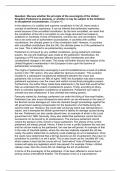
Question: Discuss whether the principle of the sovereignty of the United
Kingdom Parliament is absolute, or whether it may be subject to the limitation
in exceptional circumstances. (Chapter 4)
In the absence of a codified and supreme constitution in the UK, there exists a
concept of parliament supremacy. It can be inferred that parliament supremacy
exists because of the uncodified constitution. By the term uncodified, we mean that
the constitution of the UK is not written on one single document but instead is
scattered on hundreds of Acts of Parliament, common law, and conventions. There
has to be some sort of authoritative source/power, in countries with codified
constitutions, the ultimate power is of the constitution itself. However, in countries
with uncodified constitutions (like the UK), the ultimate power is of the parliament in
our case. This is referred to as parliamentary sovereignty.
Parliament is not bound by any codified constitution- giving parliament unlimited
powers. No one will challenge Laws made by the parliament. Nonetheless, the
supremacy of PS has been affected because of EU membership and other
constitutional changes in the state. This essay will further discuss the impacts of the
United Kingdom's membership in the European Union upon the doctrine of
parliamentary sovereignty.
The origins of parliamentary sovereignty it was first established as a result of political
events in the 17th century- this was called the ‘glorious revolution.’ This evolution
resulted in a subsequent constitutional settlement between the crown and
parliament; this is known as ‘Bills of rights’ 1689; this foundation was laid to ensure
parliament supremacy over the crown and restrict monarchical prerogative powers.
Furthermore, the author Dicey made three statements in his book that would further
help us understand the extent of parliament's powers. Firstly, according to Dicey,
there is unlimited legislative competence of parliament. Parliament can make or
unmake any laws whatsoever. It has unlimited law-making powers.
Famously started by Jennings; parliament can order the killing of blue-eyed babies.
Parliament can also enact retrospective laws which can be witnessed in the case of
the Burmah oil-war damages act. Here the claimant bought proceedings against the
UK government seeking compensation for the destruction of oil fields during the
second world war. However, the courts laid out the law which was retrospective in
nature, and it exempted the British government’s liability for damage caused during
the war. Parliament can also create absurd laws, an example of which is the Local
government Act 1985. Secondly, dicey also stated that parliament cannot bind its
successors nor be bound by its predecessors. The previous parliament cannot
control the decision of the current or future parliament. The wishes of the current
parliament will always prevail. Hence, if there is ever a conflict between the new law
and the old law made by the parliament, the new law will prevail. An example of that
is the case of Vauxhall estates, where the new law impliedly repealed the old law.
Lastly, the author stated that no authority could challenge an act of parliament. Once
the courts have determined that a bill has become an Act of parliament, they have no
jurisdiction to override it or set it aside. This is also known as the “enrolled bill” rule,
which makes it clear that the courts will not “look behind” Acts of Parliament but
instead will apply any legislation which has passed; For example: Picken v British
railways case, here the courts did not challenge the act of parliament.
In terms of the sovereignty of the parliament, it has been affected in some due to
joining various international treaties. The European Union is a supranational
Kingdom Parliament is absolute, or whether it may be subject to the limitation
in exceptional circumstances. (Chapter 4)
In the absence of a codified and supreme constitution in the UK, there exists a
concept of parliament supremacy. It can be inferred that parliament supremacy
exists because of the uncodified constitution. By the term uncodified, we mean that
the constitution of the UK is not written on one single document but instead is
scattered on hundreds of Acts of Parliament, common law, and conventions. There
has to be some sort of authoritative source/power, in countries with codified
constitutions, the ultimate power is of the constitution itself. However, in countries
with uncodified constitutions (like the UK), the ultimate power is of the parliament in
our case. This is referred to as parliamentary sovereignty.
Parliament is not bound by any codified constitution- giving parliament unlimited
powers. No one will challenge Laws made by the parliament. Nonetheless, the
supremacy of PS has been affected because of EU membership and other
constitutional changes in the state. This essay will further discuss the impacts of the
United Kingdom's membership in the European Union upon the doctrine of
parliamentary sovereignty.
The origins of parliamentary sovereignty it was first established as a result of political
events in the 17th century- this was called the ‘glorious revolution.’ This evolution
resulted in a subsequent constitutional settlement between the crown and
parliament; this is known as ‘Bills of rights’ 1689; this foundation was laid to ensure
parliament supremacy over the crown and restrict monarchical prerogative powers.
Furthermore, the author Dicey made three statements in his book that would further
help us understand the extent of parliament's powers. Firstly, according to Dicey,
there is unlimited legislative competence of parliament. Parliament can make or
unmake any laws whatsoever. It has unlimited law-making powers.
Famously started by Jennings; parliament can order the killing of blue-eyed babies.
Parliament can also enact retrospective laws which can be witnessed in the case of
the Burmah oil-war damages act. Here the claimant bought proceedings against the
UK government seeking compensation for the destruction of oil fields during the
second world war. However, the courts laid out the law which was retrospective in
nature, and it exempted the British government’s liability for damage caused during
the war. Parliament can also create absurd laws, an example of which is the Local
government Act 1985. Secondly, dicey also stated that parliament cannot bind its
successors nor be bound by its predecessors. The previous parliament cannot
control the decision of the current or future parliament. The wishes of the current
parliament will always prevail. Hence, if there is ever a conflict between the new law
and the old law made by the parliament, the new law will prevail. An example of that
is the case of Vauxhall estates, where the new law impliedly repealed the old law.
Lastly, the author stated that no authority could challenge an act of parliament. Once
the courts have determined that a bill has become an Act of parliament, they have no
jurisdiction to override it or set it aside. This is also known as the “enrolled bill” rule,
which makes it clear that the courts will not “look behind” Acts of Parliament but
instead will apply any legislation which has passed; For example: Picken v British
railways case, here the courts did not challenge the act of parliament.
In terms of the sovereignty of the parliament, it has been affected in some due to
joining various international treaties. The European Union is a supranational