Biochemistry - Exam 1 Practice Questions with correct answers 2024
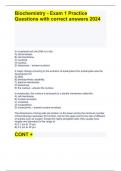
In a bacterial cell, the DNA is in the: A) cell envelope. B) cell membrane. C) nucleoid. D) nucleus. E) ribosomes. - answer-nucleoid A major change occurring in the evolution of eukaryotes from prokaryotes was the development of: A) DNA. B) photosynthetic capability. C) plasma membranes. D) ribosomes. E) the nucleus - answer-the nucleus In eukaryotes, the nucleus is enclosed by a double membrane called the: A) cell membrane. B) nuclear envelope. C) nucleolus. D) nucleoplasm. E) nucleosome. - answer-nuclear envelope The dimensions of living cells are limited, on the lower end by the minimum number of biomolecules necessary for function, and on the upper end by the rate of diffusion of solutes such as oxygen. Except for highly elongated cells, they usually have lengths and diameters in the range of: A) 0.1 µm to 10 µm. B) 0.3 µm to 30 µm. C) 0.3 µm to 100 µm. D) 1 µm to 100 µm. E) 1 µm to 300 µm - answer-0.3 µm to 100 µm The bacterium E. coli requires simple organic molecules for growth and energy—it is therefore a: A) chemoautotroph. B) chemoheterotroph. C) lithotroph. D) photoautotroph. E) photoheterotroph - answer-chemoheterotroph Which one of the following has the cellular components arranged in order of increasing size? A) Amino acid < protein < mitochondrion < ribosome B) Amino acid < protein < ribosome < mitochondrion C) Amino acid < ribosome < protein < mitochondrion D) Protein < amino acid < mitochondrion < ribosome E) Protein < ribosome < mitochondrion < amino acid - answer-Amino acid < protein < ribosome < mitochondrion The three-dimensional structure of macromolecules is formed and maintained primarily through noncovalent interactions. Which one of the following is not considered a noncovalent interaction? A) carbon-carbon bonds B) hydrogen bonds C) hydrophobic interactions D) ionic interactions E) van der Waals interactions - answer-carbon-carbon bonds Which one of the following is not among the four most abundant elements in living organisms? A) Carbon B) Hydrogen C) Nitrogen D) Oxygen E) Phosphorus - answer-Phosphorus The four covalent bonds in methane (CH4) are arranged around carbon to give which one of the following geometries? A) linear B) tetrahedral C) trigonal bipyramidal D) trigonal planar E) trigonal pyramidal - answer-tetrahedral The macromolecules that serve in the storage and transmission of genetic information are: A) carbohydrates. B) lipids. C) membranes. D) nucleic acids. E) proteins - answer-nucleic acids Stereoisomers that are nonsuperimposable mirror images of each other are known as: A) anomers. B) cis-trans isomers. C) diastereoisomers. D) enantiomers. E) geometric isomers - answer-enantiomers The enzyme fumarase catalyzes the reversible hydration of fumaric acid to l-malate, but it will not catalyze the hydration of maleic acid, the cis isomer of fumaric acid. This is an example of: A) biological activity. B) chiral activity. C) racemization. D) stereoisomerization. E) stereospecificity. - answer-stereospecificity Humans maintain a nearly constant level of hemoglobin by continually synthesizing and degrading it. This is an example of a(n): A) dynamic steady state. B) equilibrium state. C) exergonic change. D) free-energy change. E) waste of energy - answer-dynamic steady state If heat energy is absorbed by the system during a chemical reaction, the reaction is said to be: A) at equilibrium. B) endergonic. C) endothermic. D) exergonic. E) exothermic - answer-endothermic If the free energy change ∆G for a reaction is -46.11 kJ/mol, the reaction is: A) at equilibrium. B) endergonic. C) endothermic. D) exergonic. E) exothermic - answer-exergonic The major carrier of chemical energy in all cells is: A) acetyl triphosphate. B) adenosine monophosphate. C) adenosine triphosphate. D) cytosine tetraphosphate. E) uridine diphosphate - answer-adenosine triphosphate Enzymes are biological catalysts that enhance the rate of a reaction by: A) decreasing the activation energy. B) decreasing the amount of free energy released. C) increasing the activation energy. D) increasing the amount of free energy released. E) increasing the energy of the transition state - answer-decreasing the activation energy Energy requiring metabolic pathways that yield complex molecules from simpler precursors are: A) amphibolic. B) anabolic. C) autotrophic. D) catabolic. E) heterotrophic - answer-anabolic Hereditary information (with the exception of some viruses) is preserved in: A) deoxyribonucleic acid. B) membrane structures. C) nuclei. D) polysaccharides. E) ribonucleic acid. - answer-deoxyribonucleic acid When a region of DNA must be repaired by removing and replacing some of the nucleotides, what ensures that the new nucleotides are in the correct sequence? A) DNA cannot be repaired and this explains why mutations occur. B) Specific enzymes bind the correct nucleotides. C) The new nucleotides base-pair accurately with those on the complementary strand. D) The repair enzyme recognizes the removed nucleotide and brings in an identical one to replace it. E) The three-dimensional structure determines the order of nucleotides. - answer-The new nucleotides base-pair accurately with those on the complementary strand The three-dimensional structure of a protein is determined primarily by: A) electrostatic guidance from nucleic acid structure. B) how many amino acids are in the protein. C) hydrophobic interaction with lipids that provide a folding framework. D) modification during interactions with ribosomes. E) the sequence of amino acids in the protein. - answer-the sequence of amino acids in the protein According to Oparin's theory for the origin of life, the prebiotic atmosphere: A) already contained some primitive RNA molecules. B) basically was very similar to the atmosphere of today. C) contained many amino acids. D) had an abundance of methane, ammonia, and water. E) was rich in oxygen. - answer-had an abundance of methane, ammonia, and water What six characteristics distinguish living organisms from inanimate objects? - answer-- are chemically complex and highly organized; - extract, transform, and use energy from their environment; - have the capacity to precisely self-replicate and self-assemble; - exploit a chemical interplay with their environment; - possess programmatically defined functions; and - evolve to new forms over many generations The chirality of an amino acid results from the fact that its α carbon: A) has no net charge. B) is a carboxylic acid. C) is bonded to four different chemical groups. D) is in the L absolute configuration in naturally occurring proteins. E) is symmetric. - answer-is bonded to four different chemical groups Of the 20 standard amino acids, only ___________ is not optically active. The reason is that its side chain ___________. A) alanine; is a simple methyl group B) glycine; is a hydrogen atom C) glycine; is unbranched D) lysine; contains only nitrogen E) proline; forms a covalent bond with the amino group - answer-glycine; is a hydrogen atom Two amino acids of the standard 20 contain sulfur atoms. They are: A) cysteine and serine. B) cysteine and threonine. C) methionine and cysteine D) methionine and serine E) threonine and serine. - answer-methionine and cysteine All of the amino acids that are found in proteins, except for proline, contain a(n): A) amino group. B) carbonyl group. C) carboxyl group. D) ester group. E) thiol group. - answer-amino group Which of the following statements about aromatic amino acids is correct? A) All are strongly hydrophilic. B) Histidine's ring structure results in its being categorized as aromatic or basic, depending on pH. C) On a molar basis, tryptophan absorbs more ultraviolet light than tyrosine. D) The major contribution to the characteristic absorption of light at 280 nm by proteins is the phenylalanine R group. E) The presence of a ring structure in its R group determines whether or not an amino acid is aromatic. - answer-On a molar basis, tryptophan absorbs more ultraviolet light than tyrosine. Which of the following statements about cysteine is correct? A) Cysteine forms when the -CH2-SH R group is oxidized to form a -CH2-S-S-CH2- disulfide bridge between two cysteines. B) Cysteine is an example of a nonstandard amino acid, derived by linking two standard amino acids. C) Cysteine is formed by the oxidation of the carboxylic acid group on cysteine. D) Cysteine is formed through a peptide linkage between two cysteines. E) Two cysteines are released when a -CH2-S-S-CH2- disulfide bridge is reduced to -CH2-SH. - answer-Cysteine forms when the -CH2-SH R group is oxidized to form a -CH2-S-S-CH2- disulfide bridge between two cysteines The uncommon amino acid selenocysteine has an R group with the structure -CH2-SeH (pKa ≈ 5). In an aqueous solution, pH = 7.0, selenocysteine would: A) be a fully ionized zwitterion with no net charge. B) be found in proteins as D-selenocysteine. C) never be found in a protein. D) be nonionic. E) not be optically active. - answer-be a fully ionized zwitterion with no net charge Amino acids are ampholytes because they can function as either a(n): A) acid or a base. B) neutral molecule or an ion. C) polar or a nonpolar molecule. D) standard or a nonstandard monomer in proteins. E) transparent or a light-absorbing compound - answer-acid or a base Titration of valine by a strong base, for example NaOH, reveals two pK's. The titration reaction occurring at pK2 (pK2 = 9.62) is: A) —COOH + OH− → —COO− + H2O. B) —COOH + —NH2 → —COO− + —NH2+. C) —COO− + —NH2+ → —COOH + —NH2. D) —NH3+ + OH− → —NH2 + H2O. E) —NH2 + OH− → —NH− + H2O. - answer-—NH3+ + OH− → —NH2 + H2O In a highly basic solution, pH = 13, the dominant form of glycine is: A) NH2—CH2—COOH. B) NH2—CH2—COO−. C) NH2—CH3+—COO−. D) NH3+—CH2—COOH. E) NH3+—CH2—COO−. - answer-NH2—CH3+—COO− For amino acids with neutral R groups, at any pH below the pI of the amino acid, the population of amino acids in solution will have: A) a net negative charge. B) a net positive charge. C) no charged groups. D) no net charge. E) positive and negative charges in equal concentration - answer-a net positive charge What is the approximate charge difference between glutamic acid and α-ketoglutarate at pH 9.5? A) 0 B) ½ C) 1 D) 1½ E) 2 - answer-½ The formation of a peptide bond between two amino acids is an example of a(n) ______________reaction. A) cleavage B) condensation C) group transfer D) isomerization E) oxidation reduction - answer-condensation The peptide alanylglutamylglycylalanylleucine has: A) a disulfide bridge. B) five peptide bonds. C) four peptide bonds. D) no free carboxyl group. E) two free amino groups. - answer-four peptide bonds An octapeptide composed of four repeating glycylalanyl units has: A) one free amino group on an alanyl residue. B) one free amino group on an alanyl residue and one free carboxyl group on a glycyl residue. C) one free amino group on a glycyl residue and one free carboxyl group on an alanyl residue. D) two free amino and two free carboxyl groups. E) two free carboxyl groups, both on glycyl residues - answer-one free amino group on a glycyl residue and one free carboxyl group on an alanyl residue At the isoelectric pH of a tetrapeptide: A) only the amino and carboxyl termini contribute charge. B) the amino and carboxyl termini are not charged. C) the total net charge is zero. D) there are four ionic charges. E) two internal amino acids of the tetrapeptide cannot have ionizable R groups - answer-the total net charge is zero Which of the following is correct with respect to the amino acid composition of proteins? A) Larger proteins have a more uniform distribution of amino acids than smaller proteins. B) Proteins contain at least one each of the 20 different standard amino acids. C) Proteins with different functions usually differ significantly in their amino acid composition. D) Proteins with the same molecular weight have the same amino acid composition. E) The average molecular weight of an amino acid in a protein increases with the size of the protein. - answer-Proteins with different functions usually differ significantly in their amino acid composition The average molecular weight of the 20 standard amino acids is 138, but biochemists use 110 when estimating the number of amino acids in a protein of known molecular weight. Why? A) The number 110 is based on the fact that the average molecular weight of a protein is 110,000 with an average of 1,000 amino acids. B) The number 110 reflects the higher proportion of small amino acids in proteins, as well as the loss of water when the peptide bond forms. C) The number 110 reflects the number of amino acids found in the typical small protein, and only small proteins have their molecular weight estimated this way. D) The number 110 takes into account the relatively small size of nonstandard amino acids. E) The number 138 represents the molecular weight of conjugated amino acids. - answer-The number 110 reflects the higher proportion of small amino acids in proteins, as well as the loss of water when the peptide bond forms. In a conjugated protein, a prosthetic group is: A) a fibrous region of a globular protein. B) a nonidentical subunit of a protein with many identical subunits. C) a part of the protein that is not composed of amino acids. D) a subunit of an oligomeric protein. E) synonymous with "protomer." - answer-a subunit of an oligomeric protein Prosthetic groups in the class of proteins known as glycoproteins are composed of: A) carbohydrates. B) flavin nucleotides. C) lipids. D) metals . E) phosphates. - answer-carbohydrates Which of the following refers to particularly stable arrangements of amino acid residues in a protein that give rise to recurring patterns? A) Primary structure B) Secondary structure C) Tertiary structure D) Quaternary structure E) None of the above - answer-Secondary structure Which of the following describes the overall three-dimensional folding of a polypeptide? A) Primary structure B) Secondary structure C) Tertiary structure D) Quaternary structure E) None of the above - answer-Tertiary structure For the study of a protein in detail, an effort is usually made to first: A) conjugate the protein to a known molecule. B) determine its amino acid composition. C) determine its amino acid sequence. D) determine its molecular weight. E) purify the protein. - answer-purify the protein By adding SDS (sodium dodecyl sulfate) during the electrophoresis of proteins, it is possible to: A) determine a protein's isoelectric point. B) determine an enzyme's specific activity. C) determine the amino acid composition of the protein. D) preserve a protein's native structure and biological activity. E) separate proteins exclusively on the basis of molecular weight. - answer-separate proteins exclusively on the basis of molecular weight To determine the isoelectric point of a protein, first establish that a gel: A) contains a denaturing detergent that can distribute uniform negative charges over the protein's surface. B) exhibits a stable pH gradient when ampholytes become distributed in an electric field. C) is washed with an antibody specific to the protein of interest. D) neutralizes all ionic groups on a protein by titrating them with strong bases. E) relates the unknown protein to a series of protein markers with known molecular weights - answer-exhibits a stable pH gradient when ampholytes become distributed in an electric field The term specific activity differs from the term activity in that specific activity: A) is measured only under optimal conditions. B) is the activity (enzyme units) in a milligram of protein. C) is the activity (enzyme units) of a specific protein. D) refers only to a purified protein. E) refers to proteins other than enzymes. - answer-is the activity (enzyme units) in a milligram of protein The functional differences, as well as differences in three-dimensional structures, between two different enzymes from E. coli result directly from their different: A) affinities for ATP. B) amino acid sequences. C) roles in DNA metabolism. D) roles in the metabolism of E. coli. E) secondary structures. - answer-amino acid sequences One method used to prevent disulfide bond interference with protein sequencing procedures is: A) cleaving proteins with proteases that specifically recognize disulfide bonds. B) protecting the disulfide bridge against spontaneous reduction to cysteinyl sulfhydryl groups. C) reducing disulfide bridges and preventing their re-formation by further modifying the —SH groups. D) removing cystines from protein sequences by proteolytic cleavage. E) sequencing proteins that do not contain cysteinyl residues. - answer-reducing disulfide bridges and preventing their re-formation by further modifying the —SH groups Even when a gene is available and its sequence of nucleotides is known, chemical studies of the protein are still required to determine: A) molecular weight of the protein. B) the amino-terminal amino acid. C) the location of disulfide bonds. D) the number of amino acids in the protein. E) whether the protein has the amino acid methionine in its sequence. - answer-the location of disulfide bonds
École, étude et sujet
- Établissement
- Biochemistry
- Cours
- Biochemistry
Infos sur le Document
- Publié le
- 29 avril 2024
- Nombre de pages
- 16
- Écrit en
- 2023/2024
- Type
- Examen
- Contient
- Questions et réponses
Sujets
-
biochemistry exam 1 practice

Document également disponible en groupe