Introduction to Organisation Design - Radboud University
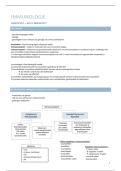
Lecture 1:
Designing = how to divide a group and coordinate work
Workplace innovation:
- aging (retention management = holding on to employees longer than competitors)
- Market evolution (VUCA = Volatile, uncertain, complex, ambiguous )
V = react quick to unpredictable changes
U= environment requires to take action
C = the environment is dynamic
A = develop new products outside core business
- Cumulative demands (productivity, quality, flexibility, innovation, sustainability,
workability)
Functional organization = very complex because of specialization of work
Structural organization = focussed on mission and vision and customer driven (top-down)
Organization should move away from too much specialization & hierarchy
Lecture 2:
Someone is motivated if their behavior shows direction, the goal energizes them and they
engage in the behavior
Job satisfaction is the outcome of motivation
Self-fulfilling prophecy -> how one thinks about motivation will influence the motivation
process
Specific and difficult goals lead to better performance
1. Two factor theory = motivation through content of work
Dissatisfaction is related to extrinsic work (hygiene factors)
Satisfaction is related to intrinsic work (the job itself)
-> does not take into account attribution theory (success by themselves, failure by others)
2. Job-demand control model
passive job -> low demand & low autonomy
Low strain job -> low demand & high autonomy
High strain job -> high demand & low autonomy
Active job -> high demand & high autonomy
Decision latitude = the degree of autonomy
Equity theory -> people compare their efforts and returns to eliminate inequity
Lecture 3:
The sum of optimized parts, also produce an optimized whole -> complex organizations with
simple tasks
, Scientific management:
- Develop scientific rules for every element of someone's work
- Focus on improving efficiency and labor productivity across industries
(workers are selected and retooled like machines, incentive systems)
-> no room for social needs)
Bureaucratic model:
- Rational authority -> rely on rules and written records
- Selection is focussed on competence and technical qualifications
- Clear hierarchy
- Management is separate from ownership
Line structure requires large quantities, constant demand and divisible work
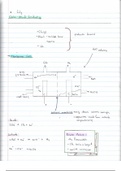
The functional structure is operations oriented, each order passes some or all departments
Design parameters:
Production structure;
- Functional concentration
- Separation of making, preparation and support
- Splitting into partial tasks
Regulatory structure;
- Separation of production and regulatory activities
- Splitting up management by process parts
- Splitting up management by aspects
- Separation of regulatory activities by level
- Splitting the control loop into steps
Bureaucracy:
Parochial -> hyperfocus on its own
Byzantine -> new problem leads to a new group to handle it
Inflexible -> hard to change
Suboptimal -> formalization presets critical trade-offs
Employees are more educated and more demanding nowadays
Guest lecture Berenschot:
The external environment influences what you as an organization achieve
Four step approach:
1. Analysis -> determine the need for change
2. Main design -> choice of main design
3. Detailed design -> sharpening and detailing the main design
4. Dry run -> test the design and make adjustments
The design team is responsible for the outcome
Dysfunctional:
Lecture 1:
Designing = how to divide a group and coordinate work
Workplace innovation:
- aging (retention management = holding on to employees longer than competitors)
- Market evolution (VUCA = Volatile, uncertain, complex, ambiguous )
V = react quick to unpredictable changes
U= environment requires to take action
C = the environment is dynamic
A = develop new products outside core business
- Cumulative demands (productivity, quality, flexibility, innovation, sustainability,
workability)
Functional organization = very complex because of specialization of work
Structural organization = focussed on mission and vision and customer driven (top-down)
Organization should move away from too much specialization & hierarchy
Lecture 2:
Someone is motivated if their behavior shows direction, the goal energizes them and they
engage in the behavior
Job satisfaction is the outcome of motivation
Self-fulfilling prophecy -> how one thinks about motivation will influence the motivation
process
Specific and difficult goals lead to better performance
1. Two factor theory = motivation through content of work
Dissatisfaction is related to extrinsic work (hygiene factors)
Satisfaction is related to intrinsic work (the job itself)
-> does not take into account attribution theory (success by themselves, failure by others)
2. Job-demand control model
passive job -> low demand & low autonomy
Low strain job -> low demand & high autonomy
High strain job -> high demand & low autonomy
Active job -> high demand & high autonomy
Decision latitude = the degree of autonomy
Equity theory -> people compare their efforts and returns to eliminate inequity
Lecture 3:
The sum of optimized parts, also produce an optimized whole -> complex organizations with
simple tasks
, Scientific management:
- Develop scientific rules for every element of someone's work
- Focus on improving efficiency and labor productivity across industries
(workers are selected and retooled like machines, incentive systems)
-> no room for social needs)
Bureaucratic model:
- Rational authority -> rely on rules and written records
- Selection is focussed on competence and technical qualifications
- Clear hierarchy
- Management is separate from ownership
Line structure requires large quantities, constant demand and divisible work
The functional structure is operations oriented, each order passes some or all departments
Design parameters:
Production structure;
- Functional concentration
- Separation of making, preparation and support
- Splitting into partial tasks
Regulatory structure;
- Separation of production and regulatory activities
- Splitting up management by process parts
- Splitting up management by aspects
- Separation of regulatory activities by level
- Splitting the control loop into steps
Bureaucracy:
Parochial -> hyperfocus on its own
Byzantine -> new problem leads to a new group to handle it
Inflexible -> hard to change
Suboptimal -> formalization presets critical trade-offs
Employees are more educated and more demanding nowadays
Guest lecture Berenschot:
The external environment influences what you as an organization achieve
Four step approach:
1. Analysis -> determine the need for change
2. Main design -> choice of main design
3. Detailed design -> sharpening and detailing the main design
4. Dry run -> test the design and make adjustments
The design team is responsible for the outcome
Dysfunctional: