IB SEHS Topic 2.2 Already Graded A+
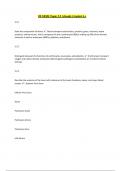
IB SEHS Topic 2.2 Already Graded A+ 2.2.1 State the composition of blood. ️Blood transports electrolytes, proteins, gases, nutrients, waste products, and hormones. And is composed of cells: erythrocytes (RBCs) making up 99% of the formed elements as well as leukocytes (WBCs), platelets, and plasma. 2.2.2 Distinguish between the functions of erythrocytes, leucocytes, and platelets. ️Erythrocytes transport oxygen and carbon dioxide, leukocytes defend against pathogens and platelets are involved in blood clotting. 2.2.3 Describe the anatomy of the heart with reference to the heart chambers, valves, and major blood vessels. ️Superior Vena Cava Inferior Vena Cava Aorta Pulmonary Valve Pulmonary Artery Pulmonary Vein Left Atrium Right Atrium Bicuspid Valve Tricuspid Valve Aortic Valve Left Ventricle Right Ventricle 2.2.4 Describe the intrinsic and extrinsic regulation of heart rate and the sequence of excitation of the heart muscle. ️The electrical impulse is generated by the sinoatrial node (SA node), AKA the "pacemaker". This sets the rate of depolarization to the heart. The internodal tract then carries the impulse throughout the atrial walls and the atria contracts, it then travels across the atria to the atrioventricular node, where a delayed impulse takes place to allow filling of the ventricle. The AV bundle carries the impulse from the atrium down through the septum where the Purkinje fibers then carry the impulse up the walls of the ventricle, contracting them. Sympathetic and parasympathetic branches of the automatic nervous system also influence heart rate, as well as hormones, ion concentration, exercise, and change in body temperature. 2.2.5 Outline the relationship between the pulmonary and systemic circulation. ️Pulmonary circulation: is the portion of the cardiovascular system, which carries oxygen-depleted blood away from the heart, to the lungs, and returns oxygenated blood back to the heart. Systemic circulation: is the portion of the cardiovascular system, which carries oxygenated blood away from the heart, to the body, and returns deoxygenated blood back to the heart. 2.2.6 Describe the relationship between heart rate, cardiac output, and stroke volume at rest and during exercise. ️Cardiac Output = Stroke Volume x Heart Rate (L/min)= (L) x (bpm) Stroke volume expands and heart rate increases during exercise. at rest, an individual has a higher cardiac output, a lower resting heart rate and a higher stroke volume than during exercise. 2.2.7 Analyze cardiac output, stroke volume and heart rate data for populations a rest and during exercise. ️Males vs. Females Females have a higher Heart rate, lower stroke volume and cardiac output than males at max. Young vs. Old Older people have a slightly higher cardiac output than children. While children have an overall h
École, étude et sujet
- Établissement
- IB SEHS Topic 2.2 Already Graded A+
- Cours
- IB SEHS Topic 2.2 Already Graded A+
Infos sur le Document
- Publié le
- 19 avril 2024
- Nombre de pages
- 7
- Écrit en
- 2023/2024
- Type
- Examen
- Contient
- Questions et réponses
Sujets
-
ib sehs topic 22 already graded a

Document également disponible en groupe