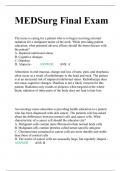
MEDSurg Final Exam
The nurse is caring for a patient who is to begin receiving external radiation for a malignant tumor of the neck. While providing patient education, what potential adverse effects should the nurse discuss with the patient?
A. Impaired nutritional status
B. Cognitive changes
C. Diarrhea
D. Alopecia - ANSWER ANS: A
Alterations in oral mucosa, change and loss of taste, pain, and dysphasia often occur as a result of radiotherapy to the head and neck. The patient is at an increased risk of impaired nutritional status. Radiotherapy does not cause cognitive changes. Diarrhea is not a likely concern for this patient. Radiation only results in alopecia when targeted at the whole brain; radiation of other parts of the body does not lead to hair loss.
An oncology nurse education is providing health education to a patient who has been diagnosed with skin cancer. The patients wife has asked about the differences between normal cells and cancer cells. What characteristic of a cancer cell should the educator cite?
A. Malignant cells contain more fibronectin than normal body cells
B. Malignant cells contain proteins called tumor-specific antigens
C. Chromosomes contained in cancer cells are more durable and stable than those of normal cells
D. The nuclei of cancer cells are unusually large, but regularly shaped. - ANSWER ANS: B The cell membranes are altered in cancer cells, which affect fluid movement in and out of the cell. The cell membrane of malignant cells also contains proteins called tumor-specific antigens. Malignant cellular membranes also contain less fibronectin, a cellular cement. Typically, nuclei of cancer cells are large and irregularly shaped (pleomorphism). Fragility of chromosomes is commonly found when cancer cells are analyzed.
The nurse is describing some of the major characteristics of cancer to a patient who has recently received a diagnosis of malignant melanoma. When differentiating between benign and malignant cancer cells, the nurse should explain differences in which of the following aspects? Select all that apply.
A. Rate of growth
B. Ability to cause death
C. Size of cells
D. Cell contents
E. Ability to spread - ANSWER ANS: A, B, E
Benign and malignant cells differ in many cellular growth characteristics, including the method and rate of growth, ability to metastasize or spread, general effects, destruction of tissue, and ability to
cause death. Cells come in many sizes, both benign and malignant. Cell contents are basically the same, but they behave differently.
A 54-year-old has a diagnosis of breast cancer and is tearfully discussing
her diagnosis with the nurse. The patient states, "they tell me my cancer is malignant, while my coworkers breast tumor was benign. I just don't understand at all. When preparing a response to this patient, the nurse should be cognizant of what characteristic that distinguishes malignant cells from benign cells of the same tissue type?
A. Slow rate of mitosis of cancer cells
B. Different proteins in the cell membrane
C. Differing size of the cells
D. Different molecular structure in the cells. - ANSWER ANS:
B
The cell membrane of malignant cells also contains proteins called tumor-specific antigens (e.g., carcinoembryonic antigen [CEA] and prostate-specific antigen [PSA]), which develop over time as the cells become less differentiated (mature). These proteins distinguish malignant cells from benign cells of the same tissue type.
Know Cancer Staging - ANSWER T/tumor size N/ spread to lymph nodes
M/Metastasis
A patient who is scheduled for a breast biopsy asks the nurse the difference between a benign tumor and a malignant tumor. Which answer by the nurse is correct?
a. "Benign tumors do not cause damage to other tissues."
b. "Benign tumors are likely to recur in the same location."
c. "Malignant tumors may spread to other tissues or organs."
d. "Malignant cells reproduce more rapidly than normal cells." - ANSWER ANS: C The major difference between benign and malignant tumors is that malignant tumors invade adjacent tissues and spread to distant tissues and benign tumors do not metastasize. The other statements are inaccurate. Both types of tumors may cause damage to adjacent tissues. Malignant cells do not reproduce more rapidly than normal cells. Benign
tumors do not usually recur.
A 62-year-old woman diagnosed with breast cancer is scheduled for a partial mastectomy. The oncology nurse explained that the surgeon will want to take tissue samples to ensure the disease has not spread to adjacent axillary lymph nodes. The patient has asked if she will have her
lymph nodes dissected, like her mother did several years ago. What alternative to lymph node dissection will this patient most likely undergo?
A. Lymphadenectomy
B. Needle biopsy
C. Open biopsy
D. Sentinel node biopsy - ANSWER ANS: D
Sentinel lymph node biopsy (SLNB), also known as sentinel lymph node
mapping, is a minimally invasive surgical approach that, in some instances, has replaced more invasive lymph node dissections (lymphadenectomy) and their associated complications such as lymphedema and delayed healing. SLNB has been widely adopted for regional lymph node staging in selected cases of melanoma and breast cancer.
The nurse is caring for a patient who is to begin receiving external radiation for a malignant tumor of the neck. While providing patient education, what potential adverse effects should the nurse discuss with the patient?
A. Impaired nutritional status
B. Cognitive changes
C. Diarrhea
D. Alopecia - ANSWER ANS: A
Alterations in oral mucosa, change and loss of taste, pain, and dysphasia often occur as a result of radiotherapy to the head and neck. The patient is at an increased risk of impaired nutritional status. Radiotherapy does not cause cognitive changes. Diarrhea is not a likely concern for this patient. Radiation only results in alopecia when targeted at the whole brain; radiation of other parts of the body does not lead to hair loss.
An oncology nurse education is providing health education to a patient who has been diagnosed with skin cancer. The patients wife has asked about the differences between normal cells and cancer cells. What characteristic of a cancer cell should the educator cite?
A. Malignant cells contain more fibronectin than normal body cells
B. Malignant cells contain proteins called tumor-specific antigens
C. Chromosomes contained in cancer cells are more durable and stable than those of normal cells
D. The nuclei of cancer cells are unusually large, but regularly shaped. - ANSWER ANS: B The cell membranes are altered in cancer cells, which affect fluid movement in and out of the cell. The cell membrane of malignant cells also contains proteins called tumor-specific antigens. Malignant cellular membranes also contain less fibronectin, a cellular cement. Typically, nuclei of cancer cells are large and irregularly shaped (pleomorphism). Fragility of chromosomes is commonly found when cancer cells are analyzed.
The nurse is describing some of the major characteristics of cancer to a patient who has recently received a diagnosis of malignant melanoma. When differentiating between benign and malignant cancer cells, the nurse should explain differences in which of the following aspects? Select all that apply.
A. Rate of growth
B. Ability to cause death
C. Size of cells
D. Cell contents
E. Ability to spread - ANSWER ANS: A, B, E
Benign and malignant cells differ in many cellular growth characteristics, including the method and rate of growth, ability to metastasize or spread, general effects, destruction of tissue, and ability to
cause death. Cells come in many sizes, both benign and malignant. Cell contents are basically the same, but they behave differently.
A 54-year-old has a diagnosis of breast cancer and is tearfully discussing
her diagnosis with the nurse. The patient states, "they tell me my cancer is malignant, while my coworkers breast tumor was benign. I just don't understand at all. When preparing a response to this patient, the nurse should be cognizant of what characteristic that distinguishes malignant cells from benign cells of the same tissue type?
A. Slow rate of mitosis of cancer cells
B. Different proteins in the cell membrane
C. Differing size of the cells
D. Different molecular structure in the cells. - ANSWER ANS:
B
The cell membrane of malignant cells also contains proteins called tumor-specific antigens (e.g., carcinoembryonic antigen [CEA] and prostate-specific antigen [PSA]), which develop over time as the cells become less differentiated (mature). These proteins distinguish malignant cells from benign cells of the same tissue type.
Know Cancer Staging - ANSWER T/tumor size N/ spread to lymph nodes
M/Metastasis
A patient who is scheduled for a breast biopsy asks the nurse the difference between a benign tumor and a malignant tumor. Which answer by the nurse is correct?
a. "Benign tumors do not cause damage to other tissues."
b. "Benign tumors are likely to recur in the same location."
c. "Malignant tumors may spread to other tissues or organs."
d. "Malignant cells reproduce more rapidly than normal cells." - ANSWER ANS: C The major difference between benign and malignant tumors is that malignant tumors invade adjacent tissues and spread to distant tissues and benign tumors do not metastasize. The other statements are inaccurate. Both types of tumors may cause damage to adjacent tissues. Malignant cells do not reproduce more rapidly than normal cells. Benign
tumors do not usually recur.
A 62-year-old woman diagnosed with breast cancer is scheduled for a partial mastectomy. The oncology nurse explained that the surgeon will want to take tissue samples to ensure the disease has not spread to adjacent axillary lymph nodes. The patient has asked if she will have her
lymph nodes dissected, like her mother did several years ago. What alternative to lymph node dissection will this patient most likely undergo?
A. Lymphadenectomy
B. Needle biopsy
C. Open biopsy
D. Sentinel node biopsy - ANSWER ANS: D
Sentinel lymph node biopsy (SLNB), also known as sentinel lymph node
mapping, is a minimally invasive surgical approach that, in some instances, has replaced more invasive lymph node dissections (lymphadenectomy) and their associated complications such as lymphedema and delayed healing. SLNB has been widely adopted for regional lymph node staging in selected cases of melanoma and breast cancer.