OpenStax Microbiology Test Bank Chapter 8: Microbial Metabolism
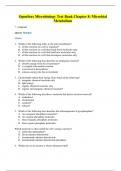
OpenStax Microbiology Test Bank Chapter 8: Microbial Metabolism * = Correct answer Multiple Choice 1.Which of the following refers to the term metabolism? A.all the reactions in a cell or organism* B.all the reactions in a cell that break down molecules only C.all the reactions in a cell that build new molecules only D.all the reactions in a cell that decompose molecules only 2.Which of the following best describes an endergonic reaction? A.absorbs energy from the environment* B.is coupled with another reaction C.is involved in biosynthesis D.releases energy into the environment 3.Chemotrophs obtain their energy from which of the following? A.inorganic chemical reactions only B.light energy C.organic chemical reactions only D.organic and inorganic chemical reactions* 4.Which of the following describes a molecule that had an electron removed? A.anabolized B.electronated C.oxidized* D.reduced 5.Which of the following best describes the subcomponents of pyrophosphate? A.two inorganic phosphate molecules* B.two organic phosphate molecules C.three inorganic phosphate molecules D.three organic phosphate molecules Which molecule is often called the cell’s energy currency? A.adenosine triphosphate* B.flavin adenine dinucleotide C.nicotinamide adenine dinucleotide D.nicotinamide adenine dinucleotide phosphate 6.Which site on an enzyme is where substrates bind? A.the activation site B.the active site* C.the catalyst site D.the lock and key site 7.Which of the following are inorganic molecules that bind to enzymes? A.apoenzymes B.coenzymes C.cofactors* D.holoenzymes 8.Which of the following best describes catabolic pathways? A.They always absorb energy. B.They break down large molecules into smaller components.* C.They build up large molecules from smaller components. D.They must be coupled with the breakdown of ATP. 9.Which group comprises all lithotrophs? A.algae B.autotrophs C.microbes* D.plants 10.Which is a common electron acceptor in catabolic reactions? A.ATP B.FADH2 C.NAD+* D.NADPH 11.The reaction that breaks down ATP to form ADP and inorganic phosphate is classified as which of the following? A.endergonic B.exergonic* C.nonspontaneous D.reduction 12.Which of the following is an inhibitor that binds to the active site of an enzyme? A.a competitive inhibitor* B.a noncompetitive inhibitor C.an allosteric inhibitor D.an uncompetitive inhibitor 13.Glycolysis produces a net gain of which of the following? A.two ATP, two NADH, and two pyruvates* B.two ATP, two NADH, and four pyruvates C.two ATP, four NADH, and two pyruvates D.four ATP, two NADH, and two pyruvates 14.Which of the following is a pathway that breaks down glucose in some microbes? A.the Calvin cycle B.the Entner-Doudoroff pathway* C.the Krebs cycle D.the tricarboxylic acid cycle 15.Which of the following best describes a transition reaction? A.a reaction that converts pyruvate to acetyl CoA with the release of carbon dioxide* B.a series of reactions that convert citric acid to oxaloacetate C.an optional reaction that transports pyruvate into the mitochondrion D.the reaction that converts glucose to glucose-6-phosphate in glycolysis 16.Which of the following is not a product of the Krebs cycle? A.carbon dioxide B.GTP, which is converted to ATP C.NADH D.pyruvate* 17.The Krebs cycle begins with the addition of acetyl CoA to which of the following? A.citric acid B.oxaloacetate* C.ribulose bisphosphate D.succinate dehydrogenase 18.Which of the following is the step in which CO2 enters the light-independent reactions (Calvin cycle)? A.fixation* B.reduction C.regeneration D.transition 19.Carotenoids are pigments that are which of the following colors? A.blue/green B.green/orange C.orange/yellow/red* D.purple/blue 20.Which of the following are enzymes that break down proteins? A.amylases B.oxidases C.oxygenases D.proteases* 21.Fatty acids are often degraded using which set of reactions? A.β-oxidation* B.glycolysis C.photophosphorylation D.the tricarboxylic acid cycle
École, étude et sujet
- Établissement
- OpenStax Microbiology Chapter 8: Microbi
- Cours
- OpenStax Microbiology Chapter 8: Microbi
Infos sur le Document
- Publié le
- 8 avril 2024
- Nombre de pages
- 12
- Écrit en
- 2023/2024
- Type
- Examen
- Contient
- Questions et réponses
Sujets
-
openstax microbiology test bank chapter 8 microbi

Document également disponible en groupe